Author Archives: marynees

look-out

Often, I am on some kind of necessary lookout, like being a watchman.

When entering any new space, the first thing I need to see is the view through the windows and beyond the confining walls. Since I was young, the wonders in landscape have drawn my eyes outward, peering horizons. In later years, the perplexities in living have moved me to abstracting what I’m seeing and thinking. An artist I’ve encountered named Ali says on his Instagram bio that “as the world becomes more scary, art becomes more abstract”. You can see the same in the trajectory of Art History. What interests me is better expressed in simplified gesture than any ‘perfected’ semblance can communicate. This is true in all my work, no matter the media. Poetry gets closer than prose.

Just yesterday I got notice that a monotype I made in 2006 got accepted into a national juried show in Cincinnati. This museum quality gallery, called Manifest, allows earlier work submissions, saying “we do not believe great art has an expiration date. Furthermore we believe that older work gains new meaning when contextualized in a new space alongside different works by different artists. Why should an exceptional work of art cease being experienced by the public once it is just a few years old? In fact, why should it ever stop being experienced? While most work submitted to our exhibits has been made within the past five years or so, sometimes works are submitted (and accepted) that are older.”

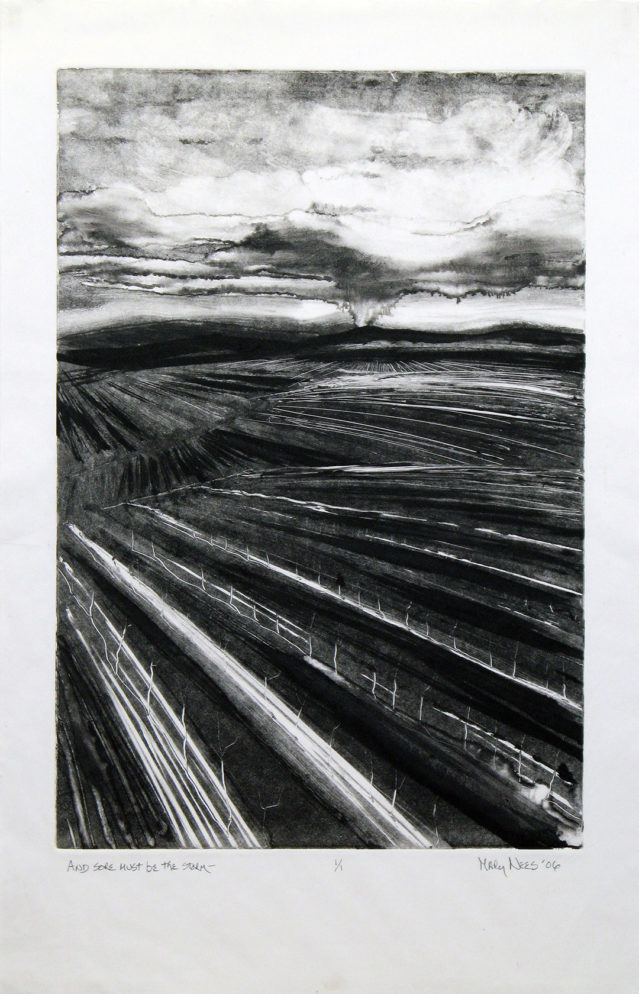
And Sore Must Be the Storm

Fortunately for me, this older piece fit their current theme nicely and got selected into a small grouping of 24 pieces out of 421 entries.

My monotype, from 2006, was made with ink and solvent painted on a sheet of Plexiglas. Rice paper was then carefully placed on top of the inked Plexi, blanketed and cranked through the pressure of a flat bed etching press. The result once the paper was peeled off the plate was a reverse image from what I had laid down. It’s a landscape, obviously, but it is also abstracted and constructed with mood even in a single color. The added element of surprise as to what the press would do to the ink, and how the composition would read in reverse was part of the risk. It was a look-out moment. The drama of the result reminded me of a favorite poem by Emily Dickinson:

“Hope” is the thing with feathers—

That perches in the soul—

And sings the tune without the words—

And never stops—at all—

And sweetest—in the Gale—is heard—

And sore must be the storm—

That could abash the little Bird

That kept so many warm—

I’ve heard it in the chillest land—

And on the strangest Sea—

Yet, never, in Extremity,

It asked a crumb—of Me.
program

When entering any performance, one is typically handed a program. The value of what is detailed on that page gives context to the progression about to be played out. Amongst myriads of possibilities, someone made selections for what you’re about to see. There’s notation about the beginning and how it will end, there are ascriptions and interludes. Your understanding is enhanced with guidance from any program.

In certain masterworks of art there is what is called a “program of images”. This is where an artist makes selections, presenting several images together to create a narrative whole. Viewing that collection takes time, for what the artist offers the viewer is a deliberate opportunity into his broad intention. Not many artists do this; those few who have (like Giotto’s fresco progression in the Scrovegni chapel, or Brunelleschi’s gates of Paradise in Florence) are offering the viewer a sublime visual performance. And examining those collections reveal the scope the artist had to have to make such deliberate choices.

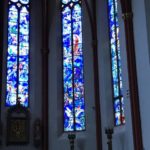
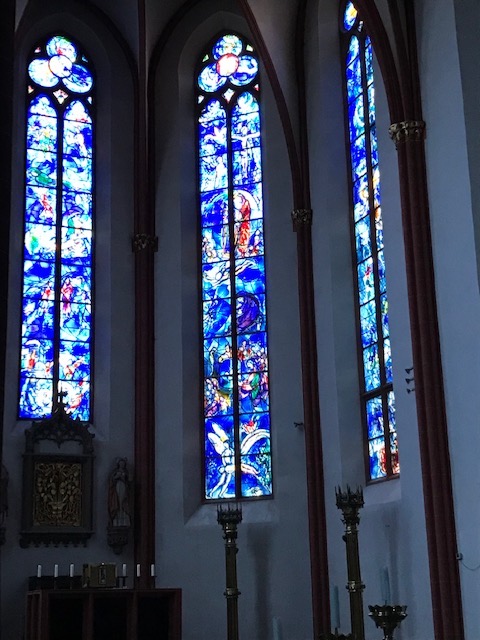
Recently I was guided into the blue hued space in the eastern apse of St. Stephan’s Church in Mainz, Germany where a cycle of images is on display. Marc Chagall sketched out and directed the pattern of images for these huge stained glass verticals when he was 91 years old! He even hand painted a number of the glass pieces. I took in the expanse with wonder. I could pick out bits and clues, and finally I bought the program book written by the former Monsignor Klaus Mayer, who consulted with Chagall in his studio on this grand project.

Chagall grew up in Belorussia into a hardworking Orthodox Jewish home, where the Sabbath was a treasured joy. Treasure and Joy could be called distinctive signatures in this man’s entire oeuvre. The artist lived and managed to work through the Russian Revolution, the sorrow of exile, then the Nazi horrors, the emigration community in NYC, and finally the reconstruction of Europe. He remained true to his unique voice through all this upheaval. He studied in Israel and though he was no longer a practicing Jew, he was an earnest Bible student all his life. “Ever since early childhood, I have been captivated by the Bible. It has always seemed to me and still seems today the greatest source of poetry of all time.”

His words are made all the more real in the images he selected for the viewer in these windows. The overriding theme in his program is the covenants of God, or those binding agreements that God has given all mankind. The Sabbath is just one of them.

The depth of his understanding took my breath away in that space, then in further reading into his motivation. Consider just this: a Jew celebrating the universal rooted from the biblical text, directs a program of images for a Christian church which had been bombed by the war. This is the only example of Chagall’s work we have in any church in Germany. I felt like I was on Holy ground, consecrated by much, much suffering and highlighted with studied biblical light.

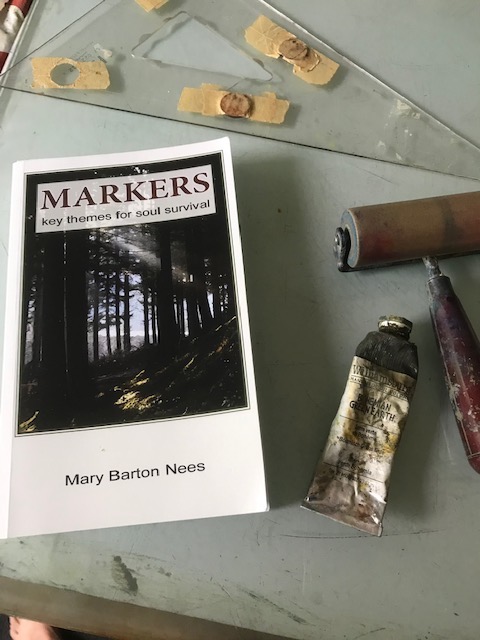
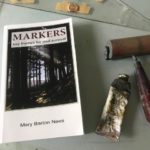
I am prompted to add this plug: the book I wrote, Markers, is also a program (though granted of a much minor sort). However, like Chagall’s images, my selected chapters, with images, are prompted by the text. I’ve simplified big ideas, not as a theologian, but as another Bible reader looking at the whole. The synthesis is mine, but the themes are big picture universal. I offer it as another guide into the same grand story that captivated Chagall and so many others.

gleaning and referencing

I complimented an artist I know for the excellent job she did designing a fresh logo. She said “well, actually, I borrowed from another logo I saw and…” as if that meant she could take no credit for the unique way she remade from another idea. Her apology made me sad; she didn’t realize what she’d done! There is a huge difference between copying and referencing. The former is plagiarism/thievery/boring — the later is crafting; it’s an entire reworking from ingredients already on the table.

All unique creativity springs from other starts. Nothing we do comes from nothing. In fact it is vain (and impossible) to assume we can do otherwise. Every great artist was influenced by what some others did. You can trace it. Only God needs no reference. Only God creates matter out of nothing before He shapes it. Only God is entirely original=out of origin. I find this simple contrast between His Creating and ours liberating, not demeaning.

We can be like the first humans in the garden, making new things. In fact, we’re commissioned to make new things, from the earth already made. We can be like Ruth, gleaning in the fields. We are all in disparate ways poor, and all in various ways hungry, as she was. The poverty and the hunger can be motivators. And it’s ones, like her, who go out and energetically glean from the leftover bits at the corners of existing fields who have something “new” to share with others. Here is an example from an articulate painter I know.

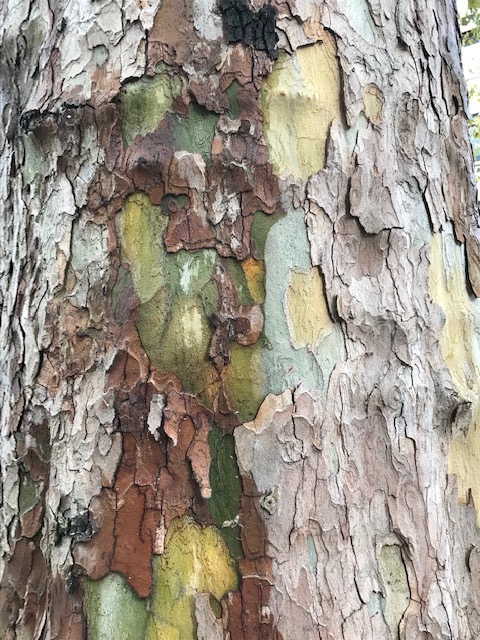
And here is one example of a reference for me. I found this tree in Mainz just recently. The context when this was captured, was loaded with wonderful conversation, sweet family and a slow walk though a charming town. This is just one of lots of references I recorded from that day. I thought the bark shapes were interesting, and maybe or maybe not will I use them as a start. The palette: this particular set of colors, is the better set of ingredients for me however. I might use them. Aren’t they beautiful! Thanks to the Creator for making such a lovely Sycamore tree, upon which I can possibly glean something new.

Mary Nees, artist and author of Markers; Key Themes for Soul Survival

taking stock

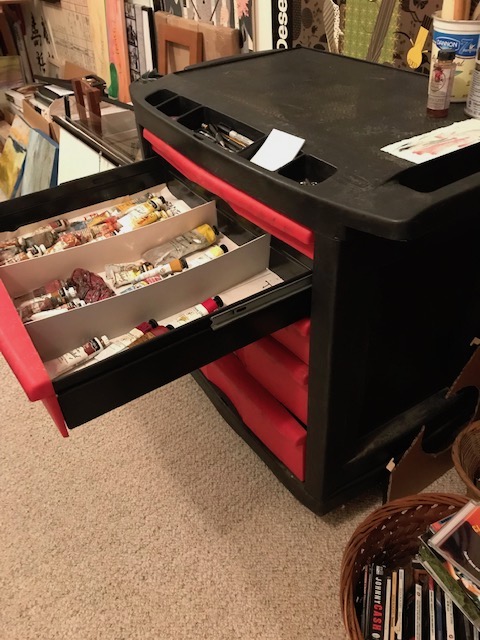
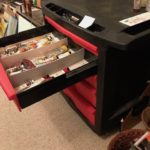
My son-in-law gave me this organizer. Crazy about it. And so now, instead of jumbled paints I know what I have at my fingertips and can more easily see what I need. I even have my hues grouped by transparency and opacity: something I’ve paid little attention to, but understand better now. We live & learn, AND gain help from others.

And here’s a new trick: I set up a 5 question survey about this blog and sent it out to my subscribers. My reason: so I could see what’s happening out there. Solomon said “ship your grain across the sea; after many days you will receive a return.” And I imagine that for King Solomon the Mediterranean Sea might have been as vast a wonder as the world wide web is to us. My stats on this blog indicate I have visitors from China, Japan, the UK, and even Israel sometimes. I’ve been writing here bi-monthly since 2008. Why? Words are seeds; I just feel I need to ship some out.

I get very little written feedback, but I can see that lots of people read. Am I hitting a target? What is the target? It feels more like grain going out on ships. I wondered about frequency: and find in responses to the survey so far that the timing of how often I post seems useful. I wondered about whether my writing is too abstract (like my paintings often are). One regular reader said “sometimes I don’t know what you mean.” Others: “I read because you make me think” “perspectives to ponder”. I gained from further comments some insight into what best helps folks and what is particularly of less of value. So thank-you to those who’ve taken the time. The survey is anonymous so to the 1 person who indicated needing to unsubscribe I ask you to do that easily when you get an email notice of a new blog entry. You’ll see the unsubscribe tab there.

And if you are one of my far away readers, I would love to hear from you too. Here is a link to a simple survey. I have adapted what I sent to subscribers as I learned the question grid on my first attempt was a bit confusing. This survey is simple check boxes, and you can choose to be anonymous. It is 5 simple questions and should only take you about 5 minutes to answer. I will definitely organize and use your input.

“Find our who you are and do it on purpose” Dolly Parton

resistance: a value or a trap

It’s a subtle thing, and lately I’ve been pondering my reasons for resisting as I’ve been examining some motivations. There are days when working or when in difficult relationships where I can feel this drag right under my skin. What is that? Time to take a careful look under my hood. And then time to study the manual. I take some care here, for resistance improperly applied can disassemble; it can destroy gradually like rust. Or, it can save lives like the firm pressing on the brake pedal when required. My difficulty (and yours) this side of Eden is discerning when resistance is good (which leads to Good) and when it is bad, leading to worse. Religions set up codes, or rulebooks to follow so one can “stay on the straight and narrow”. But creative life is much more complex than that. And in fact, in my own life there are times when “no, I wont go there” was very good, and other times when “I must face this head on”. Read Solomon on this, his words are in the middle of the Creator’s manual.

Recently I listened to a podcast by a Harvard trained Psychiatrist who now coaches artists. She does an effective job exposing the false ideas that hinder us such as “I cant” “I shouldn’t” “It’s all good” I’m all bad” (there are thousands more and we all have pet ones to which we we resort). Here’s an example “this hurts, it can’t be good for me” and I noticed I was fighting on the inside something I have no control over. Mine was not an active rebellion, but more a passive sulky resistance. Once I saw the potential in the manual for exactly this difficulty turning into something valuable I had very good reason to stop resisting and cooperate.

In my art practice, there’s often a negative resister: “I don’t have what it takes” but when I activate what I do have, little steps taken against my pet resistance can reveal something new.

Complex situations aren’t only black and white. And I’m a free agent who has the opportunity to negotiate through them: to select and to take into action. Time is one of the things I have, and materials, and a drive on the inside that I believe my Creator placed there. I’ll resist wasting these things.

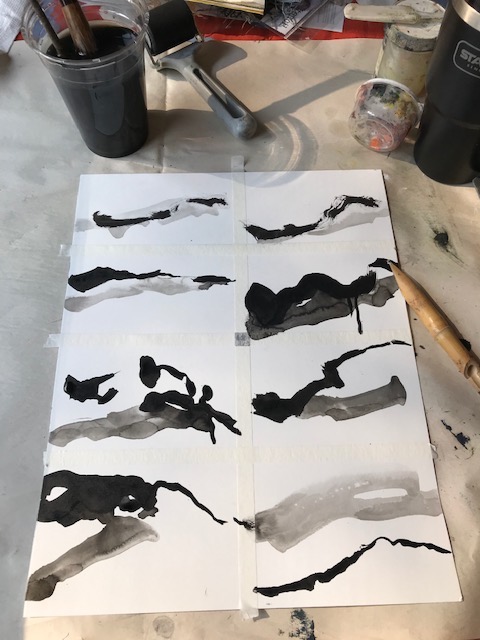
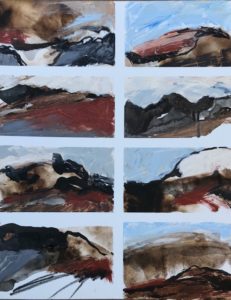
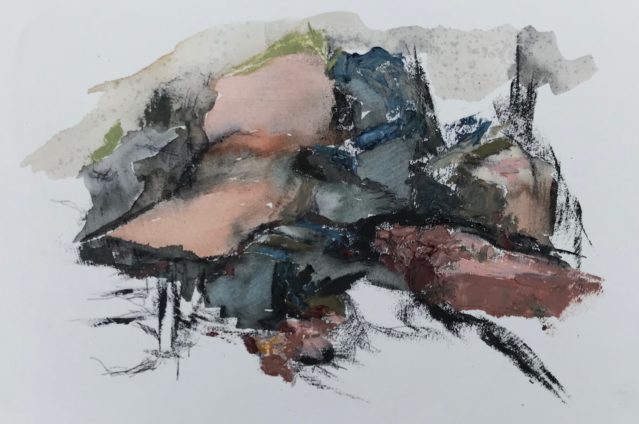
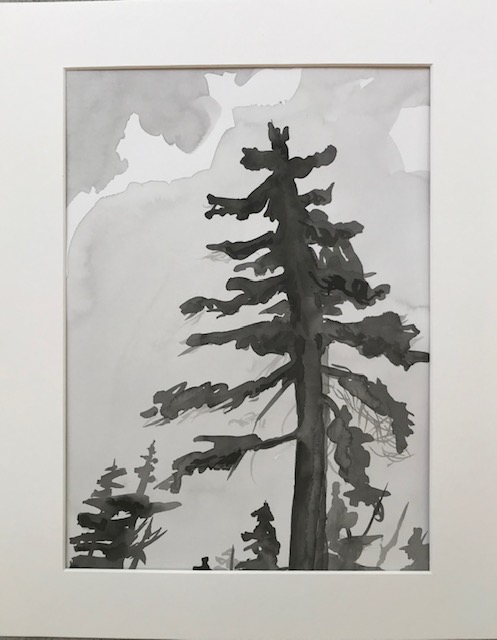
Here you can see some studio exercises this week as I was thinking on all this. I started with ink. And then overlaid with oils in some more subtle values. Each one of these small maquettes could be translated to more formal work. As I still have time, I will.

“Time is what defines our lives” says Paco Seirulo, Leo Messi’s coach, on how the champion soccer player employs his brain and his legs during split second decisions.

words and specificity

We know of Van Gogh’s particularity, his struggles and his needs through the regular letters he sent to his sympathetic brother Theo. Without that written record from Vincent’s own hand, we might have guessed some by simply looking at his images. Like a blind man feeling the walls of a soul with fingers, we could have surmised from the artist’s visual leavings, but never would’ve been specifically sure of the man.

Vincent’s 2D exuberance is evident: his promiscuity with paint and brushwork, his exaggerated sometimes garish color, his bold and roiling sketches, his animated skies, his grasping cypress trees, his bandaged and somber self portrait all suggest much about this emotional man. He’s left an incredible legacy just from this record. But his letters tell more the whole of him, and our guessing gets grounded. I’ve read through the complete collection of his letters twice and referenced it often. My college copy is marked up with highlights, underlines, exclamation marks and turned down pages. I was stunned then and am still– getting close to his motivation through his own often tortured telling. His words anchor the story.

It’s the effort of articulation with words that anchors anyone’s ideas. This is where guessing has to give way. Poetry might give a fleeting suggestion. Painting or photography might allure with a silent witness. But prose leads with particularity. And it was for that reason that I thought it important to leave a record of words beyond the images I craft from my studio. My book Markers; Key Themes for Soul Survival has been out for two years now. The same motivation that moves me to paint is more specifically laid out with words. And like the paintings, my fingerprints are all over it– but it’s ultimately not about me, more about what it is that’s moving me.

work in progress

Process involves time (a gracious given) and developing skill with steps (mine to do). I like quick. That tends to mitigate against process. But, I don’t like junk and that requires better process. Do you catch my working tension?

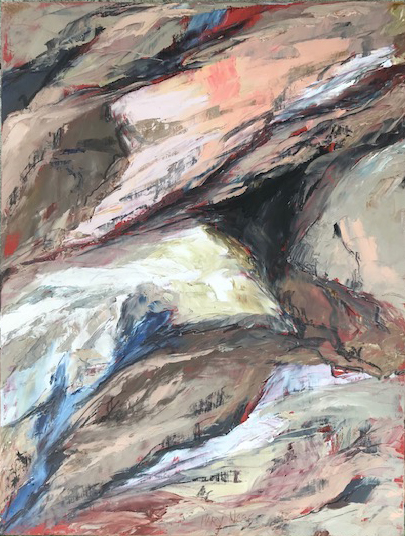
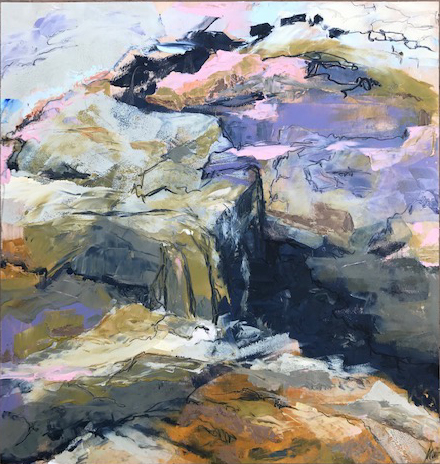
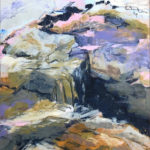
This is a quick start I’ll example today. I respond to the mark making, the palette, and this idea I’ve been mining of rock faces and what’s on the inside of those cuts. But something stops me from being satisfied that this is “done” visually and maybe even conceptually. It needs some work.

Sometimes Miss Quick needs to slow way down before next steps can complete the visual whole. I want to be done, but I need some careful time. This is partly why: it’s just startling to my reasonably trained eye that I can’t see flaws when they’re staring me in the face sometimes, and can’t see good when I’m ready to toss or cover up something. My judgment, needed and free, has inherent flaws. I bring some unseen filters or blind spots often. A different day sometimes gives a fresher view.

This blog is about the intersection of what is seen visually and what is being referenced from that which is not seen. Both the seen and the unseen are why I work visually. And when I move in to work I bring with me unseen concerns. Sorting out what is precious from what is worthless is part of this tension.  That’s really part of the fun too, but it is humbling: for knowing the difference is bigger than my eyes can often see. The hindrances in my vision may at least have to do with a vested expectation or a prejudice which clouds my seeing.

That’s precisely why I need to step away, and come back looking with clearer eyes. One of the tricks of seeing is to divorce, even repent from a settled orientation by rotating the piece while working. I’ll do that here. Another is to hold the piece in a mirror. Either trick forces the evaluator to look for the bones and balance apart from other attachments.

I have a pile of starts waiting for a finish. Some will get covered completely over, some will get interestingly repaired and some will get trashed. Not everything in my stack of un-dones shows promise, but then I’m not sure of that yet, so I keep them around. Time reveals, and time allows for better practice.

a surprising birth

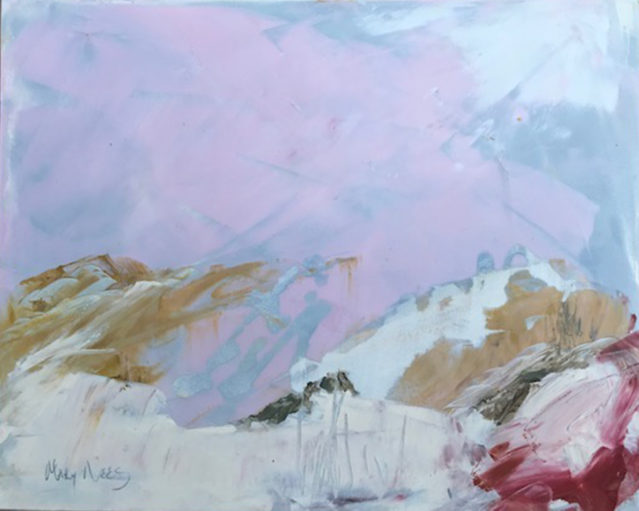
Today I’m highlighting a piece that popped out rather quickly last November. It was like a sudden birth with little pregnancy, and it encourages me with anticipation. I have it propped in my studio right at eye level where I can reference its effect. In fact, this image is the screen saver on my phone (with apologies to my grandkids). The painting might mean little to most except as a pleasing arrangement of color and strokes. But for me to date, it’s one of the best things I’ve done, and an emblem of where I want to go.

Let me explain just a bit:

When things happen quickly and strongly I am alert and curious. The color palette here was unintended, rather more intuitive, and the subtlety of some of the cool and warm hues in the upper section interests me particularly. If you squint, the pinks, grays and warm whites link together into one predominant value mass. Moreover, the unity in the whole of those lighter hues is probably what gave me an immediate sense that this was something to stand back from even as it was so quickly brushed out. It’s the particularity melting into a surprising harmony that intrigues.

There’s direction in the piece as well, though it’s just a still point in time. There’s a lifting going on that speaks personally to me. The image can’t be tied to any certain locale but clearly there is ground and then atmosphere. So it’s a landscape, and the darker hues are limited to the grounded area, which is a theme of concern in a lot of my work. But, by the palette and the mark making there is something new here also which I find entirely refreshing. In other words, there’s no yanking didacticism going on, no forcing of meaning but rather just a sense of a beckoning call. Do you start to get why has my attention? I was in a duet when making this.

I reflect on this simple gestural work and it reminds me of a conversation that happened 2000 years ago. They were talking about a mysterious birth then too. You can read the dialogue in John’s gospel, 3rd chapter. And after some very pointed words, Jesus adds rather obliquely: “The wind blows where it wishes and you hear the sound of it, but you do not know where it is going…” He was shifting very deliberately from the direct to the abstract. He was talking to a studied theologian when he said this. The man stayed curious “how can these things be?” That man was being invited to step up into another plane of understanding, to enter the birthing beyond the limits of what he knew. So it is with what I sense and somehow referenced here. T.S. Elliot speaks of this same imagined surprise in the first quartet of a poem  “where past and future are gathered”. That’s what this feels like to me.

Abstraction done well (and oh may I be able to continue) is how I can begin to picture that. When I was in grad school, this was this kind of work I wanted to do, but my skill level wasn’t there yet. That was all preparatory. It’s been a good long engagement, toward this very quick birthing.

facets

Gem cutters get close. They begin with raw material: rough rock-bits from the earth. They’ve been trained in sensing how to recognize potential, what signs to note from the faintest of glimmers. Not everything picked up holds promise, but in the working of the stuff sometimes there is reward. And then they cut. They don’t leave it alone either. They cut again. For it is in the facets where the value multiplies. The light dances, the shadows bend revealing color, and then someone’s breath gasps for the catching of something…

Have you ever noticed how folks sometimes put their hands to their mouths when being overwhelmed? Is it because we just know our outer expression will be paltry in the face of something much grander, or scarier, or livelier?

But I can’t stop trying. This is one of several sketches I’ve worked out recently in an effort to understand and articulate this grander thing going on. The photo images I took in May were only a beginning. Facing some cut rock I felt as if I was at the edge of a very rich mine.

And reading Jesus, I see he even deliberated out loud before his disciples about “how to picture” something which to us is only mystery. He spoke many parables, “figures of the true” that some would catch and others would completely miss. T.S. Eliot said “human kind cannot bear too much reality”

capturing “it”

I was in the Salvation Army thrift store this week fishing through stacks of old frames, ignoring the pictures. But one small piece started me thinking about why folks make representations and hang them on walls. The prompt was a rather darkish watercolor of a flower stalk. It wasn’t badly done, the artist set it up on paper, selected a muted palette, articulated petals, signed it carefully, then framed it for some wall. I imagine she was proud of it, wanted it seen. Now, I reckon that the real flower stalk was more stunning however short-lived. The panting remains. It’s a token or a signifier of something. What motivated the artist to capture this stalk on a piece of paper? What gave her the impulse to copy what was before her? Was it some kind of sentiment?  Or was it something else that would move her to set up and spend time? Is she still alive? Would the painting have prompted a rich memory of a moment? Or was her composition just a thing, a stand alone, made for adornment without any reference?

I muse on this because I wonder about the drive to “capture it” when I am working and when I am thinking about what it is I want to work. It is not representation that moves me. The references, the things I see with my eyes, hear with my ears and am moved by are only jumping off points. To render anything precisely for me misses the point of why I want to fill a frame. To perfectly imitate something on a board presents only a false stand in. It’s a pacifier. For the real material thing I first experienced is way more lovely than the best of copies. There is rather for me something in a glimpse or a suggestion which better captures the mindful “it” so many beautiful moments only allude to.

In C.S. Lewis’ lectures series The Weight of Glory, he uses words to try to explain: “Pictures are part of the visible world… and represent it only by being part of it. Their visibility has the same source. The suns and lamps in pictures seem to shine only because real suns or lamps shine on them; that is, they seem to shine a great deal because they really shine a little in reflecting their archtypes…it is a sign (these representations) and also more than signs for the thing signified is really in a certain mode present”.

The “it” I aim for, what I hope is rendered as “present” here, is the cut-away revealing of something solid. It’s getting the chance with some material stuff to see the gem like exposure planes, the multi facets in common things of earth. This rock wall used to be covered with dirt, but now we can see what is underneath, strong and exposed. It’s also the contrast between illumination and cavernous shadow. It’s in contrast and color planes where forms are distinguished and understood. And for me the “it” is the suggestion of a different dimension that cannot be precisely laid forth on any 2 or 3 dimensional material aspect. Case in point: Jesus prompted his closest followers privately that what they were seeing right in front of them was more than what prior prophets and Kings wished to see.

In other words, even the seeing cannot grasp full import. We need time and thought. The gestures therefore leave you looking, studying, connecting dots, and I hope desiring to apprehend more of what all these beauties are pointing toward.

“bread and butter”

So, I’ve been getting my water brushes moving doing simple ink drawings this week. I have a pile of source work waiting and ready for more intensive oil work. But the immediate impetus has been quickly recording what lingers on my retinal memory from some recent travel. I found a new gallery in Minnesota and will be sending him images of these drawings because we both want to test/have an expectation that these will sell. So, the natural question is “am I cheapening my aim by spending time making locale work just to try and sell?”

Here’s my answer to myself (and you): Maybe the most significant progress I have seen in my studio this year has been a change in my inner conversations as I work. I am checking the judging of myself in harsh ways. I look and evaluate, change and adapt for sure. All that takes critical judgment. But the self-critical part has been tamped down with an observed kindness which is freeing me to fail, to explore, to not care what happens as long as I keep at it. There’s something big about this that a short blog won’t be adequate to explain.

But, back to this “bread and butter” idea. I learned several years ago when hearing some other artists talk about their serious “out there” work that their quick saleable work is vital also because it keeps them fueled. Easily this tactic can be cheapened, I am sure. Bread and butter type work can become a numbing assembly line distraction. But there has to be something valid about making work which is accessible to a broader audience. For artists, this is often simpler, faster work which still has the genuine voice of the artist. And this avenue sustains and keeps fluid the more ponderous, ‘meaty’ idea-based work. And so, I simply enjoyed this week.

In fact, I am not making any work just to sell; my inner motivation ‘to make’ is not monetarily based. That alone is both a blessing and a curse: a blessing because the dollar is not my driver, a curse because too easily I can excuse myself from getting going. I know artists who need to sell and they work a whole lot harder than I do. But I sometimes wonder about the integrity of the outcome when money has such a high place. The hunger that drives me, to express with brushes, is not for the bread and the butter. But if I make some bread and butter work, some healthy bread and butter work, with the same personal respect, I think observers will sense it. And I expect I am going to see ultimately more of what I am working for. So, I’m letting both be. And that’s pretty good.