Author Archives: marynees

award of excellence

The juror for the Appalachian Art show this year was previously at Wellesley College as museum curator and also lecturer in their dept. of Art. David Mickenberg also had professional experience at the Louvre, and the Art Institute of Chicago, among other things. This interested me and so I selected some things to enter that I hoped might catch his interest. One piece I entered didn’t even make the show (so it goes) but this piece won an award of excellence, I am glad to report.
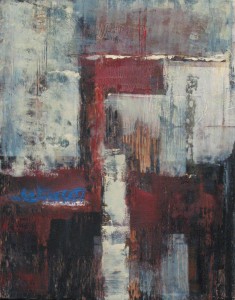
 Like so many for me, this piece is marked out not with any message intended, but rather as a physical response to all that rumbles within. And there is a lot rumbling within. It surprised me when it got done. I started it last summer and fine-tuned it just last month. There is one collaged phrase that is embedded in other text-like markings: “pray for Jerusalem’s peace.” Again, I emphasize, this piece was not a pretext to say that, but rather a natural and right seeming way to finish what I was looking at. There is a lot of energy in this piece, layering, piercing and shroudedness. I showed it to a friend who is very bright but very un-artsy and he said before seeing the text fragment “it looks like a swastika.” Ridiculous! I went home and did some research on that symbol and then became even more interested in that strange possibility, especially that in my case the symbol is definitely broken up at its core. I say all this to try to help the reader understand some of what happens in art making: it is a duet, it is intention made visual, it is something that goes beyond the artist. It can be deadly or it can be good, and often is maybe even both. Such it is for things that come from our hands and our hearts. Such it is when even these things can go beyond our hands and our hearts.

I’ve been doing some reading this month also in a fine book I got from one of my daughters for Christmas: “Objects of Grace; Conversations on Creativity and Faith,” by James Romaine. In the great interviews he has here he often discusses with the artists the idea that art making is a form of prayer. I never, ever thought of that before. I am not sure I even agree, for prayer as I practice it is much more proactive, it is also much more specific. But there is some parallel in that with both prayer and artmaking there is an extravagant use of time and trust, of faith and practice. Today, as Purim is being celebrated, I offer this prayer, entitled “Fight Unseen,” with prayer.
Spending

I reorganized my studio a couple weeks ago, clearing away mess, finding some old gems in the midst (that started sparks), setting up an ideas parking spot, better configuring cords and other safety issues, making a wider work area. . . it has been pretty liberating and the hours I have spent there so far have been fruitful and hold promise for more. This is one of the prevailing ideas for this year: “SPEND IT” Spend the time, spend the risks, spend the agony at wondering what in the world I am really doing. Spend the materials, just use them up! Don’t leave them in drawers, they are waiting for something to happen. Spend all the over-thinking and the self-critiquing, just spend it into more work that needs to be thought out and critiqued. Work bunches at a time, something is going to happen.
Here is one successful result, done primarily with cold wax. It is called “The Fields are White”

light comes in

I have been pondering Jesus’ statement that “the lamp of the body is the eye.” How curious that has always seemed to me, almost indecipherable at times. I mean, it’s a very simple sentence. But maybe it has hit me like a riddle because it is so counter-intuitive to the way I usually think. How can the eye be the source of light for men? To me there is a lot that comes from inside people that brings out light and ideas and kindnesses. But Jesus says in another place “It is not what enters into the mouth that defiles the man, but what proceeds out of the mouth, this defiles the man.” Jesus’ view of man is that there is, by original nature and ultimate potential, no light inside of man; that what man needs originates from outside him. This is radical, and disruptive to the ways we think of ourselves and others; we easily dismiss this.
However, Jesus says that the eye is the gate through which light can enter the body; that it is made for that purpose. In fact your cornea, your pupil and the lenses of your eyes are specifically arranged to take in and transmit light right onto the waiting receiver, your retina, which then translates to your brain. We do not come up with light, it must come into us.
hand-1044883__340Think about it, your body is a very dark place on its own. When scopes go into our bodies they must bring their own light, like miner’s lamps, to be able to see anything. When bodies are on surgical tables they are dark chasms until the surgeon’s knife cuts open flesh and the huge lights over the table light up what was hidden and all closed in. We only see these things because our eyes have taken in light first. This is simply true, and the physical is a signal/type for what is more important, the spiritual. Looking into someone’s eyes is often so intuitively instructive as to whether there is any life or light in there. According to Jesus, for any light to be inside us, we have to let it in, we have to allow our lamps to be lit. We cannot come forth with light on our own. Light was the 1st creative accomplishment in Genesis and it comes forth from God. This is basic though I stumble over it.
As an artist, I am working with the contrast of darks and lights all the time. I am taking materials and ideas and trying to bring forth new things with the stuff on my work table. It feels so presumptuous sometimes, impossible other times. Indeed it is. I cannot make things out of nothing. I need something to “inspire” me, to get me started. I have been invited to co-create with the One who brings light and ideas and continual kindnesses in and around me. And sometimes THIS feels like a floodgate, that I have difficulty channeling.
Today begins the festival of lights, or Hanukkah. This festival is a historical victory celebration of God bringing surprising light. How interesting that this yearly festival comes at the time of darkest days in the Northern Hemisphere. The King of Israel once said that “In Thy light we see light” Ps.36:9, in other words it is a parallel to what Jesus was saying: that light is apprehended in our experience by His initiative, only by His initiative. This is common grace, meaning it is given to everyone even though they don’t know what they have.
I think of this too because John’s gospel begins with a similar theme: ‘light came in… it came into darkness; and the darkness was exposed and illuminated and graced with the light of life. And darkness simply could not understand or comprehend this light; it could not invent light, but it could reject the light. This is such a mystery of grace. It was in the beginning and it remains.

a moment in the slow fall

Since I first saw some of his work several years ago, I have been interested in Arthur Dove. Then later, in graduate school I looked at him more seriously and was amazed at the confluence of reasons that explained more as to why his work would/should interest me. He was a graduate of my same alma mater, he worked in Long Island, he was gentle and like a “babe in the woods” amongst the effetes of his time, yet he loved them as well as needed them. . .  the listing goes on. Yet his visual work drew me in first, before I was aware of those other things. He was an American modernist who was serious, serious in his desire to use abstract language, rooted in that which is natural, to speak to that which is way beyond the natural.

There is a piece of his I saw at the Phillips collection in DC (how I got there is another wild and crazy story, I was actually thinking I was going to Beijing with my husband that day and ended up at the Phillips collection in DuPont Circle). This piece stopped me. Maybe it was not the reason I got detoured in DC, but it became one of the reasons. Without even knowing it’s intended meaning it had a rich resonance for me. Dove called it “Rain or Snow” which confirmed what I was thinking. He was both indefinite and also clear in this title: it was some kind of falling, but it was a falling. And it is slow, measured and  sadly beautiful. It was done in 1943. Think about what was happening then in the world of 1943, just pause and think about it! This also is 3 years from Dove’s own death and he was not well. But look at his gentle voice. wow.

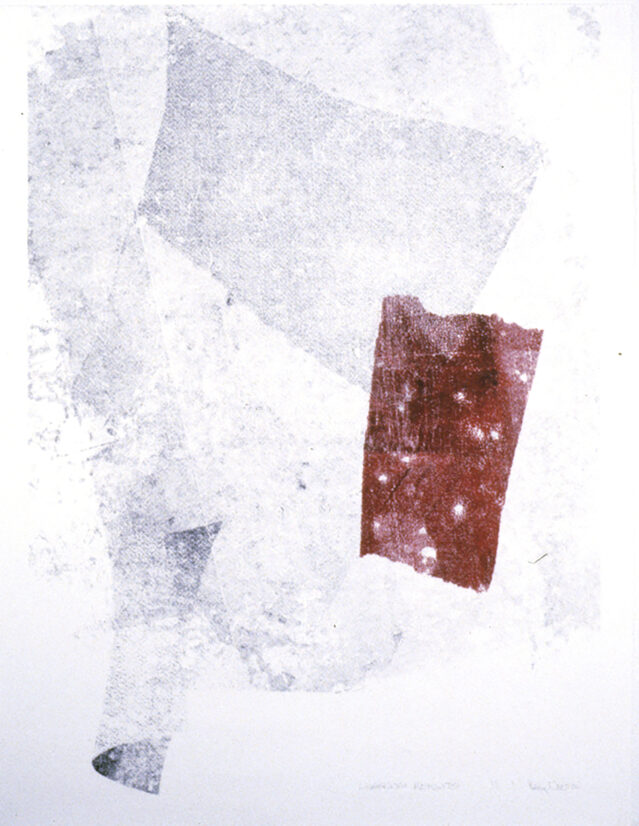
I did a piece in 2005 that surprises me for its similarity to Dove’s work here. By the way, I can say that I am pretty sure I had not seen this particular Dove piece before this last month. It really did surprise me. My own piece is hanging right now at a gallery in Philadelphia. Mine is called “Lingering Moments.” It too is about a slow falling. It too involves pain and love, urgency frozen in a slow-motion moment.
As I write this, it is the 11th day of the 11th month at least in the way we count time.
My sense of things remains suspended like this ink work. There is beauty here (that I can say happened in spite of and way beyond intention and ability), but the beauty is wrenching and urgent. I think it is beckoning too. This is my sense of what happened on that piece of paper and what is happening even right now.

no image…just a flash on the retina

Today we were with friends on a lake, the Fall colors are near peak, and my eyes kept drifting past faces and drinking in the landscape beyond. It was enchanting, winsome, just deeply beautiful. I kept taking pictures and then looking at the result that had been translated to pixels …which was just plain disappointing. There is nothing like the retinal receiving of the immediate full display: citrons and pale salmons next to dusty tans, lime yellows next to rusts and light cherry reds, sages and spruce, with lavender shadows, oh glory. Next time I just need to have my paints right there on the boat, and freshly mix what my senses are shouting. My retina does not remember well, for it has moved onto the next thing, like the car keys and the night crème, what a sorry shame.

Last week I was in Philadelphia helping my daughter move into their apartment. We made time on the last day to go over to the Philadelphia Art Museum. I had heard about their current show: “Rembrandt and the Face of Jesus.” Rembrandt is an important reference for me, though I am not a figurative painter. His deep psychological investigation into his subjects was groundbreaking; and his illustrations of the Biblical stories showed far more than just a liturgical compliance but rather a deeply personal engagement.

I grew up going to The Art Institute with my Mom. I took our daughters and son often to museums too and it is still something we like to do when we can together; so this was the carrot before our horses. But my daughter, who lives in Philly cautioned as we drove up to park, “you know Mom, this might be expensive…”  Ever the can-do kid am I, “let’s just see what they say.” Well, it’s been too long since I was in that Museum! The traveling show tickets were way more than I remember. And so we thought, let’s just go in and at least look in the shop at the catalogue to see what they have gathered and make a decision from there –no way for that either: just getting past the entry desk was a pricey proposition. This was a shock to my system. We fumed, turned instinctively together and walked out, and that too was a sorry shame. In fact it was more than that, it felt like money changers in the temple! “I can’t look at Rembrandt’s effort at capturing the sublime unless I cough up so much cash?”

I know, I know, it costs to gather and ship and hang etc. But c’mon! It seems to me that there is a diminishing return here where they have priced themselves beyond a lot of people who would otherwise not only help them pay for their work at putting on this show, but would also fill the rooms and then take the images home in their spirits and into their own work. I looked later to see what the mission statement of this museum is and no luck, except for a statement about acquisitions. Is this only a money making operation then?

“Are you ok, Mom?” “I’m just sad…I really wanted to see how he tried to capture that face directly, a reproduction on a page is not the same…” and then it occurred to me…one day I will see the real thing on my retina, and I just might be standing near Rembrandt when that happens.

My retina has long since shifted thousands of times since that opportunity so close to the hanging Rembrandts. And I likely would not now be able to remember deeply the visual impression anyway, nor be able to put it to words.

But what I saw today nobody had to hang, or ship from far away places. Those leaves have been waiting there all summer for their glorious changes, gathered into a sublimely random assortment of joy. It was free. It was available for anyone who wanted to look. And it was a flash on my retina from His heart.


in the image of my father

I saw something last night that caused tears to just stream down my face. It was somberly, maybe one of the most beautiful things I have ever seen. The whole day was somber, the 10th anniversary of 9/11. This date is now a euphemism for what we still can hardly grasp – that our nation came under attack by 19 men, driven by some kind of hateful ideology that could justify their driving planes full of innocent men, women and children at high speed, full of fuel, into some of our iconic landmarks. I lived not too far from NYC then, I remember the incalculable shock as events unfolded quickly. I remember when the towers INCREDIBLY collapsed, and the aching realization that thousands and thousands of souls were turned to dust in seconds. This is still unimaginable to me.

Those towers were a part of my own life. I toured the 78th floor in college, wearing a hard hat with a team sponsored by the Port Authority, for a project we were doing to design the space on that floor. My twin girls dressed up as the twin towers one Halloween. My husband and I celebrated our 10th anniversary at the Windows on the World restaurant in the North tower. We would often take visitors to see these amazing buildings. If you were close to them you could not see their size for how hard it was to crane your neck directly up to see such height. One needs to understand these buildings were packed with offices and people on twin levels of 110 floors each! Estimates are that at capacity these buildings held between 10-25,000 people each on a working day. This is what I was thinking about as the towers pancaked into dust and ash. It is absolutely incredible then that the actual death toll in those two towers, not counting the firemen who came inside, was only just over 2000! We don’t celebrate this number as we do not and cannot celebrate this day, but it is important to mark it. It is crucial to try to understand what events like this can teach us. There were several things we did yesterday and contemplated yesterday that helped us to piece together some meaning from such wanton evil. Yes, evil, and we are naïve to think it could be called anything else but what it is.

What tuned and melted my heart yesterday, however, was a program I saw at the end of the day. On it was a slide show of images. Dianne Sawyer has been apparently marking each year since our 9/11 by gathering the babies born to widows, most of them the widows of the brave firefighters who ran into the buildings. Over 3000 children lost their fathers this sad day. What ABC had done was to quietly show, one after another, photos of the fathers and their 10 year old children. There on their faces is a mark of connection. These children never knew their Dads, but their faces show their Dads. This is such a picture, in varying kinds of uniqueneses of what it means to be “in the image of my father.” These Dads are gone, but their children carry them in their own DNA. It is a most beautiful thing.

My soul knew it before my mind even understood. My body responded before I knew what was happening. This was beauty, and beauty often carries such an ache of recognition and longing.

Vincent Van Gogh said in one of his letters to his brother, that ‘the greatest artist is the one who works in human flesh.’ I have often thought of this, for it is true. We can’t do this kind of art, but the One who said that we all are “made in His image” can and He does.

heartened by another painting

I didn’t know what I was getting in to. I had never heard of this artist, an American woman, Mary Whyte, showing a large collection of watercolors at the Greenville County Museum in South Carolina. Something kind of pulled me to go and I got the last seat (one that had just opened up for me!) on a Senior Citizen bus making the trip. My, my, my…am I glad I went! Mary was the docent that day which was an extraordinary treat, and she explained the way her project “Working South” got started. So much can be gleaned when a serious artist explains her motivation, and her words confirmed the sense I had been gathering in front of her work, that this is a woman who sees deeply, and then through her formidable skill, loves well.

The very first piece I shot a photo of that day was the one I kept going back to out of the 50 large images in this collection. Her project was to document the people in the South whose livelihoods are disappearing. “The Bee Keeper’s Daughter” was a sermon in paint for me. It left me speechless, and deeply comforted. Beyond the occupation being rendered here were the symbols of her task: silent, and covered, with mystery ascending. The woman has her mouth slightly open as if in a quiet, possibly even joyful conversation. There is a rising of smoke. I guess beekeepers do that; but it too is emblematic to me. And the bee hives make a random-seeming tottering back into deep space, as if pacing toward the horizon. The bees too leave bitter streaks around her, but she is unmoved in her protective garb, her focus is elsewhere. She stands to the side. Most of Mary’s subjects are placed that way, off center. But clearly each subject is the focus of her concern, the reason she documents in color. She looks into souls with her work, and her work (way beyond her ability) looked back into mine. I got a visual that day that is sticking with me. It confirmed what I had already been pondering and then, right there it was. This is art at its best. I was supposed to be there that day. I left strangely warmed. I am one of The Bee Keeper’s Daughters. Thank-you to the Maker of Mary.

(and thank-you Mary Whyte for letting me except this here)

arrested by a painting

This month, I was arrested by a painting. It was among many other works in a fine exhibit the Germans brought to Beijing, housed in the newly constructed National Museum. The exhibit, covering several rooms, highlighted the “The Art of the Enlightenment.”

The Enlightenment is known by historians as a time of great scientific discovery in the West, and known by art historians for its grandiose swings away from the patronage and parochialism of the Church to a search for higher human ideals for source material. Artists explored themes and styles to authenticate their aims. From this time we get the beginnings of brilliant graphic political satire (Hogarth and Goya), a revisit to the ancient mythologies of Classicism (Delacroix, Titian), and the development of Romanticism and its reach to the landscape.

It’s easy to see how the Chinese, though not as inclined to the former two aspects of this time in Western history, would certainly resonate with the importance of the landscape. Enlightenment artists thought they had discovered “the sublime,” when all along Chinese landscape artists had been musing on those depths for centuries. There was a whole room dedicated to these sublime European landscapes and the room was being well visited.

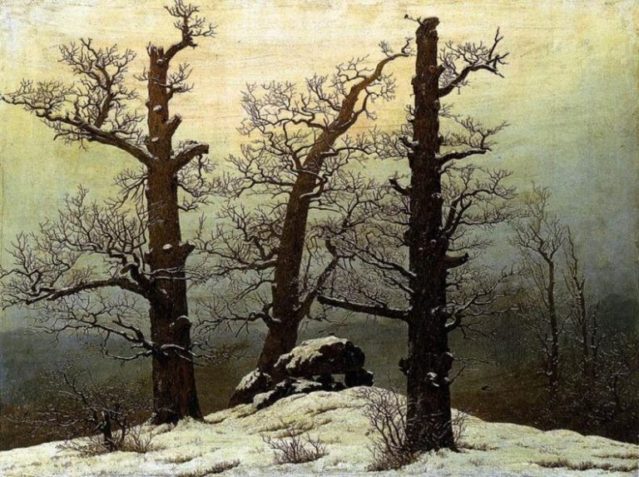
In this room I found a small oil—“Dolmen in the Snow”—by a German I knew little of, Caspar David Friedrich. This piece is simple and profound. The foreground is foreboding, indeed a dolmen is a burial place. The three trees in the painting appear dead as well, though likely dormant from winter. The central tree is leaning and is closest to the dolmen. There has been much cutting of branches of the other two trees. But of the fingerlets of branches we see, they are all reaching upward.

Snow blankets this quiet scene, and there are no figures except a lone bird whose position indicates we are located in a high place. The starkness of contrast between this dismally yearning and empty scene and the sky is what stopped me. The sky is luminescent and beckoning, warm and enveloping/changing the entire effect. Apparently Friedrich intended this piece (as with some of his other works) to be a defense of his faith as a Christian.

Friedrich was living at a time when to be overt about one’s faith was “uncool” according to the groupthink. So he stays under the radar but uses his art to symbolize what is in his heart. It still speaks. In fact, later artists look to some of his work as the beginning of symbolism.

The last room of this entire exhibit was a jump into the Modern/Postmodern era with a few selections: a portrait by Andy Warhol, some abstracts and a sculpture by Beselitz, and a video by Joseph Beuys. My sense is that the curators were wanting to show the end result, to date, of the aims of the Enlightenment. In their Western conceit they think that the end is always going to be better than the beginning, that tolerance really is the highest ideal, that meaninglessness and self-mythologizing is very deep.

I think the Chinese observers will likely have more an objective detachment and consider this end otherwise. The art speaks for itself. For me, I’m back in that landscape room.

rooms as signs

In the slow process of walking this grief out (and it has been a walk, a very slow paced walk) I have been surprised by one thing that kept catching my eye, then immediately resting my soul:

Well appointed rooms.

Well appointed rooms are very meaningful to me, even just the pictures of them.

Somehow this year I was given a subscription to a women’s magazine and I would look forward to each issue for this reason alone.

How strange… in fact it was most often the rooms of strangers, not my own pretty rooms that I live in, but rather the representation of other places, places I don’t know about, but that invited me in…

It was as if the lovely rooms pictured on glossy paper gave me a metaphor toward the reality that this place I inhabit is NOT my home, that there is another place I do not yet know and these images are signs of it for me.

I am not a material girl. I love beauty and pretty things to be sure, but I have learned not to place my aims there. I don’t have to have, or possess pretty things to glean sublime enjoyment from them; I do not need these things, thankfully, to be content. But during this time therefore it has startled me how much I have thirsted for this specific kind of beauty. It is a beauty of place, and of welcome, and of particular taste. It is a beauty of a resting place where clutter is gone and someone knew I was coming.

It occurred to me this morning that this better explains to me why Jesus said to his disciples on that sad last night on earth with them that He is “going to prepare a place” for them. This is almost an obscure promise between the important foot washing and then the important Passover… but it is ALL packed with meaning and this too now makes deep sense to me. In grief I need a picture of another place. AND, I need to know this other place is a real place, not just an ethereal hope. He is a carpenter, he is making a real place. I will be welcomed there and the chairs will be comfortable, and the colors will sing, and we will sit together and marvel at all the tears (real tears, not metaphors) that were spilled before we got there.

waiting rooms

May 8, 2011

Waiting Rooms

These are not the rooms we care much about;

They are holding places

And they usually belong to someone else.

We go to them when we have to, however

and distractedly find a chair.

– a necessary convenience in what usually is an inconvenient spell.

The colors are bland, non-committal

For you see, everyone has to wait

Therefore everyone must be accommodated.

And so not one feels at home.

Lately I’ve been thinking that even home

My sweet home

With committed color and personal touch

Is still a waiting room.

And this new thought is a revelation.

in the mean time

I believe in the resurrection. It is the only reason I have such outlandish hope. The language itself tells the meaning: re- (again) + surgere (to rise). We sit today considering this, again. For recently we ‘lost’ to this life a baby who had a name and a very specific body. She looked so much like her mother, our daughter. Her very DNA was a unique weaving. Her toes, like all of her body were perfect and recognizable. Re- (again) + cognizable (to know from previous knowing). Her weight was significantly heavy, weighty, and substantive. Holding her felt like a beginning, not an end, though it was an end in time. It was a beginning too, for her weight held a tangible hope: that such a unique weaving was not made for loss alone, never to be further enjoyed; that her body was precious and held an equally precious soul. We knew her in the few hours we had. There was a knowing there that was sure, that nothing, even death can take away. Death is a thief, an enemy, a terribly mean robber. Death halts creation. But death does not have the last word.

In this mean time also there was once a down payment made, a rescue, a first fruits resurrection of an incorruptible life, a ransom made for my life and for hers. Jesus promised He would do this and then come again. He is the great re-maker. He is the only re-storer. He does not clean the slate and start over with better stuff; he takes what was damaged and makes it new again. This is why he is my champion. He is the creator. He is the re-creator. He was the first word, He is the last word, He came into mean time. He now has transcended it. There is not another like Him. He purchased my hope with His own blood. The very substance of it all is a sure sign of what is to come.