Author Archives: marynees

Emerging color and the puzzlement of physical beauty

Driving through rural VA this past weekend, I punched open my iPhone camera to try to catch some amazing color notations. The snow was laying lightly atop an awakening earth. Before my eyes, was a transition going on from winter palette in the very dust of the earth. There were peeks of verdancy under the cold cover, and it was so beautiful! Clumps of slight but sure winsomeness was hinted also in the thin groupings of branches set against darker woods. I was stunned. I hoped the many shots I took might catch even a little glimpse of what was whizzing past my retina, what was affecting my heart!

I am reminded of what the scientist Edwin Land used to say about the retina as an incredible receptor. What the human eye could perceive in 1/3 of a second, he said, would take a super computer 100 years to do! Doubtless technology has improved that comparison, but the human eye’s incredible ability remains unmatched. Alas, the translation of color to pixels in my iPhone could not replicate the wonder I had seen. Later that day, I sat with my near 8 year old grandson, re-telling the experience while showing him several of my photos. He politely tolerated my enthusiasm and looked but could not see what I was exclaiming about. How can I somehow replicate what I experienced there in a way that can be seen? This is maybe the task of my years now, and I ache for the skill to do it.
Francis of Assisi spoke of nature being a conduit of much greater reality; that nature bespoke the glory of its Creator; that such beatific embodiment in very physical things was indicator of sure things beyond.
Albrecht Durer, the German engraver of the 14th century spent time, thought, and practice trying to understand and to communicate a theory for what makes beauty. He called it a search for the wondrous, “for it is great art that in crude, rustic things can show real power…and this gift is wondrous” (Panofsky p. 122).
Jonathan Edwards, the early American theologian, “was obsessed” with the beauty of God. Edwards said that beauty was an analog, or a sign post of God’s primary essence; “the most accessible manifestation of goodness” (writes Gerald McDermott in a new Theology of Jonathan Edwards).

All I know is that I saw some incredible flashes of beauty in the Virginia hills. Like apparitions, they do not show up on my camera screen. I hunger to translate them so others can taste and see it too.
Selah

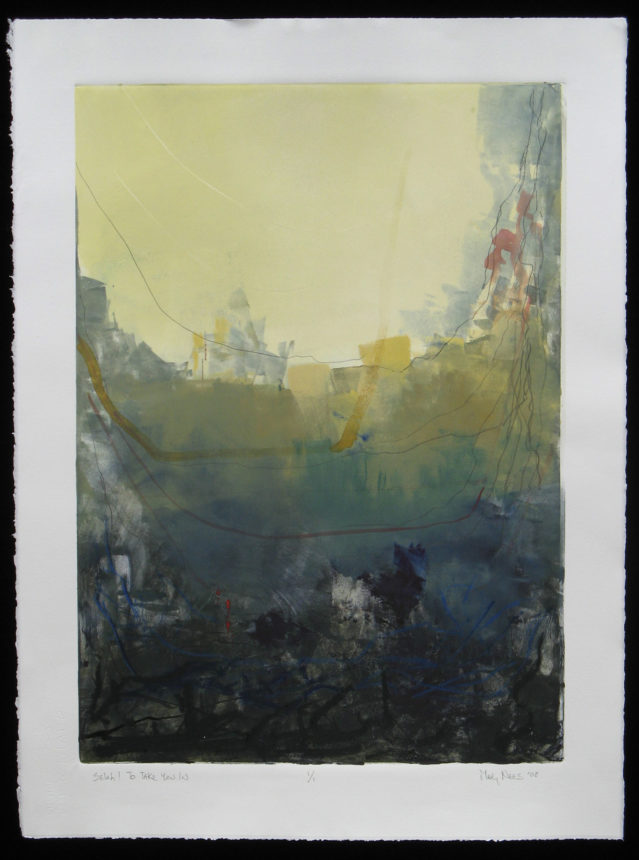
A good portion of my work is an intuitive response, rapidly laid down. This does not mean that the result seen on paper was altogether quick, though if you had watched this piece and others being birthed out of the press you might think so. What is visible is an end product of a long term simmering from my mind and spirit and body. The thoughts that collide toward and then into a particular working day, the prayers that have been raised and linger as I work, and the arms and legs that labor this forward are mine. But I live influenced and challenged in time by much around me; and that can be seen here too. Of particular note is an apprehension regarding the mystery of beauty. Add to this: mourning over so much that is broken. And finally, every piece I craft comes out from a long term feeding in the words of Scripture that continually ground and then lift me.

The word “Selah” for example is used often in the emotive expressions found in the book of the Hebrew Psalms. The word seems by its usage to be a deliberate pause for pondering. “Pause and think of that!” is how the Amplified version translates “Selah.” It is a call therefore from the penitent to other listeners. We stand together on ground that is broken, but some of us are looking up and leaning forward, yearning for His appearing.

This piece is presently hanging at the Barrington Center for the Arts at Gordon College in Wenham, MA. “Selah” was juried into a show for the monotype guild of New England’s 3rd National Exhibition. It will be up from February 23rd to April 6th.

unfinished

Here’s a beautiful little passage out of a piece I am working on/struggling with right now. I will not show the whole, for it is kind of a mess. The whole piece actually may never get finished in the way I want it to. In fact this morning, I realized that my problem is that I am trying to “make it happen”. I am trying to aesthetically force a conclusion, and it is not working! I have learned/keep on learning that once energy moves in that direction, it is a recipe for failure. So, I will work in my garden today and ease back.

The vision I’ve had for this larger piece is the prophetic statements of Balaam over Israel. You can read that strange but true series of events in Numbers 22-24. If you know that story then maybe the irony is already hitting you, for Balaam too is confronting an unfinished vision. He could not curse Israel, though he was given much incentive to do otherwise with his prophetic skill. What Balaam sees in his last vision is a dramatic statement of something sure to come, but far distant. I have been thinking on his utterance “I see Him, but not now. I behold Him, but not yet” for years and years…

As for my piece…it may get torn up and used as fragments in many new pieces. That would be fitting. I can settle with regeneration, might actually be better.

mercy’s purpose

It came off the page this morning: “I have kept silent for a long time, I have kept still and restrained Myself, (this is God speaking, timeless in time) Now like a woman in labor I will groan, I will both gasp and pant. . .” (Isaiah 42:14).
Long have I been fascinated with this prophet Isaiah who allowed himself to be an authentic mouthpiece for God’s intentions. I first heard of Isaiah from a lecture in college. This ancient Jew was unique in his multifaceted and very far-reaching vision through time. Isaiah was like an artist, one who saw the peaked mountaintops in a landscape, squished from God-dimensionality into a 2D representation. One can’t make this stuff up, it is too big, too beyond human ability. I tried to study Isaiah when a new Christian, but he was too dense. . . I keep going back to him for more understanding. Christ quoted from Isaiah more than from any of the other prophets, and He knew them all well. The words of the prophets are like echoes that keep resounding in the caves we are living in here. We do well to pay attention.

Yesterday, I worked on a piece, trying to finish it (and be done with it, frankly). It was unresolved, hanging there troubling me for its ugliness. I think I am done with it now; at least it is resolved compositionally. I still pretty much hate it for it is so dark, but I felt I had to complete it somehow. Then my husband came home and told me the news he had heard on his truck radio. My hand went to my mouth, as he choked back emotion and we both staggered to take it in. I cannot take this in: another slaughter of innocents. Child bodies, and blood, and horror. There are people now grasping for political solutions. Isaiah did not begin to see well until political solutions were exposed as dead, and then he finally would see God. You can read about that in his 6th chapter.

This piece is called “Mercy’s Purpose.” I feel I am to put it out there. This is not a display of ability as much as it is the cry from my own heart. I am as much a mess as the jerk in the mid-ground who is railing at/reaching toward God. But God is merciful. (A lot of religious people mouth that God is merciful, hoping that if they say it enough times, maybe it will be true.) You only know that God is truly merciful when you will risk getting to know Him. I do not know how much more time we will have to dally around in our caves. Open the Book and read. Jesus repeated Isaiah’s warnings, saying that labor pains would come. He also said He (Jesus and no other) would be coming back. The key is not the mess we are, or the mess we are in; the key is that He is the key. Ask Him to help you. Isaiah too cried out and learned: He is Merciful, but He is getting ready to move out.

Day of Fire

John Valadez is new to me. His concerns are the dissipation and the distractions of contemporary (Southern CA) culture. His skill is brilliant. This piece, entitled “Pool Party,” was one of his strongest for what I read as a sober warning. The piece is arresting, or it should be I would think, if you still allow yourself compassion and an honest alertness for the dangers (metaphorical and real) we live in, for the people caught clueless when hell breaks loose. Look at these young girls, enjoying their candy colored lives, oblivious to the inferno about to overrun them. A writer I came across recently said that the time we are in now is like being sheltered in a basement during a tornado, where we are all screaming but the noise outside is so loud that no one hears even his own wide open scream. Valadez takes a calmer view. He has his characters playing through shallowness, while he clues the viewer that there is much more going on. This is maybe the California version of Munch’s “The Scream,” that ensign from another anxious era.

The local University art department where I live is sponsoring an exhibit this month called “The Day on Fire.” I guess they want to join the fun with all the 2012 apocalyptic talk going on. In fact, interest in the foreboding is happening everywhere. Prominent Galleries in NYC and London have had shows recently titled “Abstraction of Destruction,” and “Those Who Remain.” The jurors for our local fire show were shocked at how many entries they got from artists all over the nation wanting in on this subject. My entry, “Appointed” did not get into the final show. So goes it. I wonder if John Valadez’s piece would have made it in. My guess is no. He too takes this subject too seriously.

Emily Dickinson is another who took such things seriously. Here she is in her poem simply numbered #530:

You cannot put a Fire out —

A Thing that can ignite

Can go itself, without a Fan —

Upon the slowest Night –

You cannot fold a Flood –

And put it in a Drawer –

Because the Winds would find it out –

And tell your Cedar Floor –

Cairns and wonderwork

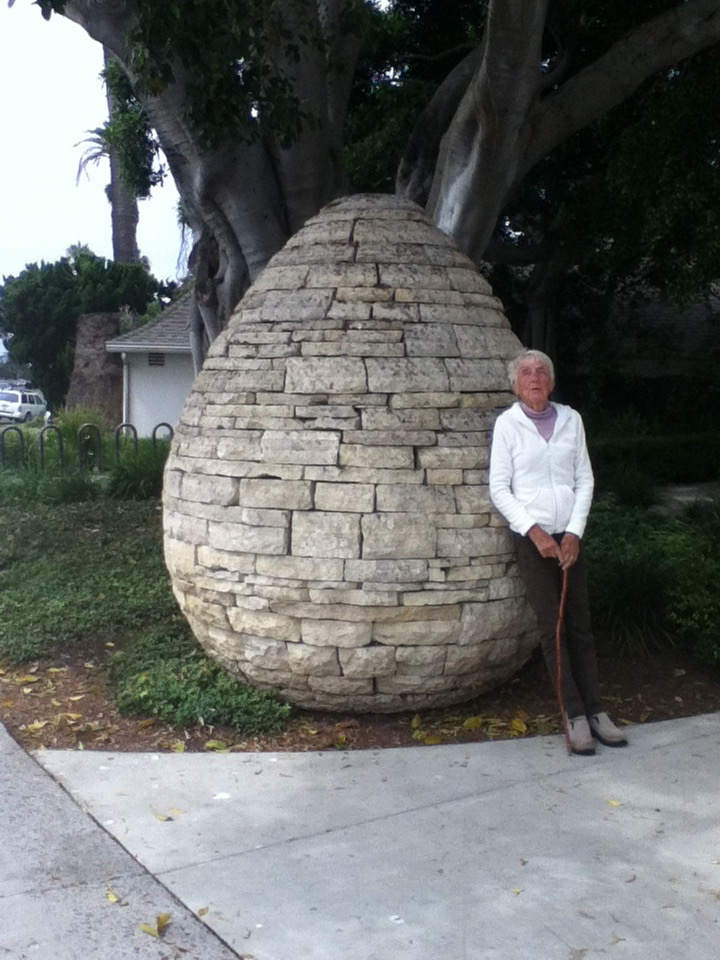
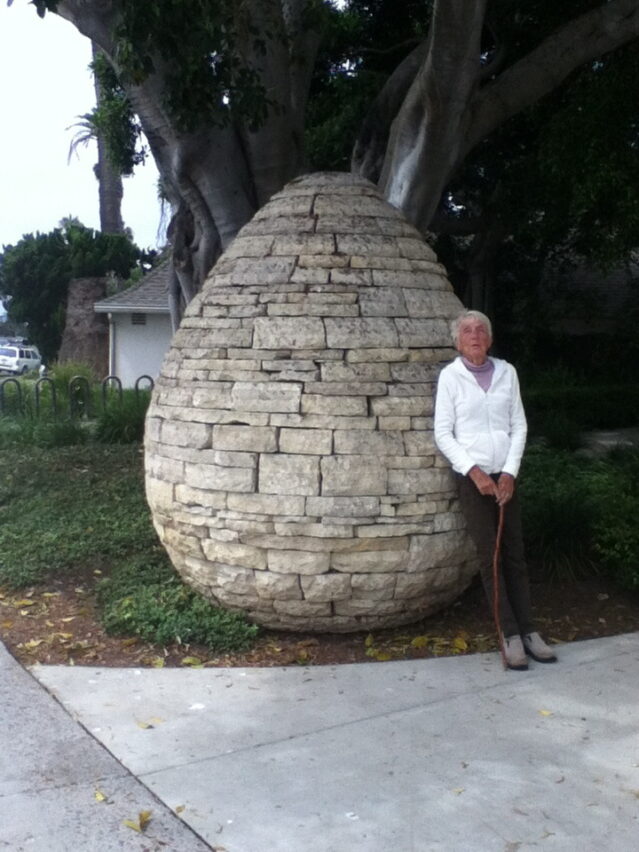
Here’s my near 96 year old Mom sizing up an Andy Goldsworthy sculptural Cairn at the Museum of Contemporary Art in LaJolla, CA. Cairns are markers, to show presence and history. Which do you think is the true Cairn? My Mom or Goldsworthy’s Iowa limestone construction?  I love Goldsworthy’s work, I love my Mom more. She is the one who introduced me to the wonders in museums. She is fading now, though Goldsworthy’s stuff will likely remain for a longer time, it too will not last forever.

Mom and I went into the museum and her most alert moment was comparing her walking cane with one of the guard’s. That was sweet. Two broken pilgrims comparing their supports. Then she was happy to sit on a bench overlooking the Pacific (always loved a good view, always had an eye for the best art in the place). The show on the walls was interesting, but she chose the best view, and then preferred the reproductions on the paper pages of the museum catalogue, tho the real pieces were steps away on the walls. It’s a wonder I can even take her into museums still, that she wants to even go. I mused on the meaning of art as she looked at the Pacific and I looked quickly at the pieces on the walls.

Vincent Van Gogh once said to his brother Theo that the greatest artist (in the whole place) is the One who can work in human flesh. I read that statement while in college and it shaped my future, directing a lot of choices I have made since then. My Mom is one of His canvasses. And He is not done yet.

Go Forth, Abraham

I was awakened one evening long ago. My young Jewish friend wanted to talk about Abraham. I listened out of respect, surprised by her wonder, startled actually by her belief. This was a fairy tale to me, but she held onto it as if it were true. We took many steps that night, one foot in front of another, hiking around a lake, high in the Colorado mountains. I was quiet mostly while she spoke. But that night, something ignited in me because of the words she exclaimed about one man, long ago, who simply decided to trust what God had told him. “how could that be?!” I wondered.

“Go forth, Abraham” is a piece I finished this year. It is an emotive response from 40 plus years of steps for me, in which I have been reminded so very often of Abraham’s example.

I don’t think it is a very pretty piece, and therefore, to me, it is all the more true.
Abram, (renamed Abraham by God), was a real man, a very unique man. He listened. His radar was tuned for wherever there was God-frequency. And when he heard what God said, Abraham took it seriously and he stepped it out. If you read of his life in Genesis 12-25 you can actually follow the learning curve of this man’s developing trust in the One he was aiming to follow and learning to love. Though a Mesopotamian ancient, culturally distant from us, the human-ness of Abraham’s growing trust comes through. It was a real-time process that took decades. And God did real time revealings and interventions into Abraham’s process. The key throughout though is this verse: “Abraham believed God, and it was reckoned to him therefore as righteousness.” Abraham was not righteous, as his history only displays. But God made a call, based on Abraham’s distinguishing characteristic: and Abraham simply believed what God said. This is big. It was Abraham’s believing that accomplished righteousness. This believing Him is a big deal with God; it is defining for us.

Abraham lived according to the promises given him. These promises came in clear when they came, but they did not come often. And so there had to have been so many steps where Abraham was just putting one foot in front of the other, trusting, trying to remember what he had heard, relying on the character of the promise giver. That is what I was thinking about when I made this piece. This is a linear picture of all the heavy steps being made in desert sand, as Abraham moved out trusting. This piece looks at his whole journey. High in the stratosphere are markings: recordings of the words that rumble in his memory and bring light to his heavy soul. There are shining bits that come on the ground: the epiphanies he would tell us of if we could hear his whole story at the end. But a lot of the steps for Abraham as he lived them out, I expect felt dry and hard and shifting under his feet. Each step was consequential. And there is this dark hovering cloud overhead. It is not one that brings rain, but one that brings only darkness and static. Discouragement is hovering not far away.

You will be hard pressed to find a better example of a mortal who risked it all to believe the One he heard speaking. It was not a pretty thing, but it was true. And it ended up being amazing.

I am delighted therefore to highlight this piece for it has been selected to be part of a traveling show called “Scribes of Hope II” which will be making the rounds in the coming couple of years. An artist whose work I have admired, Timothy Botts, was the juror. This is cold wax with metal filings embedded, using also sumi ink and gold leaf; it is on a panel 19×15”

estranged

an offering today. from one of the wisest women I know (though she too, as a daughter of Eve was being held captive. . . for a time). Here is how her heart reached for what she knew was beyond her cell:

pexels-photo-132076-medium“Estranged from Beauty-none can be-
For beauty is Infinity-
And power to be finite ceased
Before Identity was leased.

Emily Dickinson, #147


hope seen

Recently we returned from a once-in-a-lifetime celebration (40 years married!) in London and the British countryside. There was so much to see, enjoy and think about that I found myself writing 13 poems on the flight home, next to my sleeping husband. The low point of the things discovered was at the celebrated Tate Modern, what a sorry disappointment! They did not have displayed what I had hoped to see there, and instead had a shambles of selections in a warehouse kind of a space. It was as if the emperor had been discovered naked and malnourished.

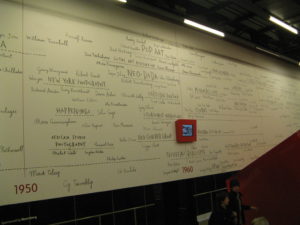
This timeline, which stretched way farther, illustrates the fragmentation of hope and ideas, like shrapnel, that have occurred since WW2. Surely both wars in the 20th century set the ground for much despair in worldview. And the art, especially in Europe that came after, illustrates that. The only interesting work was where a few, like Joseph Beuys faced despair, and articulated it with intelligent concern. Despair alone multiplies despair however, and even more fragmentation. We could not wait to get out of there, actually.

This set us up however to go back over to Trafalgar square, where we had learned earlier there was a concert at St. Martin in the Fields. Oh, what a respite that was! This church has a vibrant understanding of its mission in that city. The concert, mostly Handel, was superb. The sanctuary is where Handel played his first recital in 1726! The crypt below was well arranged for feeding the crowds who come to this place. And they had several art shows going on down there and above that were astoundingly interesting. One grouping, “Odyssey,” was a series of wooden figures done by a Brit of Polish ancestry who, in his search for spiritual roots went back to the land and the trees among which his mother walked as she migrated through the horror of the war. The figures stand as sentries overlooking the diverse crowds in the square beyond the church. They are a silent warning. The other show we loved was “110Faces,” which was a collection of photo portraits of common and not so common Londoners. It was a celebration of the uniqueness, and the amazing victory of diversity in the human image of God that we all are.

And on the portico was a sculpture that was compellingly moving, illustrating John’s gospel chapter 1:1 and verse 14: “and the word became flesh and dwelt among us, and we beheld his glory. . . ” This tied it all together. Though the despair is ever present and remains, His indwelling is the reason there is hope of any substance, and ideas that are worth illustrating.

the strength of beauty

This past weekend, I was at a conference in Oklahoma City. Having never been there, I hoped there might be a chance to see the memorial at the place of the horrible bombing that happened in their downtown in 1995. I saw an image of the site in the airport, but then the rest of our time was cloistered in a hotel some distance from where the Murrah building once stood, where the memorial remains. Death and its markers both draw and repulse me. There is something very big about this always: deep, brooding meaning that requires a direct and lingering look for understanding.
But this morning, back to the airport I had to go in the hotel shuttle. I asked the elderly Hispanic driver, who has called OK City home for 30 years, what it was like for him that day. He told me where he was, and how he felt: both the literal blast and then the emotional aftershock. There was injury upon injury as assumptions and then facts came in. Rumors flew wildly in the first hours, and someone thought the bomber had to be Hispanic. “We were all very sad,” he said, speaking for every person in the city. 19 babies died that day senselessly, and 149 adults had their lives blasted away by one evil action.
I asked my driver to tell me about the memorial. He said softly “it is so beautiful. . . it is so beautiful.” I am still pondering his response. The images I have seen of the chair-like structures in the space have never struck me as beautiful, aesthetically or even as an idea. There needs to be a way to mark it certainly, and to represent each life stolen. He described how there are trees and lovely landscaping all around the site now, and at night there is light emanating from every chair base. These descriptions maybe explain his response, but I think there has to be something far deeper in what he said: “it is so beautiful. . . ”
He says it in pain and in release, in wonder and in incompleteness of understanding. What a wonder it is, that beauty can be strong enough to be a balm for grief, that it even can begin to heal after such wonton evil. This is mystery.

wonder working

That nothing is entirely original has been a subject of interest for years. All ideas, all artwork, all the best of everything that we call “original” is yet derived from things that have preceded it. Every maker of things himself has a history, influences and experiences that set context, and which are partly directive toward what he does that is “new.” The materials he uses were already in existence before he picks them up. In an absolute sense, artists are really only creative re-arrangers. One teacher I had once said that the word “original” has its root in the word and the concept out of origin. Therefore, for something to be “original” it needs to come out of precursors; it is derived from something that went before. Postmodern theory has taken this face on: admitting and highlighting imitation to the point of parody: making “art” that is simply a tongue-in-cheek hogepodge/borrowing in an outright effort to mock that anything could be original, that there even could ever be such a real thing as “art.” In the purest sense, its true: nothing stands alone therefore as truly original, except the very first cause. This is liberating actually. I am a good re-arranger. I am not able to make things out of nothing. There is only One I know who does that.

A short while ago we were in a big Chinese city on Easter Sunday. That day not being any special Holiday there, we were a little out of our element, and missed what we would have been doing at home to welcome the day of original first things, of creative emergence out of death. So my husband and I got up early and walked around taking pictures of the blooming trees. We found others responding the same way. People celebrate when they know they are looking at something wonderful and new, even when it is something they’ve seen the year before. We have so many of these lovely shots, recording the display of color and emergence and beauty. The pixels only remind me of the live moment. This is not pastiche: a patched together borrowing of other things (well, the blooms are not, the building behind it, that’s another story). These lovely blooms are not parody, or the man and his friend in the wheel chair would not be finding delight on the sidewalk. This is simplicity and loveliness and it just sits there waiting to see if anyone notices.