Author Archives: marynees

the wonder in not knowing it all

I’ve been reading several things lately about the surfeit of information available, which consequently causes people to be dabblers or skimmers without any sense of surety. One book suggests that the true future leaders will not be those who know the pertinent facts but rather know where to find them.

When I talk to the Apple help guys about some tech problem that has me flummoxed they try steps toward a solution until they find something that works. I inevitably ask once it’s all solved “but how did that problem happen in the first place?” I’m looking for one action that caused one problem. I want to reflect on cause and effect so that I can understand better. They of course have no clue — there’s any number of ways both to get into and apparently out of a problem. We live in quantum times not linear times and my mind is still adjusting. But the implications are fascinating. One such implication is that every move, even of minute factors, such as the flap of a butterfly wing has consequence on the entire system of organisms that may or may not be measured, yet is sure. Looking for surety? Every move made is part of a complex whole that is constantly in flux, constantly has potential. It seems that while living in this kind of quantum whole, that poetry reaches and soothes our finitely glutted senses far better than any instruction manual can. And some visual art is poetry. There is something that captures my attention with a gestural stroke far better than a detailed drawing. There is a wonder and a surprising beauty with how ink lays down on surface that draws me into the journey. I am no longer after perfection. I am after participating in the wonder, and wonder leads me to the answers my soul has long craved. If on the other hand I just manage life as an information arbiter, I have resorted to being only a button pusher, a mouse clicker; I am just skimming through. There is a poverty in this kind of thin external living that is soul deadening. I will never know all I need to know, and the illusion that I ever could is just as damning as the alternative. But wonder, child-like, is the beginning of something else.

learning in community

A couple of my students from Spring ‘09 Color Theory told me that they loved the experience of community in their art classes. This interests me. To them, the chance to work together or along side each other with some tricky projects, to discuss and critique in developing relationships over time was a neat part of their growing college experience, and highly valued. I come from such a different time than these kids. When I was in college independent thinking and solo learning was expected. To come up with conclusions as a group would have been considered somewhat suspect, sloppy, or at least auxiliary to the more important solo work. It was every man/woman for himself (as if individuals on their own have all potential access to higher learning). I am changing my mind as I watch what happens when students get engaged and start problem solving together. There is a dynamic there in a group that seems larger than the sum of the parts; that is an exciting synthesis of possible outcomes in newer ways, and students emerge having caught things the teacher does not even yet know. I did have an unusual bunch of great kids this past term, I even thought several times, “maybe I should quit while I’m ahead”, for it is a lot of work anticipating and then evaluating with this kind of discovery approach to keep it still on track. But forged relationships move beyond the classroom and into life. This really interests me.

Continued Leaning in Community

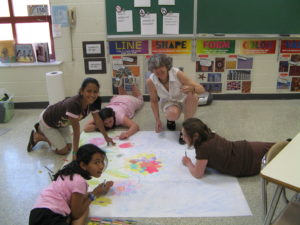
I tried the same group approach to problem solving with some of my after school kids in a local Elementary School. We had 45 minutes to make a mural that showed what the group wanted to communicate. They swang into action, and what was fascinating to me was how they synthesized content quickly, coming to their own ideas and moved into tasks. Leaders emerged, specialists took their part and started to shine, helpers got joy in being necessary, and everybody had fun. Time stopped here, and we ended up with something that was the fruit of collaborative work that can never again be repeated. I expect the lessons learned there were more than just mural coloring.

I am also involved this summer with some adult learners, who are practicing ways to be better facilitators. It is the same thing I’ve been seeing happen with the college students and the grade schoolers. Get them involved, get them dialoging, get them trying and testing, and making mistakes and then evaluating. We can do this because we have a certain freedom to explore, AND a confident expectation that discovery is possible in a world where natural things can progress. It seems the very best learning happens this way. And as a teacher, I can facilitate this best when I am confident that the material can be tested and pushed this way and that, and still the authoritative kernels will sift out and show up, now all the better apprehended. This is an adventure of confident hope.

Hope, with strings attached

We’re living in a time now where the word Hope is hot. It was the theme of a political campaign that won a young man the Presidency. Now he sits precariously as the harbinger of hope. I pray for him with all my heart. I pray to the only One who gives me hope.

Hope is like a helium balloon, it is lighter than air and all too quickly can disappear, even as the Greeks feared that hope’s companion is that inevitable foe: Delusion. Hope must be tied to something to really be able to stick around, to have any verity of reference, any true sustainability. So, one of the strings that holds my balloon is grounded to the true Giver of hope. The other tie (and I’m not sure yet if there are any other strings, but these two are enough for me) is time: Time is the context for hope to have any meaning at all as a word and as a concept. I hope because I live in time and my present time causes me to hunger with hope. Hope is a real thing because I am in the not-yet time of what hope looks to. Anticipation is sweet if it is grounded in something real that I am beginning to taste and understand.  The string I hold leads me to the sight of that lofty balloon. There is something there and I can almost touch it, I am munching on an hors d’oeuvre and that is why I can hope. The compound word in French literally means “outside, the main work”. Hors d’oeuvres sustain the guests until the meal, the “real work” arrives; and these hors d’oeuvres are said to increase my appetite. These are concepts that only make sense if there is such a thing as time. Time’s stretching out and its restless, yearning ambiguity are context for true hope. Because of time, I can learn and experience hope. Without time, hope makes no sense and is meaningless.

Here is a rich quote about time from a book I am presently enjoying:

“Childhood’s time is Adam and Eve’s time before they left the garden for good and from that time on divided everything into before and after. It is the time before God told them that the day would come when they would surely die with the result that from that point on they made clocks and calendars for counting their time out like money  and never again lived through a day of their lives without being haunted somewhere in the depths of them by the knowledge that each day brought them closer to the end of their lives.”                   Frederick Buechner The Sacred Journey, p.10

Speaking of Motherwell, and Art’s Intention

I was recently over at the Turchin Center for the Visual Arts in Boone, NC to see the exhibit “Lost in Form, Found in Line”. What a treat of imagery that was! Since I first was exposed to his work years ago, Motherwell has interested me; and then the more I read of him, my visual perceptions were confirmed that his work was not only attractive visually, but important conceptually. He was a thinker. I think he was also a paradox. For as was true amongst all the Abstract Expressionists after World War II, Robert Motherwell said that his work did not carry meaning. Yet his working process involved a lot of serious thought, considered musings, was often prompted by text. So his protestations about specific meaning often seemed disingenuous to me, the political correctness of his own time. Surely he was protesting the insult of casual viewers’ assumptions, e.g. “I see a duckie and a fishy”, when looking at his or anyone else’s non- representational work. He said that the subject of his work would emerge undirected “out of an interaction between myself, my I, and my medium.” But he also often admitted to big themes. One of his biographers, Jack Flam, says that Motherwell “wanted to create an art that would deal with the universal rather than the specific, yet be charged with feeling.” Motherwell often started with an idea. Then that idea got melded in the creative process, yet remained the idea/now feeling nonetheless, for he considered every mark, even buried under newer layers, part of the work’s important expressive history. Is this not then communication? Is this not then the embodiment, however shrouded, of some particular meaning?
I know for me, the first time I confronted abstract work at the Art Institute of Chicago when a teenager, I assumed immediately that it was coded language. It was not simple, but it was fascinating and even beckoning to me. See an example here. Now, I have been teased by an artist friend that I am looking for meaning everywhere. Actually, I have decided this is not such a foolish thing, for art is ultimately another human language. It is enculturated and wholly nuanced certainly, but it is a form of communication, I am convinced. Bird tracks on snow have meaning, even if the bird had no intention. How much more the marks of humans. The impetus to get out the materials and create starts with some kind of intention in mind, however small or unformed. Our marks leave a trail, and even trails that lead nowhere carry some inherent meaning.

(above image is “Elegy to the Spanish Republic, No 110”, accessed off Bing)

On Hope-first thoughts

I am by genetic temperament, and fostered by early upbringing a pessimist; yet my work is said to be filled with hope! This to me, as I stand back and look is a complete surprise- “a huge contradiction,” I critique myself. Or, maybe better reckoned as an intervention – that is, there is something else that is working inside of me. Indeed, hope is the thing that gets me into the inks at all. Sometimes there is this inevitable agony – every artist I have ever spoken to attests to this agony. I love how David Bayles and Ted Orland summarize this in Art and Fear, “Basically those who continue to make art are those who have learned how to continue – or more precisely, have learned how not to quit…art is all about starting again.” So, there has to be hope that is dredged up from somewhere, or every artist would simply have no choice but to quit.

The Greeks considered hope dangerous. Indeed in the myth of Pandora, when the box was opened, there were released all the evils except one: that being hope. Hope was protected from release for its risky companion was delusion. However, in the end, Pandora had to release hope because otherwise humanity was filled with despair. To the Greeks then, hope must first have been considered an evil, which when weighed on the scales opposite despair, was bartered from evil to good.

Emily Dickinson succumbed to the risky business. And she heralds it this way, “Hope is the thing with feathers – That perches in the soul – And sings the song without the words – And never stops – at all.” I can identify with this thing that sings inside (and I didn’t put it there, I simply can’t make this happen). I share resonance with the words first penned by that serious and solitary woman from Amherst. It is an intervention, and it strikes me with awe. This is a core thing.

.
On Beauty (or, fools rush in where angels fear to tread?)

I have thoughts that roll around and confound me both before and while I work. (Robert Motherwell said, “When I am thinking, I am working”). And one of the things that really interests me is this illusive thing we have named Beauty.

I remember once walking along on a cold sidewalk, heading somewhere, with some plan in my head. On my left was this ordinary bush. The sidewalk actually went around it. I happened to look up at this rather obtrusive dark green thing, and suddenly was caught to a dead stop. For there were these delicate clusters of tiny silvery-blue orbs all over this thing. They were astounding, and so winsome, and they brought me to tears, right there in the cold.

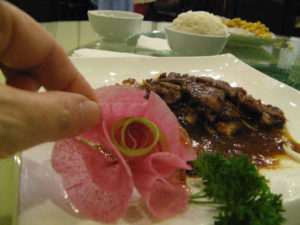
Here is a photo I took this last month, while at a meal with some friends. A Chinese radish had been carved to reveal this delicate surprise. It too was winsome. And inviting, It is made of just the common stuff from a garden, and yet it has been made with care, and anticipation, and just joy! Maybe the crafting of beauty is just like this. We start with the stuff that’s just hanging around us, but there is a remaking with anticipation and delight. And the result is so much bigger than the crafter can even know.

Beauty is not the meal, but it leads me to the meal. Beauty is like an usher, a silent gentleman who offers his arm. I am at the back of some important gathering, and I am not sure that I am dressed right, or not sure where I should sit. I am worried that I have arrived too late, I am thinking about all this mundane stuff. But beauty comes up alongside me with welcome on his face, and he ushers me in.

Beauty humbles me, and yet it does not win my humility with dominating power. It captivates me by it’s profound and winsome silence. And there is this mysterious ache I am left with after an encounter with beauty, that there is more coming.


Past Present Future

Welcome to my new webpage. And thanks to my daughter Betsy, who understands computer meta codes, and put all this in place so beautifully for me. I plan to use this blogsite to record musings that relate to the visual work I do, and will do.

I had a dream last night, and in it I was finally weeping. My husband, oldest daughter and one of her childhood friends and I were cleaning up after a party in our old neighborhood. I was folding the table cloth together when it all hit me. Years of hard and earnest work were coming to an end. All there was to show, it seemed, were crumbs on the floor.

I am reminded as I ponder this now of a story that always moved me deeply. Jesus, after feeding thousands, asked his disciples to go and pick up the leftovers. And, it is recorded for us in all four gospel accounts, as if this accounting is important, that there were 12 baskets, each full of broken pieces. Why did Jesus instruct them to gather the fragments, what was there in this for them? I remember thinking once, while living in that neighborhood, that the greater miracle would be if each soul had been fully satisfied just as the last piece of bread and fish had been consumed. Why are there fragments? Why is there a mess on the ground? And why do they need to gather it? And why does it fill 12 baskets?

It seems to me in this telling that the event is not just about the present tense feeding to assuage physical hunger. They were definitely hungry- these crowds of people;  Jesus felt compassion for them, and acted. But there was more He was doing there, and the disciples would not understand it until later. This story for me has held an aching wonder. Those piles of broken pieces, of leftovers, filled a very specific number of baskets. There is a symbol of future completion in this that superintends the present mess on the ground.  He knows what He’s doing, even in things that look to me as very undone, even wasted. My work is about this wonder in the midst of brokenness. I can hardly, in fact, I cannot explain in words the deep hope that rises up in my own soul when I am fed, and my heart is again lifted to believe from this broken ground. It is a hope that is rooted in accomplished work in the past, that carries me in the present, and that will be fully realized even later still.