Author Archives: marynees

overlook

Philosophically, and very personally this is an important word for me, more than I even understood. OVERLOOK. You will sometimes see signs that beckon you to pull over, for there is an incredible view coming up behind the trees blocking your vision. Overlooks give us that opportunity, but you must stop to see them. I have been enchanted by the big overlook for a long, long time; am coming to see reasons why in ways that are deeply satisfying and spiritually stretching. I remember a lecture I heard over 40 years ago about the Hebrew prophet Isaiah. He was a visionary who was given vistas to verbalize that were greater than he felt he could capture. He was a big picture guy. His words skip over the peaks of time, they run ahead, then linger back with comfort, and other times with terrible disruption. Time conflates in Isaiah’s visions. Assurances are way, way beyond him but he sees it! He scribes what he is given with his own unique voice.
I read just this morning this wonderful bit from chapter 26: “Lord, Thou wilt establish peace for us, since Thou hast also preformed for us all our works.” It is already done, according to Isaiah, even as it is yet to be done.

Also I saw this morning this wonderful statement from the wise thinker, Ravi Zacharias: “Enchantment needs a mind, and the emotions are given as a wellspring” he said this as he too was contemplating beauty and wonder. To be enchanted, especially in the times we’re living in, one must exercise the mind with true vision. Unlike my spider (last post) I have some equipment (a mind, emotions and a will) that give me the possibility of seeing and sharing wonder! We have to stand back from the messy things (some really awful things) however, and take the longer view in. I recommend Isaiah (but he is not for the feint of heart!). Or just open your own eyes with some humility. There is reason for expectation for there really is a daily vista right in front of every one of us. Oh, for eyes to see! And for skill to get it down.
the question of beauty

When I was in high school, I had a remarkable teacher in a world history class. I remember his name (and wonder if he is still alive). I cannot remember any of the exact words or streams of thought in his lectures, but I remember how his ideas ignited things inside me. He spoke about the question of beauty, this in the context of worldwide movements of upheaval (!) and without dropping packaged answers into the hearts of skeptics, he left at least me wondering. . . what exactly is beauty? Why do I respond to certain things and not others? Could there be a code of meaning here that speaks beyond language and culture and time? This further fueled a life long interest in art, and in the meaning behind things.

This morning I watched as a spider finished her web. She had several strands tied way beyond her tiny body up to the gutters of the house. Then she had one tied to the Laurel bush, and another anchored on the Japanese Maple. She swayed in the beautiful center of her fragile trap. Her brain, or instinctive operating center, or whatever she has that makes her move with such deliberation, has to be no bigger than a pinhead! How does she do this, and can she possibly know the beauty here? She certainly cannot see the bigger picture of what she has constructed. And it’s a trap of death for goodness sake! There is something bigger that has set things in play that she has no ability even to imagine.

And so I continue, my pencils making webs, my brushes searching with color, my tiny awareness of the things brewing worldwide at great disadvantage. This same morning I saw this in Psalm 2: “Why are the nations in an uproar, and the peoples devising a vain thing?” And I realize that before we can really handle answers, we have to be somehow startled to grapple with the big questions. And beauty, it seems to me, is one gentle way of walking us there.

plotting next steps

Unusually tired today, but thinking ahead. I was exhorted this summer about the need to draw every day and I am aiming to. I have minimized drawing as facile, but am reconsidering that dismissive attitude. Drawing is an easy entry, but important exploring that sets the stage for way more considered painting. I whipped out several large monotypes earlier this month and I think the drawing may have set the better stage for that. More to come.

dancing memory

Yesterday a generous friend let me use her fabulous intaglio press. I spent the entire day inking monotypes and dancing to music in her perfect little studio. It was perfect timing too, for today a curator from the University had scheduled to come over to see some new work for a Fall show she is planning. I was glad I had some really new work to add to other things she wanted to view. The ink was still wet.

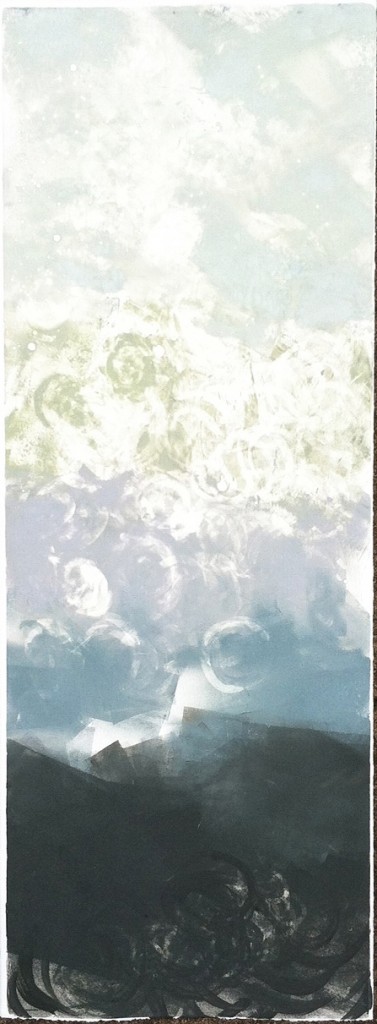
I have a series I started in ’07 called “Core Samples.” The idea that interested me behind this is what geologists do to test the hidden parts deep in the earth. They drill down a tube and grab up the layers of sediment, exactly as they have rested unnoticed for centuries. The layers are a record of time and passages, even the decaying of many organic things. The vertical pieces I have done recall this geological practice, but they are really landscapes in a sense. They are to me inner as well as outer landscapes. Landscapes I have come to understand are important work, or they can be. The Chinese have been doing sublime landscapes for centuries, and the best of them are not pretty pictures but worldview statements about the position of man in the grand scheme of wonder.

What I am posting today is one that I inked up yesterday. It is a direct response to what I wrote last time about the images that showed up in my pocket. I agree that the photo images I somehow gathered on my hike are better than this core sample representation. However the inked semblance reminds me of the gift of that day and is therefore a record of joy. I used an old racquetball of my husbands as a drawing tool to make the marks in this image. I hope you can dance with it too.

given glimpses

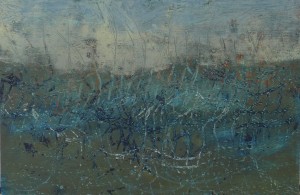
I offer two images today that I did not make happen. We were on a hike after two solid work weeks. We were aiming to take a rest, some re-creation, to gather some beauty. I could show the images from the waterfalls, or the lovely plants along the path, of my grandson’s smile, of the big Lake Superior’s sunset. . . a feast of beauty; but it is these shots that really deeply spoke to me. They are not even pointing to anything concrete. They came unsolicited into my iPhone. The device must have remained on, while inside my pocket in between my grabbing it for a shot. Somehow the little wonder of my phone kept clicking away and there were maybe 20 of these frames that day, some intensely beautiful. I am removed therefore from the selecting of these. I just get to enjoy them. The shimmer and the glimpsing of light through the fabric of my nylon pants, is like a gift I did not expect, as I walked the path.

Around the same time I was reading Frederick Buechner’s “Magnificent Defeat,” and also pondering the words of Peter’s first letter to struggling Christians. Rich words those, from two mentors. Peter encourages hard choices in hard places, but does not assume this can ever be done alone. He shows the enabling example we have, he tells of the rewards coming and he reminds that it is possible “if you have tasted the kindness of the Lord.” I have been holding onto the sweetness of that phrase and what it points to, then seeing the evidence right inside my pocket.

quickening

So often I feel I am at the beginning of new, untested things. My active faith is the only thing that checks me from the despair I sense so often clouding around me. My heart responds to glimpses and quickenings. My eyes sometimes catch a beautiful flare, and then something deeper seems to move inside me like little wings. I am so glad to be a woman for I know already what that is about. I am eternally grateful to be anchored to Jesus, because there is nothing that is going to come down that He will not use as material toward the final resolution. It’s all His. This quiets me.

I have been reading Robert Henri too. This art teacher from a century ago has much that still resonates. He said that all art speaks, that all art (good art) is like sign posts. How come I never read this guy before? I believed this before and after it was fashionable. It probably still is unfashionable, who cares? I care. I hope to go to dust caring. I hope to record some of the signs before that. Henri taught that students would better craft if their model was in another room, so that they had to place on their canvas only the sense of what moved them from within as they had interacted and been pressed inwardly by the outer model. He was trying to train them away from copying and move into deeply mining the sensibility that was theirs uniquely. That is good advice. This prompts me then to post two little studies for comment.

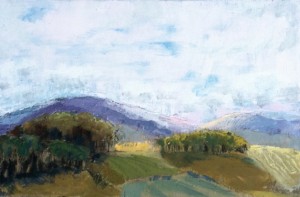
This first I am calling for now: March Vision. It arose out of views that fed me as I drove through Southern VA in March. I wrote about that previously. This is the best I have of that so far.
This next study I am calling April Gesture. This took one fourth the time of the other one, it happened on site and as can be seen, very quickly. I have some opinions about these pieces, but I am going to hold them in check for now, for I am not sure yet what is coming further from this kind of work.

casting

My husband likes to fly fish, and we carved out time to fish and paint together. We are so fortunate, that we live near such beautiful places to do what we both love. Carving out the time together is the task, and then we wonder again why it took us so long. . . anyway, what he usually does is cast, catch and release. What I do is cast and try to capture! I laugh often at his ability to give up so easily what he has worked for, but then I often end up doing the exact same thing. We are both on a silent quest. This activity is much more than the result that either of us comes home with. I love this photograph my husband took because even here he is selecting and searching, more like an artist then a fisherman. I am in the center background sitting on a rock, working on a small watercolor sketch. He composes his photograph nicely, such good color too! The image says a lot more to both of us than a viewer might see.

An art critic I resonate with, James Berger, says this same thing better when he defines the act of drawing. “Drawing is a form of probing. And the first generic impulse to draw (to fish? to paint?) derives from the human need to search, to plot points, to place things and to place oneself.” We are in fact both doing just that when we go out and work: searching, selecting, plotting and placing. That is why we can come home filled even when there is no concrete result. The activity is accomplishing something deeper.

This past week also, I attended the art showing mentioned in my last post. Stephen Wicks, curator from the Knoxville Museum of Art gave an engaging talk about the collection he had assembled, and even highlighted my two pieces with prescience. I spoke with him afterwards to thank him and gained even more, for he said something like this ‘Your work is not just about the collection of color, isn’t it; there is something much deeper going on.” Oh! How encouraging for me, he could not have said much else to propel me further.

Meanwhile, the watercolor piece I laid out, painting by the stream has since been gessoed over. (The paper was worth more than my result that day!) But the morning was memorable, marking both of us. We were both casting for what we knew not. I think we captured something that day; nothing got away.

gathering

I have been doing an inventory of certain supplies and gathering several new hues and panels toward a workshop I will be taking next month; investing toward meaningful production. Just spending the money is hard. It must be a work of faith and hope too. I want to be stingy, and make do; but I also know that unless I am ready to give it up again, there will be no worthy result out of this studio. The whole process is another reminder that this slog is hard work emotionally, physically, every which way. Sometimes I think being an artist is like being a glutton for punishment. (I used to think that same thing about raising teenagers, another rare art form of faith and hope). Now that the teenagers are grown and I get to do concentrated work in my studio, I guess I need to remember that it is just another form of the same battle. It is battle. So strange, that something so fun could also be so perplexingly hard! Willa Cather said “Artistic growth is a defining of the sense of truthfulness. Only the great artist knows how difficult it is.” I am so encouraged by that statement. For it was in the raising of young people and in the working of art that truthfulness is one of my highest motivations. One of my kids just said to me last month “…that’s because for you Mom, truth is such a core value.” Hearing her say that over a difficult thing we were processing, was very satisfying to me.

So I am pondering a lot of things today: the hard battle, the investment of hope needed in that battle, and the spine of truth that enables any real progress. We’ll see what comes of this next month. Meanwhile, I can highlight here a small cold wax panel that got selected into a good local show. This is called “Unseen Working; Gathering Undercurrent.”

Around the room

There is a small chapel in a cemetery in Minneapolis that is truly remarkable.  Styled after the Hagia Sophia in Istanbul, a very early Christian structure, this referencing chapel in Minneapolis is a jewel box.

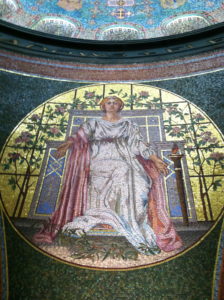
The interior mosaics are stunning, crafted by Italian artisans, who pieced over 10 million tiles into visuals! It is said that this interior is the most perfect replication of Byzantine mosaic art in our country (that’s not saying much! But this work easily rivals the mosaics in Ravenna and Venice). The focus of all the decorative work is the placement of four large personifications, four graces as it were. These represent MEMORY, FAITH, HOPE and LOVE. Each personification is labeled so the symbolism is not missed, and each figure is over 7 feet tall. Clearly the personifications are placed in a definite and progressive order from the front left of the chapel around clockwise to the back. We remembered my Dad before his burial from this chapel and now my Mom.

The beauty of this entire space is incredible and of course therefore a tonic in grief for so many who pass through. I am struck by how these four personifications summarize the process of valuing a life, no matter whose life. These were placed to be a visual tableau. One could miss their instructive value even while noting their incredible visual power. When my Dad died in 1985, the events somewhat blinded me from pondering these. But I remember the beauty and I kept the brochure. Preparing for my Mom’s funeral, I spent time considering the import of these four personified ideas: Memory, Faith, Hope and Love. These words and images corresponded with, and reinforced some important reading I have been doing. Mom would have loved the discussion in her more vital years.

MEMORY: I miss those years with Mom and have so many good memories of her significant mark on my life.

FAITH: Mom became a woman of faith in her mid-fifties as a result of great trauma with one of my siblings. It was the significance in the suffering that Jesus accomplished that got Mom’s attention, and her allegiance. She went from being a casual churchgoer to a hungry believer. These two ideals, Memory and Faith, my Mother accomplished so well.

HOPE: The back of the room reveals the potential of life’s journey after faith has been grasped. Hope springs from faith; it is a sure confidence (the word is a compound that means literally “with faith”). True Biblical hope is grounded in what has been accomplished to buy our rescue. Jesus now promises to bind up the believer’s wounds, to make final sense of every sorrow, to deal justly with every evil, and to lift us out of our own death in time. This is not empty wishing; it is solid unseen trust.
LOVE: This last idea, pictured here, is the greatest.  Yet it is not prominent; it almost sits shyly in the back until noticed, until mourners are walking out. Love is realized after lived-out hope. The gaze of each of the personifications in the room is noteworthy: Memory ponders, looking downward. Faith looks intently away. Hope looks upward. Love alone looks directly forward. I am most moved by this. She looks right into you and keeps on looking. She is straightforward, while gentle. She is at ease but also very courageous. Her gaze penetrates time: past, present and future. I know few who practice love like this. I know only One who lived like this.

fragile return

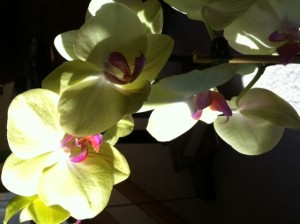
A friend gave me this lovely plant as I have been grieving the loss of my Mother. Yellow was my Mom’s favorite color. Mom would have enjoyed seeing how lovely this is, such a tender reminder. I am not a great plant person, so I hope I can keep this alive to bloom again. It is so interesting to me. These tender orchid blooms emerge out of long tendrils, pencil-like stalks. And the long blooming stalks (which look like nothing when they appear out of the base of the much showier leaves) need to be supported as they lengthen. For it is out of these emerging outgrowths, that the beautiful blooms finally appear. Someone else set up the support on my bloomed stalk. I am told that without that support the bloom simply would not have happened.

Friday, I received back a huge box from the Monotype show in Massachusetts. I have been traveling, so I forgot about this simultaneously traveling piece of artwork. It was neat to have my piece “Selah” come back to my door. I had set up return shipping, and without any more effort, my piece came back.

This whole paradox between effort and supplied reward in time has me musing. And the reality of fragility…That anything so beautiful exists for any length of time is quite extraordinary here, it seems to me. My heart feels as fragile as these blooms. But I can feel the support right inside my heart.

Embodied wonder

A friend of mine took a shot of a sculpture while in Lisbon, a bleeding Christ. The image has had me thinking.

Like the transmission of real physical color to pixels (last post) we have difficulty grasping the deep significance of that which this wooden image represents. As a young adult, this event: Jesus being hung up to die was sorry failure. At best, Jesus to me was a good man taken down.

What I missed was that he had laid himself down, that this excruciating choice was seminal to his whole long prefigured rescue plan. Something significant gets lost in translation. We see politely, but are blind. In fact, agnostic presuppositions, or even religious inoculations often prevent us from appreciating this single greatest act of love ever accomplished. Think of it: the Creator submitting to the scourging and the bindings of mortals. Can you name for me any other god who gave up his life, in ransom for his subjects? You simply cannot, for there is no other, and we would never have dreamed up such a preposterous idea. ‘God would never do that’, we say confidently (as if we know what God will and will not do). Maybe like me your first instinct is rejection at such condescension. Yes. We would not do that.

The attempt above his head, in this sculpture, to represent his deity is lame to me. It is to my eyes a pastiche, like some misplaced party decoration. But I wonder, how would one show such a holy free-fall from deity into dust? The blood that one dark day was very real however, it was not a dramatic effect. It was bright and pulsating with the perfect purity of God Himself. Maybe this is what moves me most in this piece. The blood was red and sticky, messy as it was mixed with DNA that tied back to Abraham, back to Adam. . .and even also back to God. The blood did not rise in some holy cloud of exemption; it was subject to gravity and fell, like we all do, to earth. His flesh was warm like ours is, until He gave up his last breath. His character was on display all the way through. Only a few had the courage to open their eyes to the desperate wonder, and even they were not “getting” what was happening before them. Only a few still care to consider now. We whizz by, not noticing the emergence of deep hope here.

If God really did this, in a physical body, what does this say to me, in my body, which is vulnerable, graying and frail?

If God loved this perfectly, this selflessly, can I ignore this in my own attempts to make life work?

If God could do this in hope toward the coming resolution of all things (true justice coming), then what on earth or in heaven am I afraid of?

“God made Jesus who knew no sin to become sin on our behalf, that we might become the righteousness of God in Him” 2 Corinthians 5:21