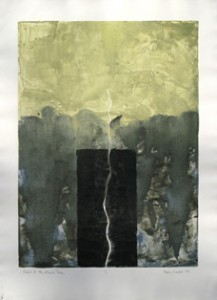
Author Archives: marynees

Achor

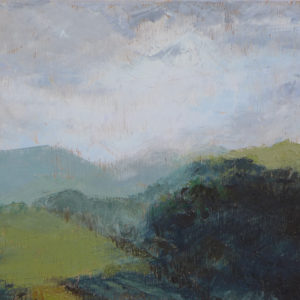
Achor, a Hebrew place name, literally means “disturbance”, or “trouble” for the town named with this word was in a border valley toward the wilderness that was often vulnerable. There was a reason in Israel’s past why the town was originally named “trouble”, and there is reason given by the prophet Isaiah for the future when the town will no longer be a place of trouble. But between that past and our future there is the plodding forward in our own valleys of trouble. We seem to have many of these valleys, and they seem to be claiming more of the landscape of our souls. Do you sense the growing dis-ease? Many I know are forcing smiles while privately worrying. The times we are in are remarkable. A plane goes missing in Malaysia and is immediately assumed the casue when a building explodes in New York. People are on their edges.
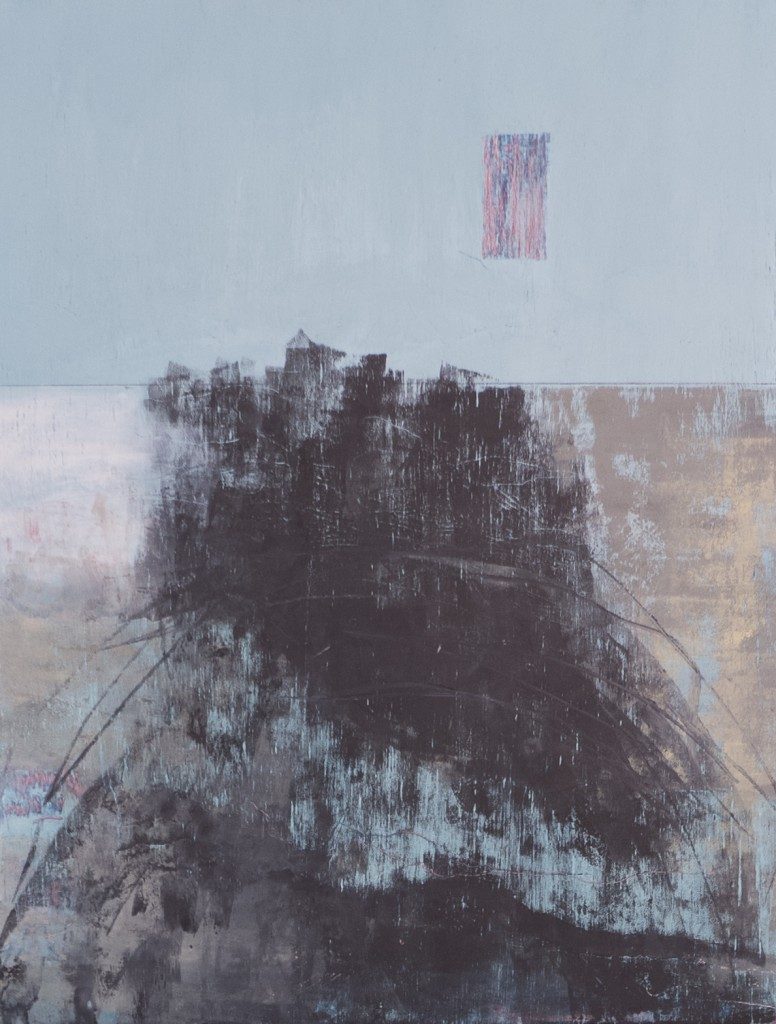
Hosea, another Hebrew prophet spoke of Achor too. He proclaimed that God was saying that for those whom He/God would draw out into Achor, that the place of trouble would become “a door of hope” (Hosea 2:15). What is happening on the ground, that you see and you feel is not the only reality working. In fact there is a super reality working even as I type. And it was working as I painted this piece. I started this panel in 2012, and it sat as an idea but an unresolved composition. I had to sit with it, not despise it, consider it and wait. Then this Fall, after seeing another visual prompt that moved me, in a burst of action my own work came to completion. I knew immediately when it was done.
spending time

Enid Williams juried the Appalachian Art Show this year. Her statement about her own work is interesting: “I rely on a complex ordering of form and color to create elaborate visual scenarios that appear to be in continual flux. There is little evidence of pictorial hierarchy, instead the optical effects create an ambiguous space, both undermining and heightening our desire for logic and order. Although historical and cultural influences inform my work, charts that test for colorblindness served as my initial inspiration. I find a certain irony in this source, as the charts are quite beautiful in their own right, and the viewer is persuaded into a longer examination in order to”read” their content.

Fortunately for me, Enid spent time with one of my entries in this year’s regional show, and gave me an award. She had this to say at the end of her juror’s statement:
“Finally, Mary Nees’ ‘Achor,’ creates intrigue and mystery through a complex networking of marks and densely layered inner structures. There is something very satisfying in works that are carefully titled, (and) can be interpreted in more than one way. Place is no longer literal in Nees’ modestly scaled panel, and this is part of it’s strength.”

Here, both my entires are being viewed by another artist friend, doing what he does well: spending good time.

a manner of speaking

Emily had me in tears this week. I cannot wait to meet this woman once we are both behind the veil, when we “wade in Liberty” as she puts it. What a gift of words E. Dickinson had to hint us there, what a manner of speaking. Here is one sample I recently came across, #276:

Many a phrase has the English language—
I have heard but one—
Low as the laughter of the Cricket,
Loud as the Thunder’s Tongue–

Murmuring, like old Caspain Choirs,
When the Tide’s a’lull
Saying itself in new inflection—
Like a Whippoorwill—

Breaking in bright Orthography
On my simple sleep—
Thundering its Prospective—
Till I stir and weep—

Not for sorrow, done me—
But for push of Joy—
Say it again Saxon!
Hush—Only to me!

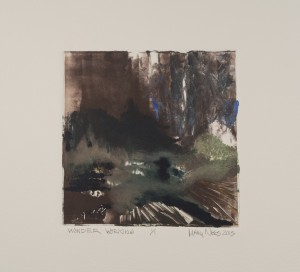
Here’s another monotype I did in December and titled in January, “A Manner of Speaking.” It is that similar sense of language (though not English) out there that is continually speaking, if we will look and earnestly consider, for joy and for healthy weeping.

wonder working

I am thinking often these days of the prophet Habakkuk’s dilemma. He cannot abide what he sees around him, and when he complains to God he gets an answer right back. “Look… Observe! Wonder!” because I am doing something in your days. “You would not believe it if you were told.” God’s reply to the struggling seer opens a world of potential. It is there for the asking.

This exchange calls for some humility however, at the very least. If a Hebrew prophet, with an up close and personal relationship with Creator is told he would not believe specifics as to what God is presently up to, how do any of us think we can assume otherwise? The wonder here to me is that this clueless one gets an answer. There is wonder even that he had the temerity to ask and to expect an answer. There’s wonder in that he is given then a lot of detail, and when he asks for more he gets it. God does not wait for the prophet to have it all together before God lets him in on some of the wonder-workings. And wonder, this pregnant tension, is admonished by God. “Wonder!” Take time, while you still have it (it’s a gift), look around you (there’s much to see and learn from). Observe and be astonished, for Creator still exists and there is very much yet going on right now on this breaking ground.

This piece is entitled “Wonder Working.” It is one of my favorites from a series of monotypes I pulled out in December. It reveals the dynamic tension, the surprise midst the darkness, the softness hovering, and the entrance of the unexpected.

seeing value

I was in a workshop this past week, with a very able instructor. It is not easy teaching abstraction well, but she was a great model and help to me. I have come home now seeing value studies everywhere and I am sure it will affect my work, already has. Value, color, line—the basics. These are the kind of fundamentals we teach in beginning art school classes, that athletes speak of, kind of “here we go again” only better this time around.

I moved past a counter and got caught by the beauty just sitting quietly waiting to be noticed. A shadow reminded me of a great phrase I’d recently read from Emily Dickinson’s poem #132 “… and shadows tremble so—“

This I am realizing is an exercise in joy! Listen to this echo from Henri Nouwen “I am tempted to be so impressed by the obvious sadness of the human condition that I no longer claim the joy manifesting itself in many small but very real ways…” Joy is not denial, but rather a chance to see what’s really real. Value is found in the common made celebratory. Real things representing, hinting at, suggesting so much more.

speaking the spire

I have been back to reading Emily Dickinson. My vain resolution is that if I simply read 5 of her poems a day, I can get through the complete collection in a year. Try me.
She has a similar aesthetic sensibility to mine, though from a much simpler time, I am afraid. She worked in words, but called out imagery. She looked hard, she mused deeply and she took great courage from simple glimpses out in the natural world (landscape). Her hopes and her struggles were anchored, again and again in her childlike, sometimes whimsical trust in the Words of her unseen Father. I have actually been mining some of her apt phrases for titles of my own images. Here is one, “The Twilight Spoke the Spire”

Here is that whole poem, #1278

The Mountains stood in Haze—
The Valleys stopped below
And went and waited as they liked
The River and the Sky.

At leisure was the Sun—
His interests of Fire
A little from remark withdrawn—
The Twilight spoke the Spire,

So soft upon the Scene
The act of evening fell
We felt how neighborly a Thing
Was the Invisible.

between Heaven and Earth

I shot an image yesterday as I was hurrying to pack up and deliver some work to a gallery. I did not want to bother un-framing it, so I just snapped a quick pixelated record through the glass. What is cool though, is that you could see me shooting in the reflection; it’s as if I live in this piece and indeed I do. This is a simple sumi ink drawing, entitled “Between Heaven and Earth.” It shows the far horizon, it shows the expanse of air and ground, compressed symbolically on a 2D surface. it shows the tangled vista that must be got through before the horizon. It’s all there; it seems always to be there.

2013 was a very strange year for me emotionally, there are reasons for that, but to me the more important thing to talk about (and to do in my art) is my response with what is all broken on the ground. How do I see clear? A couple times this year, I heard myself slowly saying out loud “I do not know how to think about that…” Indeed. I can think a lot of stuff through but some deep things are beyond thinking and full understanding. Maybe this is where art becomes such important language for me, even as I grab and go with it sometimes (like in this quick shot).

If my little drawing sells, I am in trouble for I do not have a good enough image of it. But I do have this image and for me, this is pretty poignant.

visual aid

“What do you see, Jeremiah?” (Was this the first teaching using a visual aid?) God gets Jeremiah’s attention. God, the original socratic prompter puts His young prophet in the uncomfortable position of having to search out an answer. Jeremiah blurts out the obvious. (Were they literally having a conversation, did Jeremiah hear audible words? All I know is there was a very specific dialogue going on, and it is important enough to have been recorded.) Jeremiah answers, “I see a rod of an almond tree.” There was something physical they were looking at then. Jeremiah needed help understanding. Maybe there was a pause; pauses are pregnant with God. Maybe Jeremiah kept looking at this almond branch, wondering to himself “what in the world…” God breaks in then “You have seen well, for I am watching over my word to preform it.”  And that is all we have in that beginning of their long relationship.
God makes His point with a simple natural object. The almond branch is a symbol that signals substance. And with this frail object, God offers an incontrovertible guarantee. I so love this, for pregnant are His words still remaining, yet He is watching over every one. There is so much that Jeremiah heard and reported from what God said to him, and so much of that is even yet to be seen on the ground. There are hard words and there are amazingly hopeful words, “to build and to plant,” “to give you a future and a hope…” But this first assurance clearly puts God in the driver’s seat. It puts God taking the responsibility for the faithful executing of every word He has ever said. He is clear that He is actively watching over the sprouting of His consummating work. Long after Jeremiah’s time then, I sit pondering the faithful words, from the faithful word giver. From these amazing assurances does my hope come. I did this monotype in ’08, “Sign of the Almond Tree.” It just came back from Philadelphia. I am so glad to see this again.

casting on waters

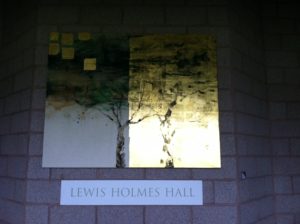
This past week we picked up 12 pieces that were on display at a University outside Philadelphia. Cairn University is a unique training place for young believers who want to impact culture Biblically. It was a privilege to hang work there. As we packed up we got to meet the President, Dr. Todd Williams, “it was a God thing” he said kindly to us. Then he took us up to see a large piece hanging in their new building that he is (and should be) very proud of. This piece, called “Tree Grace Two” is the first work of art commissioned by a Christian college, and some forward thinking donors moved this visual accomplishment forward. The piece is by well-known Christian artist, Makoto Fujimura. This is a quick shot from my iphone and Mako might well want it seen better. But he too, I know from his writings and having met him once briefly, is making his work to speak beyond him in ways he may never get to realize in a present tense, or quick caught way. There is a lot about making visual work that is a casting forward, and the displaying of it also is an exercise in faith. Faith that is grounded in sure promise is a very good investment. A wisest investor (who was also a poet) once said it this way: “Cast your bread on the surface of the waters, for you will find it after many days.” There is so much in that pregnant promise; in fact I am visualizing more work even as I type this verse out.

I am casting this promise out there for you to ponder too. I have received my work back, safe and sound. What it accomplished while it was “out there” is a confident trust that I own also. Yes, and there is more coming.

hint of the holy

This week I tore down the aging tomato plants and picked what I think may be the last of my chard and kale. I thought as I did this about the pictures that had enchanted me in the seed catalogue (compared to what actually grew). My gardening skills are improving, but never have I bought some seed according to a picture and then found the reality to be quite as good. If I were a seed farmer I might call myself a “seller of hope.” The potential is there in the seed for the pictures promised, they aren’t lying, these seed sellers; but time and entropy, as well as droughts and bugs work against my final harvest.

There is something like that working in my art. I often have big ideas and unfinished pictures in my head. I am after representations and ideas that have enchanted, that are inspired by the glimpses I catch in the landscape or off on the horizon. But what comes onto the paper or the panel works through the mesh of my abilities and inabilities, and is often only a fragment of something far grander that I can hardly grasp let alone visualize. This piece is a cropped excerpt from one effort that was successful. I call it “Hint of the Holy” for that is what beauty is to me: a beckoning appetizer toward a meal coming that is beyond my imagination and certainly my ability. Can you see a hint of that here?


it’s not about the hay

With a group of middle-schoolers, I am doing a big overview art history module. These kids are so eager and ready. We are exploring themes and examples as to WHY art has been done through time. We talked about beauty last time and I asked them to tell me what that was. Quick answers came until they had to think more. It was so interesting to watch them struggle and then engage with this important question. We looked quickly at the Greeks, and then the early 19thc. American Hudson River School, an abstract piece and then focused on what Monet did with stacks of hay. We then tried to practice with random color in four set values. In one half hour they knocked out some pretty exciting stuff! I told them about the time, when not much older than they are now, I saw so many of these haystack studies, done at various lightings in Monet’s days, all displayed together on a wall in Chicago’s Art Institute. How could such beauty be rendered from piles of wasted grass? The vision of that day in Chicago was transforming for me. It wasn’t about the hay!

I recently came across this quote from Peter Kreeft who describes this wonder well: “Glory is greater than we can contain, comprehend or control. It ravishes us right out of our skins, out of ourselves, into an ek-stasy, a standing-outside-the-self, an out-of-body experience; and we tremble in fear and delight. It is not in us, we are in it, like being ‘in love’: ‘it’s bigger than both of us’. “ (I would add: it’s bigger than all of us) Kreeft continues, “Thus it does not enter into us, we enter into it. “ For Monet, the hay was a prop, a device he used for what he really was studying to say.