Author Archives: marynees

able as the dust

from Emily (#1221) this morning as I ponder the sad loss of another soul.

Some we see no more, Tenements of Wonder
Occupy to us though perhaps to them
Simpler are the Days than the Supposition
Their removing Manners
Leave us to presume

That oblique belief which we call Conjecture
Grapples with a Theme stubborn as Sublime
Able as the Dust to equip its feature
Adequate as Drums
To enlist the Tomb.

Incarnation

In Philadelphia’s Museum of Art there hangs one of my favorites. Henry Osawa Tanner painted this image of the surprising encounter Mary had with the angel Gabriel. This visitor to her chamber, rendered as ineffable light, is speaking. He is announcing the Messiah’s entrance into matter. Of all the attempts to visualize this wonder, this to me is the best. Mary looks as she certainly was: frightened, young, simple and Semitic. She was no blond Italian (in Renaissance finery) blandly receiving such news. Such news. People still think it impossible. Tanner did not.

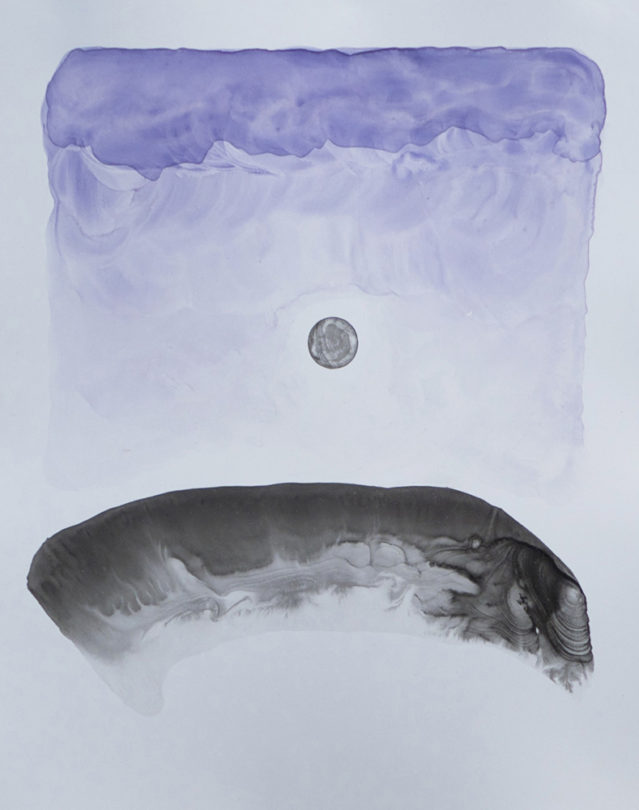
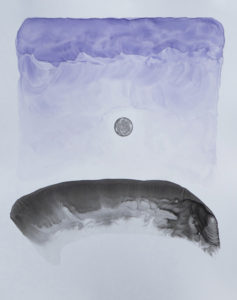
My Incarnation is the third in a present series (shown until September ’14 at the Reece Museum, ETSU). My rendering is meant to look as moonlight over part of the circumference. The hues are not dramatic, and not surreal. Light is reflecting quietly over matter, like a very purposed hovering over chaos.

But look more closely. A detail of the moon face shows the entrance of life in seed form. Soon a crowd of angels would break their silence when this baby would arrive full term. But even that arrival was surprising, only a few even “got it.” His own Mother, who witnessed it all would treasure up all these things, pondering them in her heart.

It all began here, tangibly speaking that is. In time, in a certain fragile space, the One who “is before all things, and in whom all things hold together” reduced Himself to the same dust we are made of so that He could justly win for us the only way out of this ground of dust. He came “all in” to both life and death as we experience it. And He purchased the way into the Life our hearts somehow know to yearn for. We are more than dust, because He became dust for us.

Character of Good vs. Evil

To have a sense of character, one has to spend some time observing and experiencing. We make decisions on character based on what we see, sometimes quickly, sometimes considerably. When someone then does something “out of character,” we state our surprise according to a prior set of expectations, coming out of some kind of history. Shift to the realm of ideas. When it comes to knowing or recognizing what is good and what is truly evil, it seems to me that we have lost our way. We have given up caring to know. Discernment is hard to find in a culture which denigrates any reflective judgement.

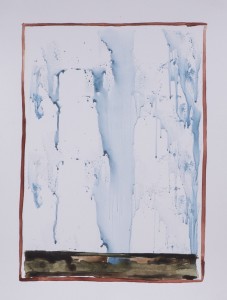
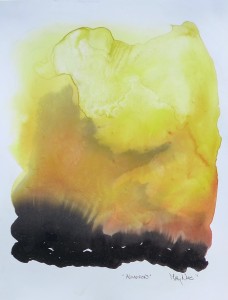
I decided to name these two pieces (last post and this image). “The Nature of Evil” and “The Nature of Good” because of their complete contrast in visual character. These two serve as a primer, using symbolic imagery to introduce the notion that there are two material poles: one is good, the other is fearfully evil. And if this reality is even remotely true, being alert to the character of these poles would be a significant pursuit.

The first image, that of evil, called Abaddon, is dominant and encroaching, seemingly boundless and fearful. The second image is much quieter, gentle but life-giving, boundaried but free. It penetrates the ground rather than taking it over. And it is rimmed by this mysteriously fragile red enclosure. When I made this second image it was after studying some illuminated manuscripts from a book a friend had given me. The first image, as I wrote earlier, took over when I made it, surprised me, troubled me. But it seemed necessary to consider. This second image was planned more carefully, but its making  also involved some serendipity. I used a brayer to lay down the veils of blue watercolor, loving the delicate surprise in the markings that resulted, and that were still “in character” with the quiet beauty of good.

This from Art & Fear, p.103 “What Science bears witness to experimentally, art has always known intuitively–that there is an innate rightness to the recurring forms of nature.” If you are able, please come see these pieces along with work from several other fine artisans at the Reece Museum on campus of East TN State, until September 12th, 2014.

Abaddon

I am framing this week, a series I did that has never yet been seen together. Four images done with ink and watercolor on polypropylene paper will hang for two months in the Reece Museum at East Tennessee State University’s main campus. I will show here each of the images from this small series in coming posts.

The paper these were worked on was an experiment for me, this surface is completely synthetic which allows the marking media to set up and modulate on the surface in such interesting ways. The first in this collection, seen here, is an image that startled me in the making of it. Artists sometimes speak of allowing the work to become what it is. . . not fighting or over-editing what emerges. I partially agree with that idea. In fact, using new materials and process that hinder my tendency to superintend while working has been important in what I have found to be my best work. This piece however strong, I do not want to call best, though it leads the series. For the nature of this piece’s subject is daunting to say the very least.

This is an exposure– a hint in a small visual way, of a most difficult concept: the problem of evil. An excellent writer I admire has crafted a brilliant attempt to understand the challenge of real evil. In Unspeakable, Os Guiness says “Modern people have shown a chronic inability to name and judge evil and to respond effectively. . . Evil dwarfs our best discussions and remains a mystery even after our best explanations.”

Abaddon was the obvious title for this once I saw what melted and dried onto the page before me. I would have rather this be something else, but it would not. To me that fact alone is an illustration of the dilemma I share with every reader and every viewer. We would all rather deny or dismiss this subject.  Abaddon is a Hebrew word of the place refered to as the bottomless pit, or the abyss of fire. It is also used as the name of one identified in Revelation as a being, called in Greek “The Destroyer.”

Quoting the prophet Daniel: “As for me, my spirit was distressed within me, and the visions in my mind kept alarming me.” 7:15


vista land

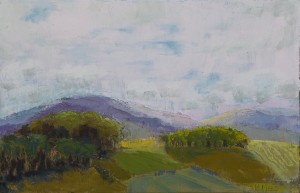
This is where I get to live! My husband and I still revel in such a place to be. He loves the quiet the most. I love the long views. I grew up in flat lands. I was always looking out the windows though, searching, even as a child for something (I knew not what to even call it). I just remember the ache and the longing. And I especially was enchanted by the lines that seemed to point to horizons. Now my horizons are much more enchanting, irregular, changing, suggesting deeper promise.

This small representation is called “Beauty’s Kiss.” It is an attempt to show the incredible response on the land when light enters and embraces the contours. There truly is a very tangible ache in such beauty. The land responds to its maker. We can/I can so easily miss this in our own preoccupations. Isaiah says that one day these trees will clap their hands for what they are waiting for. Paul in Romans says that there is a groaning going on in all this waiting. But meanwhile we get treated to glimpses like this!

what makes good?

This is a thing I am wondering about. How does good happen? What prompted my musing about this was a surprising good which came my way.

I was pulling out of Lowes recently and noticed a torn paper placed under my wiper blade. Irritated, I pulled over hoping whoever placed that there was not leaving me insurance info. due to some mishap. . . yes, assuming the worst was my first response. The handwritten note said “We found an iPhone by your van. Lowes will have it!”
I immediately reached in the pouch where I keep my phone: no phone.

Woah.
I had used my phone on my way to the store, I must’ve forgotten it was on my lap then when I got out of the car. Oblivious. Not the first time. I went into the store’s customer service desk and they had no iPhone, but as I stood there wondering what to do next, a guy I had seen in the garden section walked up and handed another employee the iPhone he had just been given by some shopper. Of course I was grateful, there it was: surely lost and now so quickly found. I asked the guy: what makes someone do this? This was his response.

All the way home I thought on this, for making good is of interest to me, and it is a challenge for me. It seems that good is getting rarer (either that or I am getting more cynical, but I do think it is the former more than the later). Maybe 30 years ago I would not have marveled at someone returning a valuable thing. These days we are all more vulnerable. And vulnerability is why I ponder more, and why I am surprised more when good shows up.

What is this thing we call good?
The other thing I recognized is that for good to happen, there has to be some kind of effort made. Good does not get actualized by just looking, thinking nice thoughts and then moving on. The finder of my iPhone had to notice, then they had to bend over, then they had to decide what to do, then they had to get out notepaper, then. . .  Good takes effort and tangible action, it is in fact a creative act.
This is my takeaway so far: vulnerability is the ground for more good coming. Vulnerable reality is the very setting by which good is even apprehended. We’re just going to miss it otherwise.

And, for good to come out it is going to take work. Good has to be made. Maybe this is obvious to you, but it is rather instructive for me. I am working as I wonder about this. Good is an abstract concept. But then it surprises us and shows up! I may not see the result (the finder of my iPhone did not see the result of her work) but because there is such a thing as good, I can expect results too.
grass rising

. . . if light can cause old grass to rise–
remade from last year’s loam,
then I’m fool to not regard such as sign toward the way home.

There’s terror in the news abroad-
and foreboding can’t be shaken.
But I take courage from upright stalks so fragile, not forsaken.

I read in a book that our lives are grass: the Maker’s view on how we last, but He says there is more, through winds that blow, are things that last forever ago.

Judging–past impressions

Quick decisions are part of every day: yes/no, in/out, right/left, scroll/click. The word “judge” has lost favor in the zeitgeist, yet there tellingly remains a hunger for recognition no matter what age you’re swimming in.

And for artists, after a considerable amount of work has gone into a visual piece, which is often subjective, symbolic or very personal, they risk “putting themselves out there” for any kind of assessment. I was recently asked to jury the student show for Milligan College’s Fine Arts Department. Knowing what it’s like to be “out there,” and also that I would be quickly drawn by my own preferences, I worked up a rubric so that I had a framework for considering all the work as fairly as I could. Soon I was in front of an impressive collection of over 70 submissions: in oils, watercolor, photography, and digital work. I took my time, but soon it was yes/no, right/left, in/out.

The final show was then hung by a student committee who had the fun of seeing the relationships and the interesting contrasts between the winners. They did such an impressive job!

At the opening, I got to meet and speak with several of the artists. One student, who has never shown before, articulated his fear at having his work evaluated and likely misunderstood. It takes a lot once something is birthed to let it go before the critique of others. But good art is not just for the enjoyment of its maker, even while (and maybe especially because?) viewers are going to see things you never intended.
Another student was eager to tell me the story around the serendipitous catching of his self-portrait. His was shot with the timer and a deliberate shallow depth of field. These choices made the piece shine beyond his intention. For the mood of his expression in front of the very vague setting caught me. This hit all my buttons for beauty, meaning, a lingering mystery, and skill of execution. And so he was one of the merit winners. But what was even more fun was his telling the tale of how that day happened. It was not a moody day at all, for what he was really musing over in his self-portrait was whether the timer was working correctly. I laughed at this, even the juror got to participate in the surprise. He caught an amazing photograph in spite of himself and beyond how he walked through his process. Is not so much of what we do just like this? We stumble forward and some things, just come together and speak to others in ways that are much bigger than our best intention.

persistence of meaning

In an afterschool program I am involved in, we have been continuing to look at the major themes in art as a means of understanding “why bother?” The kids I have are bothered by a lot of things in their young lives. I showed them some work by the Abstract Expressionists; and tried to explain how these guys insisted that art was for art’s sake alone; that it had no inherent meaning. The artists of this period had to use words to explain this insistence, for people looking at the random markings and collages, kept searching for meaning. I told the kids, “This is freedom day, your piece need not mean a thing, just tear the paper and. . .”

And here, I had to give some kind of guidelines for what makes a finished composition good (meaning?).

They started in. it was so interesting to me how even with freedom from meaning they kept trying to make meaning on their two dimensional panels.

The next time I came in, the theme for historical art making was “saying something that is true.” We looked at some important examples using Homer, and Grant Wood. How quickly the kids could catch the artist’s intent. Then it was their turn, continuing with torn paper. Their grasp on what is true easily focused on their own personal worlds, self portraits mostly. We only have about 45 minutes for the craft part of this curriculum. But they dive in and these are kids who feel little confidence otherwise. As we talked and worked they taught me a new text code: tmi=too much information. I laughed out loud at that, as I watched them work with their materials. Without words, without tmi, they were showing me in their constructions what was on their minds.

good egg (or after Emily: “awed by my errand”)

I’m aching to get back to work…but there’s other work to do-
This morning when I timed his eggs I found a little clue.
There in my trusty cookbook, from many years gone by,
The yellowed pages, torn, so dated, startled me “Oh My!”

I do not feel like an antique, though things around me show
That time has passed, so much time has passed!
Yet in my insides “No!”
What is this mystery of deep down soul that feels forever young?
That holds some torch through every storm, and still is want to run?

My mind’s distracted by “many things” that I need to do.
But here’s a clue that touches close to such a different view–
That what’s inside me does not age.
Creator’s gift is true!
So I can rest, we’ll get it done, what He has planned to do.

(and Happy Birthday to our first born–forever young)

light enters

The shaft of light peeking onto his wall was so enchanting that he had to figure out how to get more. Cause and effect began a curious quest and the little guy, reaching hard, figured out how to manipulate the shade in his room.

“Look! You can see it too!” His eyes say, what he does not yet have words for. We shared this discovery again and again, watching how the shaft of light on the wall would grow. The joy in this did not get old. It wont get old, I don’t think, for such is a touch into transcendence. There is something sublime about the entrance of light into dark corners. It has to come into, from somewhere else. And as it grows, it changes the entire space; it changes us! It is a sign. It is a gift. And what enchanted me most was how much the littlest among us can know this, can take in the simple joy of it, reveling that there is someone else to lock eyes with in such a discovery. These things are best shared, and why, I wonder, is that?

I am in the North country where Spring comes late. I am far from my studio. But my eyes too are locking onto the hints of light falling onto the fallow ground. It almost seems to me that the ground here is so ready, ready after such a long winter to soak in the rays. From day to day the buds are responding quickly, the colors are getting magically more saturated. It is really compelling; it moves me in deep places. Light, dark, and some kind of movement are of course important basic elements in any visual work. To me, and to this little guy, they are more than compositional constructs. This is discovery!