Author Archives: marynees

an image for distinction

I’ve been thinking about the tension between the quiet voice and the piercing alarm. It is a difficult one to hold in mind, to balance with integrity, to express with any clarity. A wise friend said, “you need to help us see what you see.” I am not sure I can in a way others can grasp, except through comparisons.

There are two very different sounds going on in our time. One is slow, steady and uncelebrated. The other is an irritating, very troubling, low sounding warning. We all hear it.

With some friends recently in an exhibit, we were looking at heartening images, when each phone in each pocket started echoing an Amber Alert. Beyond the walls, someone was in desperate trouble. Phones were pulled out, screens looked at, some prayers whispered. . . and then silence. The phones were put away, some turned off. We all would rather look at the lovely things. Yes, the alarm was irritating, but necessary, and in that sense “good”. It was a sounder for someone unknown. We are living right alongside the bad, while wanting to shield ourselves with mufflers. Even using those words “good” and “bad” is up for grabs, mocked, thrown to the wind.

I am mourning the muddled distinction. I am troubled by this blurring of things that need to matter, while being lulled to sleep by the insistent matter-less. This morning I read this word “and they followed vanity and became vain.”. If what is good and what is bad is no longer acknowledged, carefully considered, wrestled with, articulated, then in our blind arrogance all we will have to negotiate through is bad.
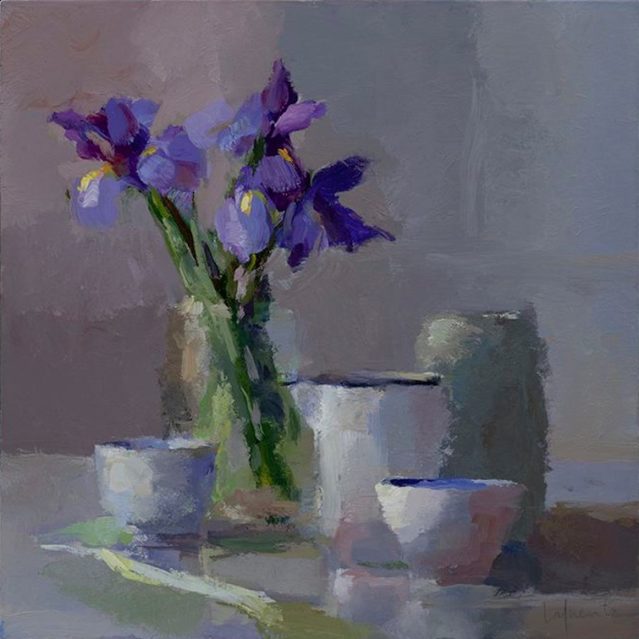
To honor some kind of distinction then, I offer this link today. The artist, Christine LaFuente, has ability to highlight clarity of color and light in remarkable ways, but always midst very unsaturated mud colors. Look at the surrounds in her work. The settings are dim, completely uninteresting on their own. So, the piercing bits of beauty are apprehended all the more. Her gestural gems are gathered out of mud. It’s the boring that gives the beauty its chance to captivate. To me her work is a parable, a picture of the distinctiveness between that which shines, and that which is only a passing setting.
If you care to comment, look around you as you go about your day: what do you see, or hear, even just one thing: that shines, and what is only passing backdrop?
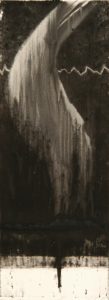
whirlwind apprehension

This is an older image, but a concept I’ve been revisiting in my head: the coming of whirlwind.
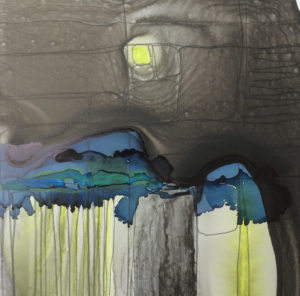
I made this monotype (ink on paper) in 2005 and titled it “Not in the Whirlwind”.

‘Sowing to the wind, reaping in return a whirlwind’ is an ancient idea and one that I’m sensing now is immediately pertinent to our current moment nationally and even globally. Hosea, a prophet to Israel in the 8th century BC, coined this visual alarm. In his writing, he spoke a mixture of severe warnings mixed with surprising hope. His listeners barely could grasp the import, and so his life became a visual aid at several points. Still, he feared their deafness to his words, saying, “My people are destroyed for lack of knowledge.” He labored to inform them. The small book we have from his pen is 14 chapters long. In the 8th chapter, he announces the coming despair, saying, “they sow the wind, and they reap the whirlwind.” He could see it in their future. His words are not angry or manipulative finger pointing but rather a lamenting plea. For what it cost Hosea to log that lament, I wonder if anyone heard? History indicates “no”, at least for the nation as a whole.

When Elijah, another even earlier prophet, retreated exhausted and discouraged, he needed God’s intervention. His story gives examples of how God moved in Elijah’s life to sustain him and then to speak to him. God was not in the whirlwind, (where I got my title for the above image). Then God was not in the earthquake, nor in the fire. But God spoke as Elijah sought Him in the coming of a gentle blowing after these events. Thus exhibited the character of God’s voice: a gentle blowing. But Elijah had to listen for it—past the din of the alarms that preceded God’s words. This is the purpose of prophecy: not to frighten but to alert any one, even just one who will listen. Prophetic words are wake-up calls.

But then as now, they are easily dismissed. When the whirlwind comes the quiet voice will be much harder heard.

good things in the dark

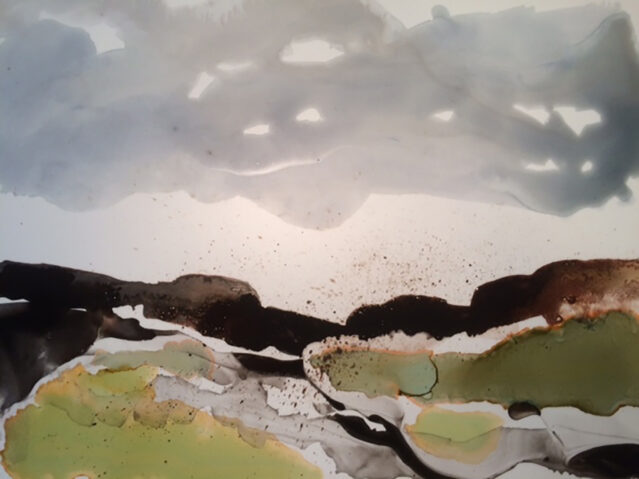
Last evening we stayed too late: a Barcelona soccer game, a walk in the woods, finished with sautéed lobster tail, a watercress salad, and Chambord! I said out loud to our hosts “how come we’re so lucky?” None of us have any valid answer to that question, for the good things we enjoy are never because we deserve them, somehow earned them. My husband made a toast, remembering the words of the wise man of Ecclesiastes. And then, knowing snow was accumulating we headed home. Within a few minutes we knew we were in trouble, our light truck without chains was sliding on the unplowed roads.

It was only a quick couple inches of snow, but cars were already ditched all along our way. The interstate, a safer way to travel, was still unplowed, 25 mph at best. Stopping would mean stuck so we inched and slid along, figuring that at some point we were going to have to use our phones for help. How quickly ease of enjoyment turns to edge of our seats apprehension. And the interesting thing is that we are surprised at both: unexpected grace and also unexpected trouble. Don’t we live on ground that is constantly changing?

But we had to think forward now. We knew that if we made it to our own street we would never make it up the hill. I coached the man behind the wheel that we best park on the flat spot and walk that last way home. He is a determined man. I have been by his side over 4 decades. So we kept on going and incredibly swerved up the hill getting ready to negotiate the last turn. And there it was ahead, as if she was expecting us. Our neighbor, with the much flatter driveway had her garage door open, space made available for our truck. Her big light was on and she was beckoning us forward. We laughed again, “how come we’re so lucky?” “how come we’re not in a ditch also?” There is no good answer. And so my non-religious neighbor got out an antique hymnbook and the three of us sat at her table and sang. This is unexpected joy.
what goes up

I throw my thoughts up in the air. I do this regularly now, like a seed sower.

I’m either a fool, or a confident investor. Fools say there is no god. Confidence comes from knowing: knowing that He listens, that He adjusts, that He does answer in some kind of time. I do this because things are falling apart, “the best lack all conviction, while the worst are full of passionate intensity” as W.B. Yeats said in his poem The Second Coming. That was so last century. It was rough then when he penned this. I do sense it is soon to be worse now. Thomas Cahill writes that artists see ahead so often, better than others somehow. I believe that may be true, though we are all so fallible. Mark Rothko feared that “one day the dark will swallow the red”. I am not afraid. Maybe it is because I know who is really at work.

It’s said that prayer is mystery, and surely that be true. But this I know, I’m moved to do it, so this is what I do.

when the dust gets focused

I noticed something interesting this week when I was in Barnes and Noble. I asked the sales guy and he confirmed that they have recently changed their section heading from “Self Improvement” to “Living Your Best Life”. It seems the dust is getting more focused! This store’s general section title, to me sounds a little more humble, and a lot more realistic about what is even possible to promise now.

I see the same in a small ancient tale called “Jonah”. In this short story, the religious guy, the one who actually “fears God” is the biggest louse. The guys in the troubled ship, flailing around with their self made gods are the ones who actually pray and find their rescue first. And it’s in all the tumbling around, at the strategic initiative of a compassionate Creator, that each one in the story learns the true God’s character. He is the point; the swirling dust just fleshes out this deeper mystery.

I’ve stopped wringing my hands. I am no longer going to get exercised about what’s going down. I want to be like those guys in the boat who were the first to get focused and pray (to a God they hardly yet knew!) This is a huge excitement, because, my friends, He really hears even our feeblest cries to Him.

early impression

An early memory still informs me. I’m told that these early impressions shape us in profound ways, and it may be true. In fact this could be my very earliest memory, for I distinctly remember standing in my crib. I was nimble enough to stand, and tall enough to be able to feel the screen top preventing me from being able to climb out. The latch on that 50’s model contraption had me trapped. I was therefore looking out the window which was open and just beyond me to the right. It was a partly cloudy day, the curtains gently swaying. Can a toddler marvel at the sun? If so, I was doing precisely that, watching the brightness emerge, then remove as the clouds shifted. That memory sticks sure for some interesting reason; time was involved, and wonder. I could have had no understanding about orbs and atmosphere. I just remember being so very happy every time the sun was visible again. I could feel it, I could see it, and then it would hide again. This whole scenario was beyond my control, and as a young one so much else was too. I was an observer. But the pleasure of this revealing warmth was as personal as such things can be, grasped by a little girl who was alone in her wonderings. If my Mother had come in and found the right questions to ask, if I had even had the language to express, I am not sure I would have been able then or even later to explain how this moved me so deeply.

I could try to understand this partly now. For one thing, whenever I am in a new space, the most important impressions for me are out the window, not interiors. This has simply always been true. What is “out there” is far more significant for me than what is trapped or caught here. I just have known this for a very long time. It has to do with place and position and outlook I think, and maybe even destination.
When I got older and found my interest in landscape, I first thought my own attempts were only “hobby art” until I studied the thinking behind Song Dynasty landscapes. The Chinese, long before the Europeans, understood the mystic depth of “the beyond” vs. the small observer. This makes total sense to me, likely because of my own impression in that crib. The Hebrew poet expressed this, way earlier, in Psalm 19.

And the personal experience of warmth, the assurance of it’s presence even behind the darkening cloud was the beginning of hope for me, I feel. I have a melancholic temperament with depressive tendencies, but I have never been locked in a deep depression. I really thank God for that, for I know my tendencies and I have dear friends who suffer terribly. I wonder if this is why: I knew early on that the bright warming happiness was there, really there; and that it would soon reveal again. You cannot convince me otherwise.

Long before I knew the Creator’s name, or came to understand His character, I was experiencing Him.

that time

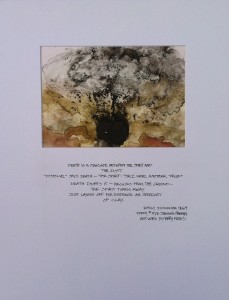
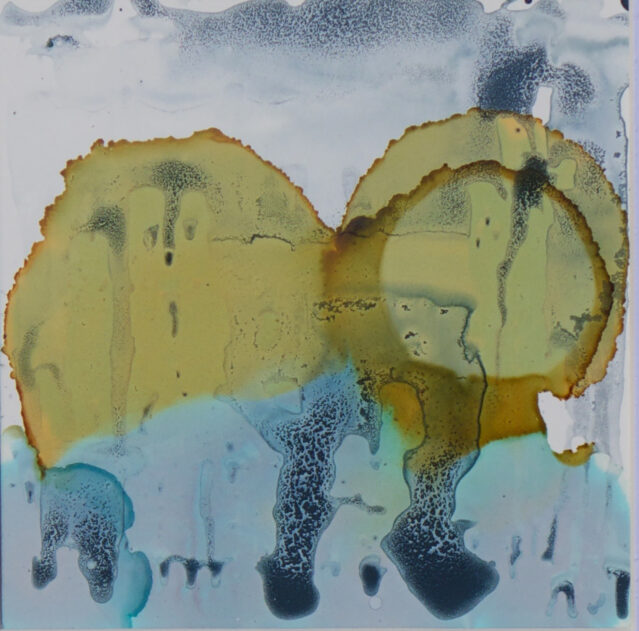
If you look around in galleries or online at 21st century visual work, you will find a lot of chaos and disassembling, a lot of broken line and seeming randomness. Some of it is strikingly beautiful. And this work is concurrent with some very interesting science called chaos theory which is seeking to understand any patterns in very complex, sensitive and interdependent systems. My small piece here is one example, done with watercolor, ink and gravity. I have paired it with a Dickinson poem, #217:

“Savior! I’ve no one else to tell—
And so I trouble thee.
I am the one forgot thee so—
Dost thou remember me?
Nor, for myself, I came so far—
That were the little load—
I brought thee the imperial Heart
I had not strength to hold—
The Heart I carried in my own—
Til mine too heavy grew—
Yet—strangest—heavier since it went—
Is it too large for you?

Last night on Skype, one of my daughters and I continued our own simple investigation into the ancient words in the Psalms. We are doing this because we both need it. We are like sheep who need to be laid down and fed. It is so noisy “out there”, so many lies, so many distractions in the seeming randomness, and each of us is vulnerable. If you think you are not vulnerable, you are already dumbed into captivity. We are like the girl in the prayer meeting who ran to answer the interruption at the door. When the answer to their prayers was standing right at the gate, she could not open though she recognized his voice. She ran and told the others, and they, having just mumbled more prayers for Peter’s release, could not imagine that God was really listening, let alone had already answered. This was a group of early Jesus-followers, not much different than us. They all ended up being amazed in spite of their paltry belief.

“We are in a time.” I keep saying that to myself: we are in a time that is momentous and consequential. There is now a collision of world-views going on about which the nations’ leaders are ignorant. The lessons of history are being ignored, the warnings of Jesus have long been disregarded. The arrogance of the narrative spinners has deceived them. And the church? They are mumbling prayers, staying cloistered, and discounting any young one who comes with joy. “You are out of your mind!” the prayer group told the girl who had heard the desire of their prayers with her own ears.

After the resurrection Jesus was gentle but very direct with one of His followers who was struggling. In the face of incontrovertible evidence, Jesus still needed to say to that man “ be not unbelieving, but believing.” There is something about the will then, something about a willingness to step forward into safety with Him. “He’s still in it with us”, says Adrian Plass. And be sure you understand that there is an eternal difference between believing any other creed than the one that is only Jesus.

“A man can’t always be defending the truth; there must be a time to feed on it.” C.S. Lewis said that from hard won experience. Now is that time.

on the vacancy of meaningless-ness

“I knew nihilism, and my friend, you’re no nihilist.”
In my art History class we just finished the 20th century. My students’ lives barely skimmed the top of that century, while I lived completely immersed in half of it. I remember the horror of the photos from the Pacific war in books my father brought home. I remember the sound of the sirens in a film about the quiet hiding annex of Anne Frank’s family. True, I only experienced these from the safety of distance, but the horror entered my soul and has never left. The image linked here (at the MOMA in NYC) is typical of the art that emerged out of Europe after that time. On this side of the ocean, the work was much more confident, though the thinkers were not. I grew up on this side of the pond, pondering Abstract Expressionism, and Matisse’s effort at order with his cutouts. I looked and then lost interest in Warhol’s reproductions, his 15 minutes of fame. It’s been said that Warhol killed art, and philosophically that case can be made. If a pianist can go on stage, dressed for performance, sit down and then 4’33” later, no finger on the keys, stand and walk away, we are done. We might as well go home. But wait. . .where is home now, maybe that no longer exists as well?

That silence (the pianist would later need to explain) was the real piece. The awaited anticipation of the unsuspecting audience, filled with nervous coughs was the real work, he would tell us. The duration was the real ‘music’ and it was indeterminate. We just needed to take his word for it.
“When I hear what we call music”, John Cage (the pianist) later explained, “it seems to me that someone is talking”. . . “I don’t need sound to talk to me”. . . “it doesn’t have to mean anything”
He spent many meaningful words trying convince us of this.

But the immense problem is that we do not want to live this way, indeterminably. After the high brow concert we still want to go home. It was nice for a time, that silence; souls do love quiet. But quiet is only satisfying in a world where things will eventually make some sense. If indeterminate quiet is all we really have, we are completely un-done.
We raise our kids, and plan our days trusting that certain things will emerge, that important things do have meaning. Cage informed us otherwise, then needed to elaborate. He had to explain because we rubes need meaning. He looked down his nose at us, even as he had to add some kind of sense to his idea. Now we are all looking beyond him.

And artists are still making work after Wahol. If all is meaningless, then why make work? Marcel Duchamp admitted this, spending the rest of his life after rocking the art establishment, by just turning his back on it all and playing chess.
The nihilists are vacant, being challenged by some great work going on now with integrity and intelligence. There is also a lot of meaningless work. One of my students has decided that the work he wants to do “needs to have meaning”.


No Prisoner Be

“No Prisoner be—
Where Liberty—
Himself—abide with Thee”

Emily Dickinson,#720, 1863

My husband and I have a very dear friend who is a Prince of a man: gentle, wise and selfless are just the starting points describing the deep character of this man. My husband taught with him overseas, and labored with this man on the board of our church. Our son and daughter were both treated under his watch-care as an orthopedic surgeon.

Our friend sits right now in Federal prison, having been framed by arrogant and over zealous young prosecutors in a quick show trail. They made much noise to nab a professional over some scam that a group of people tried to pull to gain fraudulent disability payments. The evidence of our friend’s innocence was not even allowed, was apparently not even looked at in appeal. This is the crime.

What used to be called the Justice system is now a mockery to us, from first hand experience. If our friend, maybe the most blameless man we know, could be framed, then none of us are safe here and now, even in innocence.

And this man? Though he once worked as a celebrated leader serving any comers in a clinic for the poor, he now works as a tailor, using a sewing machine to mend prison garb. And he labors to mend hearts there too. He is teaching a small group the words of the great prophet Isaiah; he is mentoring a growing group of Christian leaders in their midst, modeling forgiveness and enduring faith; and, our friend is learning Greek so he can better read the original language of the New Testament.

He is not a prisoner, he is a saint; I made this for him.

death dialogue

in partnership with Emily Dickinson, #976, 1864; image: Mary Nees, 2015

Death is a Dialogue between

The Spirit and the Dust.

“Dissolve” says Death — The Spirit “Sir

I have another Trust” —

Death doubts it — Argues from the Ground —

The Spirit turns away

Just laying off for evidence

An Overcoat of Clay.