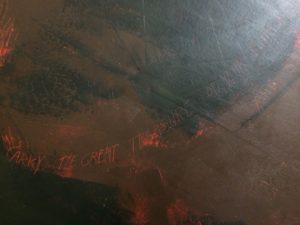
 The idea (last post) of God writing has had me musing. For text marked into pieces of ground is kind of a current thing. Detailed is just a fragment of a painting I saw last week in a gallery in Asheville, NC. The hand is artist Carol Bomer’s. The marking of words gives direction not only visually but conceptually. One takes in the whole of this dark piece as it envelopes your eye-space, but then the writing captures your focus.
We think this marking into media is avant-garde. Search and you’ll find lots of new and inventive uses of text. But the idea is as old, really, as the hills. At the Mountain called Sinai, the finger of God etched his law into two pieces of rock. This inscribing of text was not Moses’ idea. The finished tablets were not Moses’ handiwork. The entire initiative was God’s. Moses was only the invited mediator. (There are many questions here: If God is God, why did he even need to use a finger? Why two tablets, why not 10, why not one? Why was any mediator needed? Why were words needed? Were the Hebrews, recently slaves, literate? Was the marking that God used common Egyptian?) Back to what’s clear in the story: Moses responded as he was asked. He picked up the rock slabs and brought them down from Sinai to the awaiting tribes.
Think about this even if you don’t know much more. The Hebrew text makes it plain that God’s own finger made visible markings on 2 pieces of mountain rock. He communicated, from His otherness into man’s space. This was one directional. He selected a means that was legible, tangible and understandable. Then came the history of man’s response to that specific communication.
Besides the later episode in Babylon with the mysterious hand (previous post), there is no other hint of God Himself writing in the whole of the Hebrew Bible.
Fast forward to what is called the New Testament or that part of Scripture that tells of Jesus’ arrival and the revolution he brought. There is only one recorded episode of Jesus writing. The story is found only in John’s telling of events. The context is a test. Religious lawyers drag a woman before Jesus. Having just been caught breaking one of the laws on Moses’ tablets, she stands vulnerable and shamed. These prosecutors figured shrewdly. With the evidence before them all, Jesus would be trapped. If gentle Jesus dismissed the woman, he would be sanctioning the breaking of God’s law, and therefore could be correctly branded as a false prophet. If Jesus, a righteous Jew, followed the law and condemned the woman to be stoned, the religious testers would be vindicated, their power enhanced with Jesus as their pawn. Jesus turned the tables, and this is how he did it.
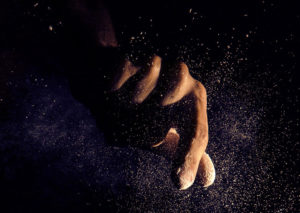 He stooped down and used his finger to write something into the dirt.
“Doesn’t this man have eyes and ears?” “Doesn’t he understand the violation?” The accusers mocked and persisted, pointing their own fingers wildly. The noise around this huddle grew louder. Only one finger was writing. Then, remaining silent, Jesus stooped down a second time into the dust beneath them and wrote again. (What did he write? Could they all see it? Why a second time? In the angry heat, how could dusty marks be any tactic?) Whatever he wrote there is not explained, but what is clear remains. What he did in the dirt was enough to silence them all. One by one, the angry men put down their stones and walked away.
What strikes me is the symmetry in both these singular stories. When Jesus writes he is likely referencing the writing of God. The fact that he does it twice, and quietly is poignant. The law God wrote was left intact that day. But now one, with her feet still there in the dust, saw the final mediator. Failure had constrained them all to face Him who alone had authority to bridge the gap between a history of shattered lawbreakers, and the Law giver Himself. He could only do that if He had fingers, eyes, ears, a knowledge of his people’s mandate intersected with a heart of compassion.
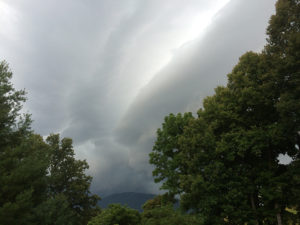 This image from my backyard in June, is taken from my iphone and completely unretouched.
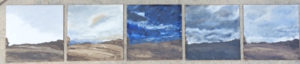 What you see here is an under painting value plotting (using simply burnt umber and ultramarine) for a series of 5. It’s about time, and wonder and expectancy. These, once finished with top layers of color, are going to go in a prayer room. I hope to get the finished series done this coming month. I worked on a couple of them yesterday and already they are looking pretty cool.
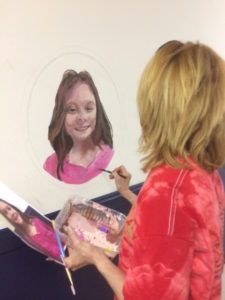 Renee kept fussing over this little girl’s face. It was hard to stop. Not one of the paintings is perfect. Not one of the kids is perfect. Not one of the artists is perfect, Lord knows. We are all a jumble of things. But today they will see what we’ve attempted to do so far with their little twinkly smiles. It’s fixed. And then we will move on with the bigger broader picture.
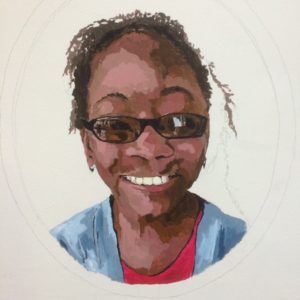 I’m getting some expert help on the mural project we are spearheading for a local non-profit. But this face I reserved to do myself. This little girl is precious, with big ideas, so she is being placed on one of the most important parts of the wall. I love her funky glasses. I love most the reflection out from her eyes and even off the plastic lenses. That was really, really fun to paint!
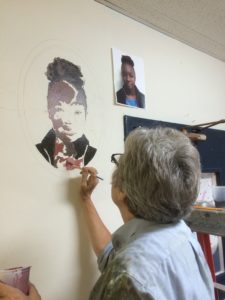 I am working on a mural for a non-profit in my community. I got to design the entire project and knew that the best idea for this refuge place for kids would be to highlight the very ones the organization serves. We took photos of 10 selected kids, then posterized them, and sketched the value divisions from each face onto the wall. Painting will start this coming week. What I hope to express here is how poignant it was to just draw their young faces, the unique smile curves, the spark in some eyes, the little crooked tooth, the sweetness on each entirely different form. These are just semblaces on a wall. But I know the real kids a little bit. I interviewed each to gain some buy-in for the ideas behind this whole project.
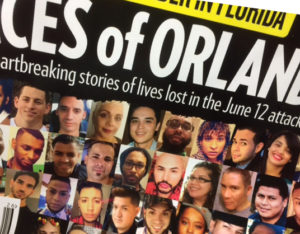 While sketching onto this wall, I was living through the news reports; faces all lined up (each completely unique) who were mowed down by a murderer’s gun in Orlando. You probably saw those images too. I did not know those folks, and so I cannot share the same sense of relationship. But the loss is incalculable for those who loved them. Such searing pain is grief! We are all robbed when even one precious soul is ripped away. Robbed and ripped and many, many left sorrowing.
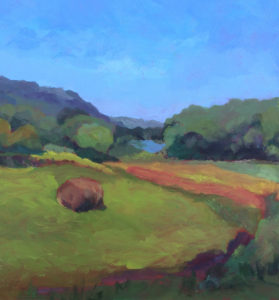 And I will use my energy instead to slice a section of a piece I painted Monday. I was at a beautiful farm owned by a woman named Ginger in a place called Goshen Valley. I was standing painting quietly next to a friend who also is suffering on the inside and doing it bravely. We took courage together and both managed to look out and to gather in some of the beauty and the glory with our brushes. That was a good day. The whole is good. But for now: just a slice, thank-you. I can be sustained with a good slice. For here’s a simple truth, easy to absorb: that which is good comes from Him (every last bit of it) and that which is not good does not.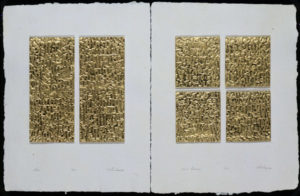
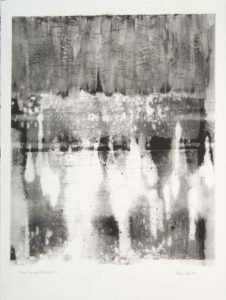 I illustrate this today with a piece I made some years ago. If you wanted to own this you would have to pay me a lot of money, and the work would need to be hand delivered for it is encaustic wax. But you can see and ponder it here for free. It is a response to Psalm 19’s declaration of the outpouring into our ground. I think it is a masterpiece, “after the Master” who said he was doing this communication into our broken places freely “day to day” and “night to night” Such an idea calms my anger, and awakens my dulled spirit. That’s what the truth does, it breaks in. George Orwell observed in another difficult time that “During times of universal deceit, telling the truth becomes a revolutionary act.” And so it is.
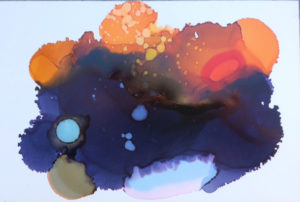 I struggle with my own voice in my work, living as I do in such a time of disintegration. I cannot make the work of my hands “say” what I hold in my heart so often. It is not my goal to be literal, but it is a desire to lift the viewer’s eyes. A friend of mine who is a photographer, grieving deeply over the death of her husband is now doing the best work of her career. We talked of this: why are we doing this work, this searching with images? Is it meaningful, is it what we “should be doing”? We got this far in our discussion: this work is an exploration into JOY. This expression is as fleeting as a sunset and as mysterious as a bird’s flight, but it is necessary, if even just for us. I have some ability to look, and to craft. Maybe through the work of my own hands others will see meaningfully also. For this, I keep on.