
Author Archives: marynees

expect the unexpected

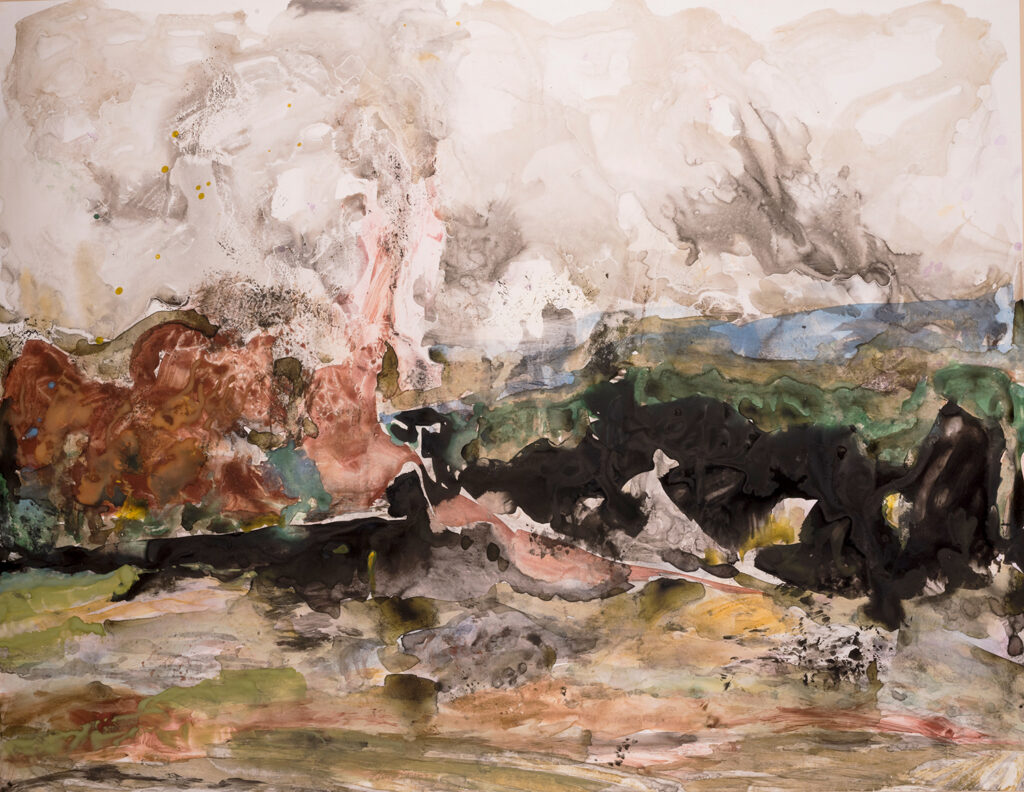
Working with Chinese inks on plastic paper has been bringing some interesting surprises, the most fun when I am just loosely holding an idea while the inks behave as inks do. There are certain boundaries I set, and then there are outer boundaries at work (like gravity, and viscosity). But the fun comes in the unexpected finish. I am working together in a sort of duet with these materials, and I rarely know what is going to happen next.

I do have a plan. I need to get 17 pieces done for a showing in November. I have been studying through Emily Dickinson’s work for a couple years, just finished. And lately I have been tracking through the emotional journey of another poet and prophet: Jeremiah the Hebrew. Just today I gave a lecture to students about how Michelangelo saw himself as Jeremiah—at least he chose that singular brooding figure on which to place his own resemblance in the Sistine chapel program. And there was a lot about that project that was a huge struggle for Michelangelo. He wrote about the days when his neck hurt and the plaster was all over him, and he doubted his ability. Oh, but the results.

Time moves. It is all ground for more work to be done until that set moment when all the work is done. I love the finish. But I am learning to enjoy the stretched out surprises in time too, and part of my reason is because I am not the one in charge.

hours and hours

In early morning dark, I was driving my friend to a hospital in another city. We’d been given some pretty clear directions and told it was simple, so off we went. Toward the end of our journey, our eyes focused for the landmarks (in the disruption, neither of us had our “devices”). Ok, we passed the Walgreens where we turn. Ok, we’re supposed to go over this bridge. Ok. . . so where is the next turn, did we miss it? We both leaned forward in our seats, the car ambling forward into the dim. Another couple blocks and we saw a blue hospital sign, then down a hill, around a corner and it felt like maybe we were approaching the right vicinity. Soon: lights, cameras, action.

On the way out, hours later, we retraced our route to get back to the interstate. This part is why I am telling the story: the time to travel out was eons shorter than that long and ponderous earlier drive! How could this be? It was the same exact path of streets we took coming in. But our experience of time was completely different in the reverse direction. We both were startled by this and it got me thinking.

Time seems to be an elastic thing, even as it ticks with a measurable rhythm. Sometimes as I lie in bed at night, I can feel and hear in my ears the beat of my own heart in a predictable rhythm that is beyond my control: pump. pump. pump. I can manipulate some variance in the count of those beats: get excited and they move faster, focus on relaxing and they settle down, but I cannot stop the beats, nor do I want to. Time moves like this in a set program; I cannot ultimately change it’s progress or it’s pace. As I move through time however some things feel quick and some things feel terribly, terribly slow. Certainly the moments looking for the hospital as we examined every sign and longed for every turn were experienced by us as LONG. But on the way out, hearts lifted, day shining and mission accomplished—the entrance to the interstate was so quick it was entirely startling.

Here’s why this informs me: I am awaiting the arrival of Jesus, as He promised. I am moving along looking for His signs. He said the way was simple and just ahead. But it is dim out there where I am traveling now. I will keep going forward. His way is sure. It’s the time thing that has me at the edge of my seat.

So, is it my experience in time, awaiting His arrival that makes it seem LONG? Is it the heartstopping events that make the pace seem to stagger, and the exciting parts make it seem to speed up? This much is clear: time may be subjectively experienced, yet it remains a measured finite resource that moves in one direction only. This video I shot was on a blustery afternoon, also just recently. The movement here reminds me of a phrase in a poem by Susan Morrison, (age 11) “Hours are leaves of life, and I am their gardener, each hour falls down slow.”

in honor

There is an image I cannot now get out of my head. You may have seen it. I wont attach the visual. Instead I leave a frame to honor the little boy whose body washed up on a beach in Turkey. My heart aches for him, for them, for us. Refugees are flooding away from the terror in the Middle East. A truck stuffed with 71 suffocated souls was left on the side of the road in Austria. Traffickers entice the desperate into what becomes more desperation. Is this not increasing horror? How do we manage this, how does my own heart respond? To ignore it is easier but I cannot. To post something about beauty, or about hope now is excruciating. I used to wonder how people handled terrible events during WW2. Now I feel I am living it.

Evil is not explainable to the skeptic; the materialist can’t accommodate this as reality, he has to deny it. Or he chooses to shame those who don’t follow his idea of rules. It seems now that all rules are moot. All are mute.
It is noticeable to me that when confronted with such horror, a natural response is to push any idea of God away in disgust. We judge Him according to our notion of good (and where did that come from?) while we will not accommodate any notion of evil. As judge of God then, and name-caller of God followers, the mocker now feels safe. You see the put-downs and the bullying on social media. This is how we hide, anesthetizing ourselves from owning what is happening around us and within us.

But to face it full on is painful! And it seems to me that those of us who still hold conviction that God sees, that He cares have greater pain reconciling such horror in real time. If you actually believe that there is a God who exists and who cares, then where is He? His silence now is extremely troubling. If you do not hold to a God, then what difference does any of this make: none. It all means nothing. I believe we should be troubled.

The prophets saw, and wept. Jeremiah said “wilt Thou indeed be to me like a deceptive stream with water that is unreliable?” (15:18b)

Habakkuk blurted “How long O Lord, will I call for help And Thou wilt not hear, I cry out tho Thee ‘Violence’ Yet Thou dost not save.” (1:2)

Daniel: “So, I gave my attention to the Lord God to seek Him by prayer and supplications with fasting, sackcloth and ashes. . .” (9:3)

Here is some summary of what these men learned.

Do not mistake God’s seeming silence as tolerance. He sees. He is at work. And He gave answer to each prophet’s cry.

Do not mistake a terrible length of time as a sign of His impotence. He has verbalized a specific plan. He is coming back to judge. And the time lag that remains is more a sign of mercy for you to look up before it is too late.

Would you have the courage to take your own blurting questions not to others but to Him?

“And there is Hope, because of Him.
So sure and steadfast, on which my heart lays hold,
On high He hears, He’ll come from hiding
And heal the bruise that He foretold.”

“O Come great Captain, Captain of my soul
Re-create Creator, cleanse and make me whole.
The curse Commander, is a Covenant keeper!
In your care I rest, Captain of my soul.”

“And in upheavals of unbelief
that You will usher, while so urgent to reach.
Unrighteous came we, and would remain
Apart from You underneath, My God who came.”
darkness is a sign

Signs in daily life are indicators. I see a red stop sign; I stop within a few feet. Signs give warning as to what’s ahead, and signs give one time to think and still to choose which way to respond. There’s a little bit of time between seeing the sign and getting my foot soundly on the brake. I am glad for that. So are my riders.

Darkness is a sign; a shaded marker that is showing up everywhere now. Look around, listen, watch. I am just articulating what you already know (maybe don’t want to know, but sense just the same). Darkness is a departure from light. It surrounds, entraps and leaves one cold. You don’t want to be there. There is nothing calming in a place of unarticulated blackness.

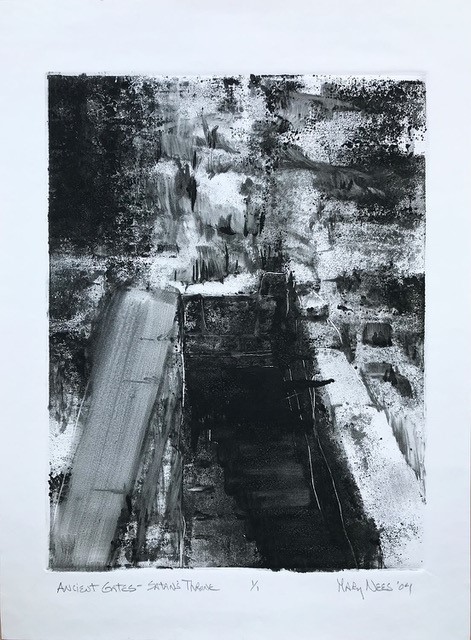
Artists work in the arena of making some kind of signs, knowingly or not, coherent or otherwise. All artists are doing representation of some sort, making indicators of something else. For example, even in the arranging of darks and lights, an artist seeks to use these elements toward highlighting some aim. We even talk about “value structure” though we might otherwise insist there is not such a thing as real value indicated at all by our arrangements. Still, handling lights and darks well are basic coins of the realm in visual work. All light in the composition and we are overwhelmed and cannot see. All darkness and there simply is nothing to see. This is basic, and objectively understood.

Handling light and darks well in life is another matter all together. I have worked with both. I am also a current events watcher, a Bible reader, and a concerned friend. I’m noting that dark signs are stacking up faster than I have ever seen in my 4 plus decades of following the words of the prophets. There is some heaviness in all this observing, there is also some significant hope. Think about this (recorded by the first prophet Moses): the Creator came first in the Genesis account. He was primal. He was deliberative. He spoke and then light came into a place that was full of darkness. That place is further described in Genesis, 1st chapter, verse 2, as being a deep and formless void. The light entering there was a jail break, a remake. The light came into the darkness and then started staging a re-creation. And that was just in the beginning.

But there’s a problem, revealed in the story of the rest of the book. There is an imitator of light who lies, and we are all vulnerable to him. He was named by Jesus as “the father of lies”, “the serpent of old”. He entrapped the whole human race early, not long after that re-make. He masquerades as light (or as any number of fascinating imitations). He can only imitate; he cannot Create but he is crafty. Even the most earnest seekers of good get sidetracked by his clever luring. He is luring you if you are unawares. His intentions are the opposite of the Creator’s; the imitator’s intentions are not good. Like the pilgrim in Bunyan’s tale, we are too easily blinded by this one who lies.

“This life’s dim windows of the soul
Distorts the heavens from pole to pole
And leads you to believe a lie
When you see with, not through, the eye.”

And here’s a watchword: it doesn’t have to end this way. Inserted here is a video that might help you see more of the grand story. If God is the originator of the story, then there is a story, and it has a valuable end. (If He is not, then ultimately there is no story.)

poem above by William Blake, 1757-1827
image “Ancient Gates/Satan’s Throne”, monotype by Mary Nees

encounter at the gym

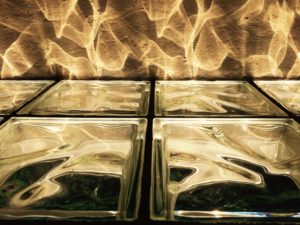
Amid the noisy machines, flashing tv screens and the running track, there is a window at my fitness center. It is a glass block section that scatters light into the space where we work. Everyone inside has an individual training plan going on. There’s sweat, determined looks, clocks, and all around the sounds of metal clanking. I was tromping along with my earbuds locked into a current-events podcast when I got stopped by this view. This was greater news.
In the Genesis account of how the world came to be, the calling forth of light was the very first creative act. Everything else followed this. As artists, (creators who move at the initiation of Creator) we know the value of light in any composition. We manage light, move it, mix it, manipulate it, arrange it, mimic it. But we cannot create it out of nothing.
The reflected light dancing on the sill here is so lyrical, cast forward by the waves in the glass, received on another plane and resting there all day for anyone to notice. But the source of this light is what captured me and still continues to quietly move me. The light is not a blinding flood, or an enchanting deception but rather a beckoning presence. And it is highlighted all the more because of the shadows mingling near it. This was a singular moment.

I spent a little time here, turning my phone from talking machine to image recorder. After a bit of sheer enjoyment, I went back to the busy track. The news on the podcast I could not repeat to you now, though it was important. The calories lost and the cardio exercised was necessary. But the experience with this light is sustaining for me, even today. For this was not just about the passing of something pretty. It was an engagement with the maker of pretty.

Imagine if you were walking through a space and came across the illumination in a painting by Carravagio. This might stop you too. But what if Carravagio himself was standing right there, hoping you might notice. What if the artist himself was somehow translated to your time and place so that you could actually talk with him a bit if you wanted to. What would you say to him? “How did you do that?” “Why did you arrange it this way?” or maybe just “. . .thank-you”. I am thinking that Someone greater than Caravaggio is here.

beside the embers

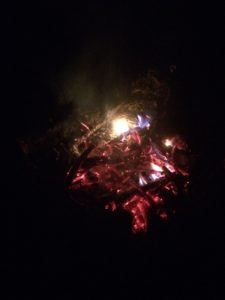
I found her sitting outside alone when I went back out to douse the campfire. Her heart language is Chinese, but here in my back yard she was using her phone to find words in English to capture what she was feeling. She showed me the little screen and a collection of words she thought perfect. Then we both were thrilled. She had just discovered one of my very favorite poems on her own. Here is Yeats’ “When You Are Old”
“When you are old and grey and full of sleep,
And nodding by the fire, take down this book
And slowly read, and dream of the soft look
Your eyes had once, and of their shadows deep;

How many loved your moments of glad grace
And loved your beauty with love false or true,
But one man loved the pilgrim soul in you,
And loved the sorrows of your changing face;

And bending down beside the glowing bars,
Murmur a little sadly how love fled
And paced upon the mountains overhead,
And hid his face amid a crowd of stars.”

Sometimes there is immediate communication, if even just a sweetest glimpse, that touches beyond culture and light years, and languages and time. Even if I had her language ability, I am not sure I would have been able to search out words as meaningful. But we both know the same well spring of deepest meaning. We speak out of completely different cultures, but we both have come to love the One who is “riding atop the mountains.”

sparks rising, then what remains

An ancient philosopher once stated that “man is born to trouble as the sparks fly upward.” His was an observation based on hard won experience, evaluated carefully, critically. We’re told that ancients were ignorant and primitive, that our evaluations now are much more advanced and sophisticated. Moderns consider such a statement about man’s bent toward trouble as nonsense, for we are making utopia (don’t you know) we can do it, yes we can. Yet such projections are faith statements that have no reliability. To project that our efforts will build what human history has yet to see is an exercise in folly at the very least.

I see sparks. They are brilliant and captivating for a moment, then they are gone.
And (if this brooding thought goes beyond my own campfire) what will then remain?

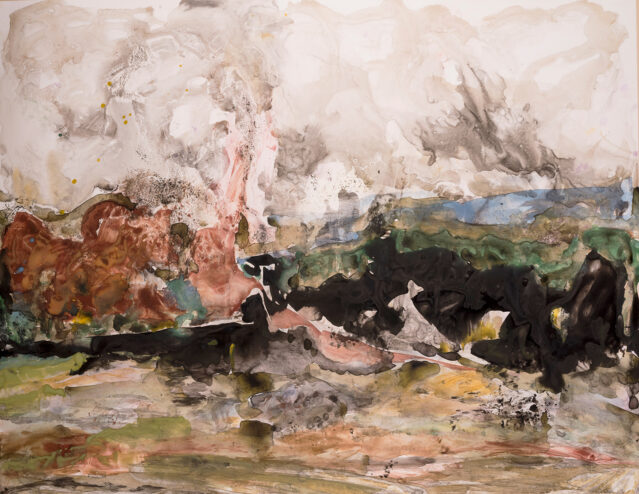
In the 8th century BCE, a well regarded Hebrew prophet recorded a 66 chapter oracle that covers the globe, detailing events centuries ahead of him that he could not have known. For believers this is not difficult. God spoke through this man. Here is just one fragment: “For the mountains may be removed and the hills may shake, but My lovingkindness will not be removed from you, and My covenant of peace will not be shaken, says the Lord who has compassion on you.” The Psalmist echoes this word. “Therefore we will not fear, though the earth should change and the mountains slip into the heart of the sea.”

True faith is not mindless religious duty, but rather a response of trust in something reliable.

God has made many promises. He alone is ultimate reliability. What remains then is Him: His character, His covenant agreement of peace (now in the heart, later, on the ground), and His compassion on me. If these are words only to you, I invite you to explore His reliability.

My watercolor piece above is a response to His breaking promise in Isaiah 54:10.
The British thinker Malcolm Muggeridge added this:
“As Christians we know that here we have no continuing city, that crowns roll in the dust and every earthly kingdom must sometime flounder, whereas we acknowledge a king men did not crown and cannot dethrone, as we are citizens of a city of God they did not build and cannot destroy… precisely when every earthly hope has been explored and found wanting, when every possibility of help from earthly sources has been sought and is not forthcoming, when every recourse this world offers, moral as well as material, has been explored to no effect, when in the shivering cold the last faggot has been thrown on the fire and in the gathering darkness every glimmer of light has finally flickered out, it’s then that Christ’s hand reaches out sure and firm. Then Christ’s words bring their inexpressible comfort, then his light shines brightest, abolishing the darkness forever.”

at an intersection


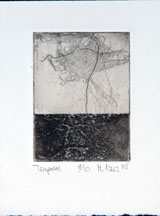
Trajectories that meet at a single point are called a convergence. Lines become a single point of intersection, and these places are rare. Rare in life, and I think intriguing in art. This image is a detail of an etching I did several years ago. The piece is called “Temporal”. The idea to me was just the wonder in the slowness of time. As things look random, time is what gives us a chance to view the quiet emergence of so much that is important: the blossoming of fruit, the maturing of character, the perfect development of every longed for thing. And in this waiting there can be great mercy as a trajectory moves toward fulfillment.

Right now in the evening sky there is an unusual convergence happening. You can see it at dusk above the western horizon. The planets Venus and Jupiter have been moving in their singular orbits closer and closer toward a meeting as seen from our vantage point on earth. Tonight, June 30th they will be so near as to appear as one large star. The constellations (that is the star clusters that have been identified by several ancient cultures) are a pictorial back drop behind what happens as our solar system keeps moving like a swiss watch. This convergence of two planets in line with our own is happening in front of the constellation Leo. Maybe that means something. Maybe it doesn’t. But, thinking like an artist, I’m paying attention. Something’s happening here.

patterns below

When random sound moves to even a hint of rhythm, instinctively human ears take note to listen more carefully. Patterns alert curiosity, giving clues as to some kind of intention. Imagine being in a deep woods when a distant tapping becomes metered. Anyone might begin to wonder “what is happening here that I maybe need to catch?” Is someone trying to send a signal? Is there some kind of purposeful activity going on up ahead?
Patterns in visual work bring a similar alertness. Our eyes look for the connections, for any relationships that reveal the pattern-maker’s idea. Sometimes even just the suggestion of intention is enough to sharpen the observer’s gaze.
Pattern is inherently interesting. It is curious while also even calming, especially in the midst of much else that appears random. But it is also mysterious and that is maybe also some of the draw.

I think some of our heightened interest is because pattern indicates some kind of promise behind the hints. Pattern then is like a veil that allures, that brings close while leaving us with more that needs investigation.
To observe pattern quite simply necessitates the expectation of more. And this I think is founded (wether we admit to this or not) in some expectation that there must be a pattern maker behind that veil. Crumbs are not left on a path unless there has been bread that has already been broken.
To glimpse the pattern and run without giving time to consider the character and intentions of the pattern maker is a sort of consumerist robbery. It is a grabbing of the gift without considering where it came from or why. One needs to take time and consideration when noting the crumbs and any other signs on the ground. One takes time looking at art because it is presupposed that someone made it with purpose. When observing the veins in a leaf, when listening to a sonata, the senses focus to understand. All of these things and many more quietly inform the observer.

Rhythms indicate a plan and a process. And process takes a measure of time.
We are hardwired, I think, to hunger after a sense of intention underneath the veil. The restfulness of this little video I shot last month is a good example of what I am thinking about still today. I sat and just observed that morning. I made myself take time. Then the gentle ripples seemed to be coalescing in a very quiet, very unified dance right in front of me. It was as if I was being reminded, again, that what is underneath, and what is far above is at work. Constantly.


patterns above

One evening late, near Canada this month, I was walking outside and looked up.

It was startling!

Above me was a tableau sparkling with wonderment. I remember as a child pondering the patterns in the wilderness skies. I had no concrete belief in God then, at least I didn’t until I started looking up.

I remember not too long ago having a probing conversation with a young Navy man. I asked him “have you ever looked up and just wondered about all those star clusters . . ?” The young man looked at me and said, “Ma’am, we can’t see the stars in the ghetto.” I was stopped short. He returned my silence with sadness. He knew he’d stopped my wonder. Poverty is not just material.

When the vacuous haze of our own artificial light is dimmed however, when we can get away to where the simple sky is visible we have opportunity to see so much more. It hangs there for free. It has no boundaries of nation or class. In all the other centuries of history the brilliance was so much more accessible. There are star names from ancient Persian, Chinese, Greek, Coptic, Arabic, Ethiopian, Hebrew and Chaldean observers who studied and followed the patterns.

I so wanted to photograph the night sky this time. I emailed a friend to find out if there could be a way to catch a record with my simple camera. No, she said, “you will just have to burn the sight onto your retina, and then paint it for us!” So I did, I burned it into my memory and in some way, I want to translate it.

The real display is still there. Find some way to look up.

abstraction–like a poem

Tell all the Truth but tell it slant—
Success in Circuit lies
Too bright for our infirm Delight
The Truth’s superb surprise

As Lightening to the Children eased
With explanation kind
The Truth must dazzle gradually
Or every man be blind—

Emily Dickinson penned these words in 1868. I believe she was grappling with how to bring important things forward into human awareness. She used what she saw in nature as sign posts for bigger ideas. She was therefore an abstractionist, looking for simple indicators that could tease the way forward for blind men. Reading through her poems I catch her spirit though we live in such different times. She was not didactic, but she was determined.

Yesterday, as I was lying on an exam bed, the scanner moving back and forth above me, my eyes looked to the wall at an image similar to this. Here, like with Emily’s words, is a suggestion that dazzles gradually. Images are “quick talk” without words, and language (we are given to expect, or we are deaf as well) holds meaning.