Long story, but I was given an open door to audit an advanced painting course, at just the perfect time: another gift. The instructor is quick and good. I figured the opportunity would help me get my brushes moving toward a series I aim to finish but have been stalled out on.
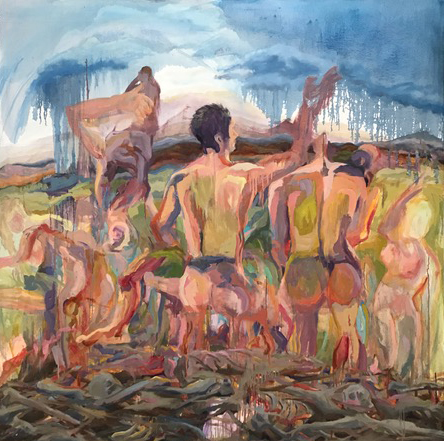
Before I could get to that work though, the prof. gave an assignment: stretch a huge canvas, gesture in the model for 3 sessions, and then complete a piece that shows figures in motion. Having just studied through Ezekiel, I knew easily what I wanted to do with figures in motion. I had a concept. However, figure painting has never been a strength nor a motivation. Still, I moved into this one with some expectancy.
Toward the end, the instructor commented on a certain central vertical thrust in the sky that didn’t sit right. I pushed back “but I have learned that this downward stroke is part of my angst, it’s part of my own voice. I know it’s probably psychological but it’s real”. I did some adjusting (not yet seen in this photo) and then went home and thought about this push that comes out of my spirit. It’s as if I have long said ‘God, I believe in you but I’ve about had it with you! You take so long. There are so many things wrong, other things unformed why don’t you act? Things you say you care about are left hanging! I want you to come down.” Slash. Thrust. Slash goes my brush from top to bottom.
But the story in Ezekiel 37, is all about what God is doing, from the ground up. The bones in the valley are brittle and long dry. The prophet cannot make things happen. God asks him “can these bones live?” Ezekiel’s response is not a thrust of determinate action but a quiet wonder. And then the forming begins. The bones become united structure for flesh, and then are given breath: it’s a process of transformation metered out in time.
I am suggesting some of that here in this chaotic piece. And as I mix, stroke, evaluate and question there’s transformation happening in my flesh and my spirit too. It is happening.
The prophet had a certain role, this was a tandem work for sure, but God was the initiator and fulfiller of the entire story. The prophet’s broken voice was needed, indeed prompted by God. And then as he watched fearsome changes blooming before him, Ezekiel too was transformed. We know this because he recorded it. Breakthrough is when, with feet still tied to gravity and voice still tainted with angst that something bigger happens on the ground. I learned a lot with this giant piece. But what comes after it, I am trusting will be even better. Here’s near final:
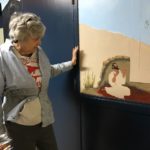 Another friend and I worked this week on the huge mural project we started last year. It too is a continuum. It starts at the beginning of historical time and ends where the kids in the program we are serving, can look into a mirror. All along the way are emblems of the grand story, punctuated by avatars of the very kids who walk this hallway after school. We’re hoping to lift their vision even as we are lifting our own.
 I will end the year with a simple post and a simple piece. After the workshop I taught, putting materials away, I decided to play on my own just a bit more. This one is a success and I matted it with an Emily Dickinson poem I have loved: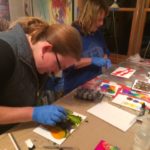
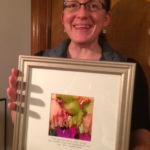 Voila, or “There it is!” was the result after a couple hours of experimentation. We really are creative whether we understand how we’re made or not. The excitement in getting a glimpse of that is contagious. This finished result was just one of several little gems made that night. Liz illuminated a favorite quote from Brenda Ueland’s “If You Want to Write”: “Since you are like no other being ever created since the beginning of time, you are incomparable.”
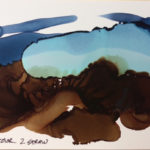 I am inserting here two little experiments with some inks for a workshop I’ll be conducting next week. Beginners will be introduced to some of the rationale behind abstraction’s promise. If some good work shows up from some of these craftsmen, I’ll be sure to post.
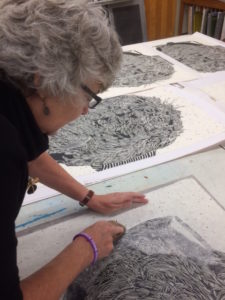 I’m not dressed for printmaking. Instead this one night, I attended an art opening of politically motivated art accompanied by an interesting lecture. The show’s juror,
 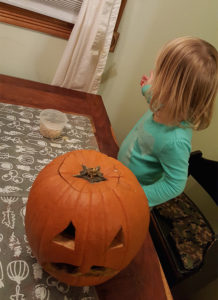 My granddaughter asked “what’s that?” as I was wiping up pumpkin mess. I looked up and saw her pointing to the wall and the round gray mimic cast by our big orange beauty. “That’s a shadow! Do you see how it moves as I slide this over? And if I turn the light off. . . it goes away! Isn’t that amazing? The light is what causes that shadow and the pumpkin is just blocking light on the wall. See, you can do the same thing with your hand: move your fingers and see how you can block the shine and change the shadow’s shape.” So, she got totally engaged with that exercise, and kept twinkling her fingers while I twinkled with thoughts.
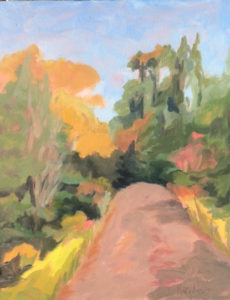 This week I went out on a trail where the leaves are turning, colors singing. The soil in this part of the state has a lot of iron in it. As a result, the dirt under my boots and all ahead of me is an unremarkable dull red-brown. The perfect foil for the brilliance decking the foliage layers on the sides of the road, I made this trail the centerpiece then. It seemed good to do. On this ground is where I stand with my easel. It’s my reference point. In the painting, I started here too, mixing the dull hues as the base line. The dirty earth is the substance out of which all this other beauty gains its nourishment, and then its contrasting show. But soon the colors above will dull too and fall back on down to the mud, enriching it with deadness and only slim memory of a day like this was. I captured a bit of it. But I often think on this idea that beauty is ultimately un-capturable in any really satisfying way. This transience, or fleeting quality seems to me to be the nature of things we call beautiful. With beauty you are ushered to a lovely impression which beckons deeply and then the knowing of it disappears as quickly as Tinkerbelle. I grasp at hues out of tubes, and mix with intention. I make stabs with the brush trying to produce a likeness. But the image is never as rich as what my retina reveled in. Beauty is a whiff of something I can’t fully own, it seems. It’s a signifier, a stand in for something grander that is calling my soul. And I keep traveling after it. I think of beauty as a moment’s glimpse of forever while my feet are still gravity bound in this mud.
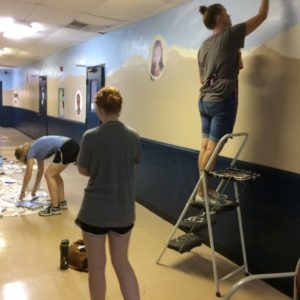 In some previous posts, I’ve highlighted the portrait work begun this summer for a community space, an after school refuge for kids. On a recent Saturday, a group of us gathered for several hours to paint in a basic background to set the avatars into a landscape. This entire tableau is going to be a storied timeline, further to be detailed and linked. Do I sound like I know what I’m doing? I laugh at the thought and my own chutzpah. I’ve never tackled something this big! But the stars aligned this year for the project. The ideas clicked, the grant money provided, the kids showed enthusiasm, and the time came available soon after I was asked to consider spearheading the venture. It’s going to come to a unified completion with a little help from friends. It’s way better together. Our goal is to have these two long hallway walls completed with all the elements by Christmas.
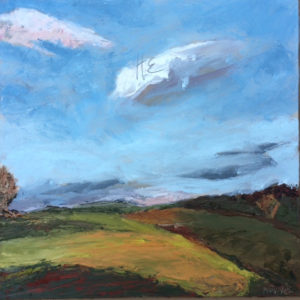 The small painting inserted here got finished today. It is one from the series I mentioned last post. Looking up is not the anesthesia of escape artists. It is rather a choice, based on sure evidence made more necessary in darkening times. It looks