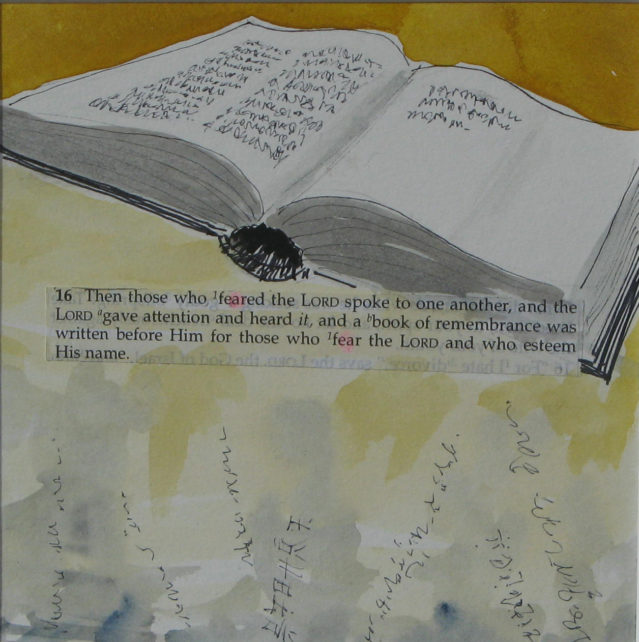
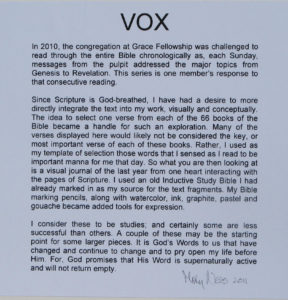
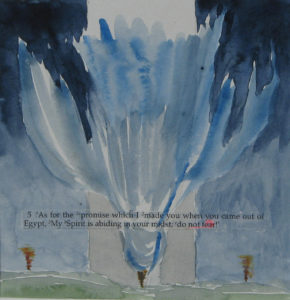
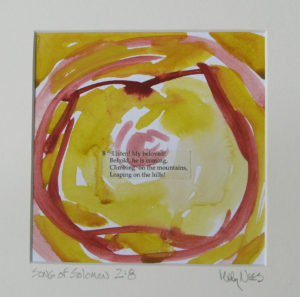
 Another sketch from my Vox series, here illustrated is one verse from the very last book of the Hebrew collection. The prophet Malachi had some blistering words to say to his hearers, as well as a couple reassuring promises.
Any current assumption that spiritual giants “just need to be nice” are blinding themselves to alot of rich material. Moses, Joshua and Jeremiah were not known for being nice. John the Baptist was a firebrand; Jesus was a spiritual revolutionary and if either of them had just been “nice” we would never have heard of them again.
Piercing words function like an alarm clock to those who need to be jolted awake. Here’s just one example from Malachi’s short treatise: (the prophet speaking for God in chapter 1) “I am honored all over the world. And there are people who know how to worship me all over the world, who honor me by bringing their best to me. They’re saying it everywhere: ‘God is greater, this God-of-the-Angel-Armies.’ All except you. Instead of honoring me, you profane me. You profane me when you say, ‘Worship is not important, and what we bring to worship is of no account,’ and when you say, ‘I’m bored—this doesn’t do anything for me.’ You act so superior, sticking your noses in the air—act superior to me, God-of-the-Angel-Armies! And when you do offer something to me, it’s a hand-me-down, or broken, or useless. Do you think I’m going to accept it? This is God speaking to you!”
I would call that a verbal alarm clock. It sounds like the words of an angry parent. In the next chapter, vs.17 is this critique: “You make God tired with all your talk.”
But the verse in this small 3 chapter book that I selected to illustrate was one of promise toward the end of Malachi’s warnings. That promise melts my wavering heart. Chapter 2 actually sets the context by reminding the listeners (whoever is still listening) that God is a covenant keeper. And what God has promised will stand though others will not stand in the day of His sure appearing. After more warning words, God challenges “Test me… I will defend you.” vs.10-11.
And as if it is a follow through response from that call-out “Then those whose lives honored God got together and talked it over. God saw what they were doing and listened in. A book was opened in God’s presence and minutes were taken of the meeting, with the names of the God-fearers written down, all the names of those who honored God’s name.” (This is the same verse 3:16 that I illustrated in the image, set in a contemporary paraphrase called The Message.)
I’ve often thought of that promise when speaking quietly with others. I take His words literally just as I see He does ours. And when we gather and speak of Him, He lets us know that He’s a bookkeeper.
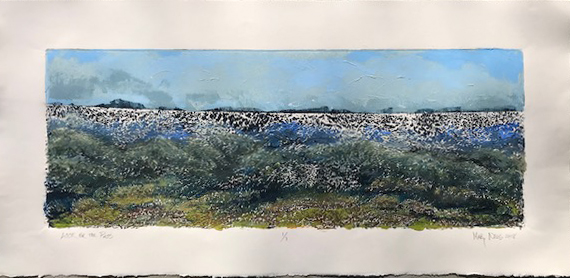
 I am delighted to highlight a piece I made this winter which has been selected along with a small collection of other pieces by Dr. Noland, ETSU’s President, for brightening office spaces on campus.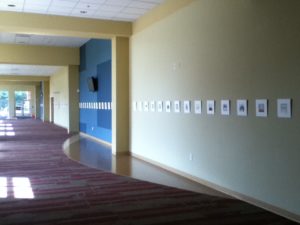
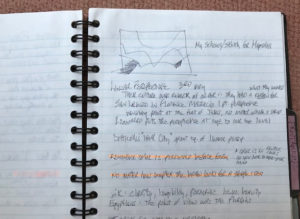 “First I have the picture” Einstein reportedly said, “then I come up with the math”. Before any of us knew how to decode language, our little eyes trained on images. Even the cones on our retinae respond to color before form is understood. We begin from image impression, but then sometimes the more we “know” what’s in front of us, the less we can wholly grasp.
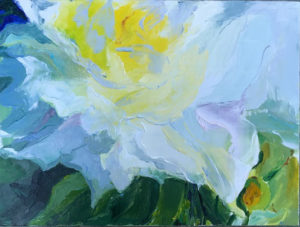 darks and lights from a photo of a magnolia blossom. What was important in translating this into paint was not “this is a magnolia’ but rather more than that, and I needed to take time to consider how. My oil color is carefully selected. But what excites me is the emergent shine, and the impasto lending toward a sense of exuberance. The cropping too was a choice, as if I am just teasing the viewer into only a glimpse. Glimpses for me are key, for if I try to tell the whole story, we’ll all get lost in words. There’s an energy in this translation into color that springs off the canvas. Usually I dive into work from an idea in my head, but to take the time to map it first, if even so simply, is important, and more than I knew. I’ve heard about the necessity of sketchbook planning, but since I’m not much of a draftsman and am also impatient, I’ve often skipped that part. “I see said the blind man”. So this mapping process was a win for me, and it’s informing further practice.
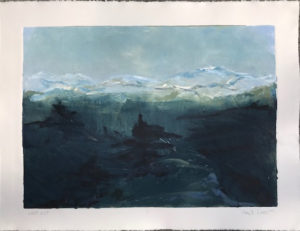 The fields are white, the horizon beckons and we’re keeping our trekking boots on. Some 48 years ago, I heard theologian Dr. Joseph Dillow explain the patterns in the ridges and the valleys of Isaiah’s prophetic masterpiece. It was like being in a biblical glider over peaks and valleys in the histories of nations. The prophet, viewing from hundreds of years before Jesus, saw with distinct clarity what was coming. To a young design student, this uber-view was mind-altering stuff. And we are standing in the midst of what Isaiah further predicted. To quote a secular seer “so let us not speak falsely now, the hour is getting late”*. We know the King is coming — we’ll not lag here in retreat.
 The little ones around us this week are learning to wait. “Can we have Daddy’s cake now that you have come in the door?” “Nini, can I play (bang) on the piano now?!’ “Are you done resting?” “Are you awake?” “Can you tell that story again Pop? Let’s go back in my room and pretend you’re putting me to bed! Tell it to me again, Pop!”
 We’re preparing. And since visuals speak so powerfully to me, I painted a symbol on our front door. Similar to any other sign, one has to stop here and think. Strange things require some investigation to understand what’s really going on. People who know me already are primed for surprises. My engineer looked tentatively, bemused at the gleam in my eyes as to what I’d done now. One of my daughters just smiled at her weird mom. I got out some red paint, and researched which branches in my backyard would more closely resemble the hyssop used in Exodus. When the Israelites were told to paint blood on the lintel and posts of their doors right before their great rescue it must have been a truly weird act of faith. But the
 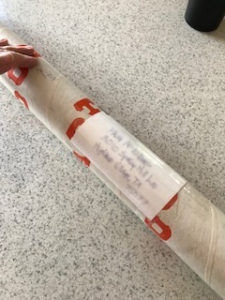 Back to earth, there is something in Job’s proclamation that does ring true for me. I have ideas and ambition, but unless my hands get busy, unless I have the courage to learn from the messes, and unless I manifest it somewhere. I have nothin’. Yesterday I picked up from the post office a piece which has been all over the country in a 3 year traveling show: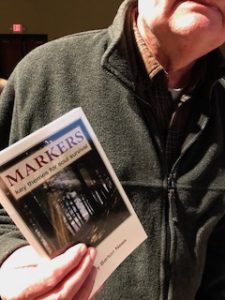
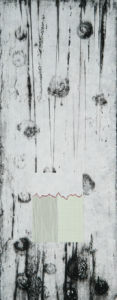 I showed them some pieces like this one, “Time and Mercy” where the chaos is falling down all around the inner life. But there on the inside is the mark of a heartbeat, and the recording of time. There’s a history that is undeniable, part of the fabric that cannot be changed. There’s a span ahead yet unknown. But in this present moment I can breathe and pause. This is the potential moment where beauty is born. For right now I can lift my head because the evidence of love is still shining through for those who are eager for it.
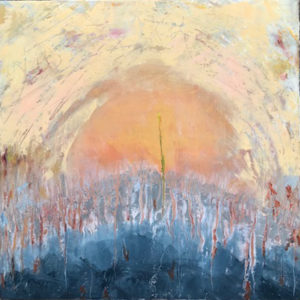 The theme keeps repeating and it’s a universal one. From mythology to classic literature this idea of trekking toward some kind of attainment is in our DNA. Moses, Odysseus, Buddha, Lao Tzu, Dante — the list is long of courageous ones who were answering the ancient quest “where have you come from, and where are you going?”* Something keeps us moving, sometimes for what we’re not even sure; and if our bodies get tired, our spirits keep longing.
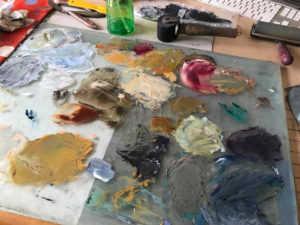 A seasoned pro said this last fall in my hearing and it struck me: SO TRUE: “it’s simple, but it’s not easy”! This could be a mantra for continued practice in any discipline worth pursuing. The key things to know are basic, evident, clear from the ground up. They are simple. Jesus boiled all the law and the prophets down to just two ideas. Nodding our heads, we’re all pleased with ourselves until we actually try to do those two things.
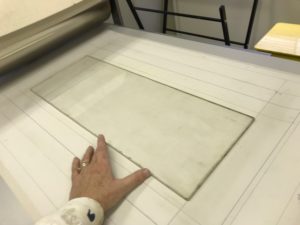 Stick with the simple things and then start moving out creatively! Easy Peasy. It’s getting to the finish that’s the tough part. We know what to do, we imagine so easily! But the sublime result takes a whole lot more effort than we romantics ever imagined!
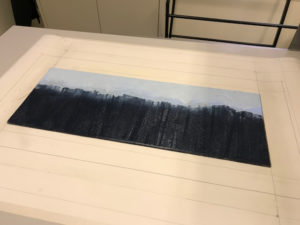 And so, I consider the basics again, chalk it up to “at least I tried” and “I learned something today that will feed the next one”… So, there’s nothing to show here today but some starts, and some working resolve.