Author Archives: marynees

still life or “reality show”

I’ve been thinking again about the tension of living between the quiet voice and the urgent alarm. If you lived in Hawaii this past weekend you’d still have alarm withdrawal going on in your psyche. Nobody would say we shouldn’t have blaring alert systems, even after one misfired and people panicked. But we cant live with the heightened noise level that seems to be so much of the modern “reality show” of life in this nation now. I don’t know how I would have handled the alarm, but I know I would have prayed.

With some friends a while back, we were looking at images at an exhibit, when each phone in each pocket started echoing an Amber Alert. Beyond the walls, someone was in real trouble. Devices were pulled out, screens looked at, a couple prayers whispered. . . and then silence. The phones were put away, some turned off. The alarm was frightening; the quiet voices in response much more sustaining.

There are two very different realities going on in our time. One is slow, steady and uncelebrated. The other is an irritating, very troubling scramble for attention. One is loud and obnoxious. We all hear it. We’re all sick of it. There’s another sounding, but you have to tune your ears to hear it
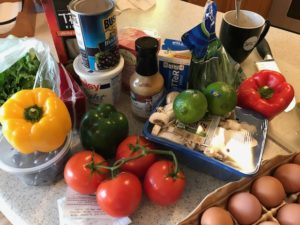
I slammed my computer closed this morning. The click-bait headlines have me so wearied, sickened. You can point fingers, but we’re all in this thing together. So, I did the next thing in my little life. I went to the grocery store. I had to do this anyway today, but I got there early and started to relish the simple tasks of handling and selecting real live things that will make a difference in our well being this week. I got to choose. I chose to enjoy the steps, the colors, the kindness of the produce man. I don’t think I have ever enjoyed a grocery trip more! I came home with several bags of supplies, and arranged some on my counter like a Dutch still life. Art is not imitating life here. Real life was already happening. You could rather say Life is imitating art of a sort. This is some of the gleanings I’ll use up this week.

I think of the Northern European “vanitas” paintings, where commodities (due to increased trading and middle class means) would be arranged in a collection, then painted in oil. The intention of vanitas, was to show symbolically that the everyday things (like an orange half peeled) were all stand-ins for moments in time. And bigger than that was the idea that the temporal things would decay but the moment would be marked as a time of reflection and joy. That’s small voice stuff. That’s the kind of thing that reality shows can’t show you.

Come tomorrow. Come what may. I’ll be listening for the quieter voice.


light bursting

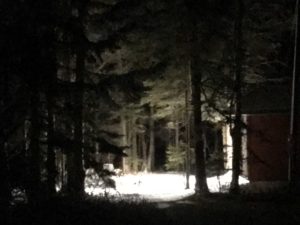
The last image of the year is one my husband shot out our tiny cabin window. The garage light was on, and all was still on the darkest night of the year in the Northland where my grandparents settled long ago. The frigid air, the wild vunerability of this backwater place and the mystery of light penetrating, so surgically into enveloping darkness was what moved us both with this digital glimpse. This is only a token, an illustration, of a sublime reality. I’m thinking of a baby born on another dark night, in another backwater place, where light burst forth into their precarious situation. John’s gospel says at the beginning “light shines (present tense) into the darkness, and the darkness did not comprehend it.” John 1:5
How utterly strange, and beyond the ways we would stage it. God comes to rescue: through a humble couple willing to listen to Him, midst political chaos swirling beyond their control, with a baby of suspicious origin who is entirely vulnerable! And that is just the beginning of the story.

I’m reminded of the words of the 1st century thinker, Paul of Tarsus. His reflections were preached into my own ears by a master theologian in the early 1970’s. The passage being explored was the very 1st chapter of Corinthians, where Paul is contrasting what many seek vs. what God has simply given as greatest wisdom. I was deeply moved by the surprising ‘rightness’ of God’s way vs. all our own proud attempts. Paul ends his discussion with this summary: “…because the foolishness of God is wiser than men, and the weakness of God is stronger then men.” (1 Cor. 1:25).

I used to wonder: if God wants our attention, why does He not make it more obvious? I was new to understanding Him then, and troubled that His existence was not as clear to my friends as it was bursting into my own heart so astoundingly. Here is how another writer expresses this mystery “Everyone supposed that You were limited, You Who cannot be contained by anything, all speech is not able to tell of You, and a mind that is compelled tries to grasp with yearning…”

This last quote excerpted from an Eastern Orthodox liturgy posted on Dec. 26th, 2017

time’s slow move

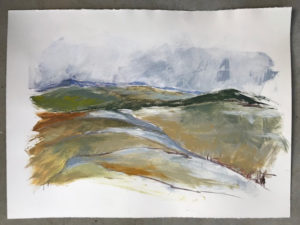
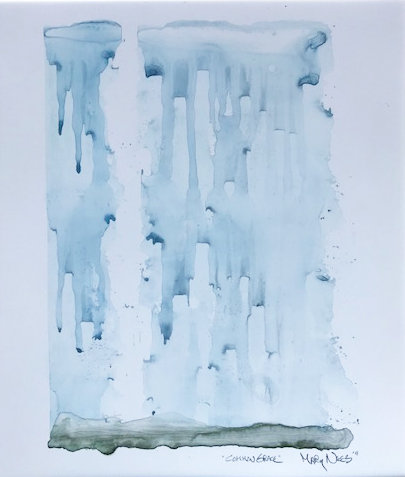
We had a wonderful snowfall this past weekend. Everyone took a break to look-out and to rest within. That was glorious at such a busy season. I have lots of pictures, but the impression that got translated into oil was some aftermath from the bigger event. There’s story here. For, as the snow blanket thinned, the ground revealed some surprising December alive-ness. You could not see it happen, this snow thinning, unless you sped up a time-lapse cam. It’s lived so slow from our angle. We move here on the ground at a snail’s response to what is happening second by second in the heavenlies. My sky here is active, for that’s where the real drama is being directed. The land only reflects the weather patterns and the light working above it. I live on the ground, held by gravity, where time creeps sometimes agonizingly slow. I don’t like that slowness, for there’s so much that needs to change down here, so much I long for from the only One who can bring us justice and peace. Humans and their leaders so disappoint me! He said He’d return, why is He taking so long!?
In the first century, after the resurrection, one of Jesus’ followers must have been wondering the same for he writes: “with the Lord, one day is like a thousand years, and a thousand years as one day. The Lord is not slow about His promise, as some count slowness (me), but is patient toward you, not wishing for any to perish, but for all to come to repentance.”

So what happens on the ground is timed-out by a God who is waiting patiently, redemptively for those who will take the time to consider.

I don’t mean to just drop off a sweet Sunday school lesson here; in fact I am eeking it out with tears some days lately. He knows. I tell Him. For I am startled at the deep vexation in my spirit. It’s like my soul is buried under frigid crystals, but there are angry embers way down deep. In my piece, it’s the higher grounded areas where the snow is still sitting (in real fields it’s typically the other way around, for the heights catch the sun first and longest.) But the valleys, where tiny me cannot see far enough, are where my hot anger resides.

The thinning snow, pulled back it’s cover, so the heat could eek out slow. Timed slowly, the active sky is in a duet with the receiving ground, and something much grander is happening.


not to talk?

A quality gallery marketer published a podcast I listened to just this past week. The teaser? ‘Three things not to talk about (if you want to sell your art)’. Here’s the short version: never talk about politics, religion or sports. This guy is good, and I respect his advice; but the funny part is, I had just that morning posted an opinion piece on my personal facebook page. I decided to leave it there, as there is so much mud in the waters now politically, and the op-ed writer I shared was shining some light on a certain subject. It didn’t take long before another artist friend of mine (who sells very well) posted an alternate view to the article I liked under mine. I appreciated her viewpoint; it gave some important info. But haunting me was the echo of several who’ve instructed me “don’t get political” so, I did the more sober thing and deleted the entire post. Politics has shown its complete unreliability, and so I’ll stay mum on that score.

I’m reminded of advice given my husband and I years ago. We were in our young 20’s, and taking our summer job boss out to dinner to thank him. He was a pleasant man, maybe several decades older than us. We were from the era of campus political demonstrations and new in our spiritual convictions. To us: ‘if you care about someone, you talk about what is most important to you.’ He tried to give us advice (which we did not take): “There are two things you never talk about: religion or politics”. People said something like that a lot in the 1950’s. I remember quietly imagining how boring if conversations could never wrestle with such things.

Now I’m older than that boss was then. Now I am learning new tricks and living in a very different, even more divisive time. And one of those taboo subjects (according the gallery marketer) is what moves me to work! I certainly will talk about what moves my work and my every aim. Life has exposed politics as simply the maneuvers and manipulations of men on other men. And religion of every stripe is simply the same attempted upward. What moves me however is how the Creator of each and every man and woman is still speaking. He enters in.

The advantage I have doing art is that I can “tell it slant” as Emily Dickinson used to say. There is no muzzle on when the work sings with beauty on its own. Makoto Fujimura explains it: “Art is an inherently hopeful act, an act that echoes the creativity of the Creator. Every time an architect imagines a new building, an artist envisions that first stroke of a brush on a white canvas, a poet seeks a resonant sound in words, or a choreographer weaves a pause in layers of movements, that act is done in hope; the creator reaches out in hope to call the world into that creation.” –Refractions (NavPress, 2009), 68.
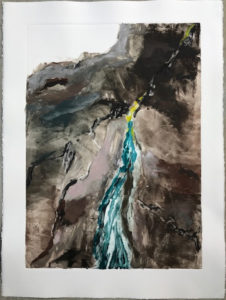
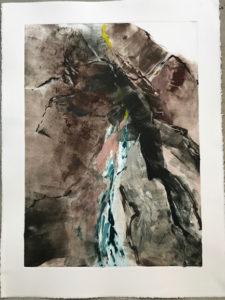
No deletions have to be considered when the work gently vibrates into even the harshest of times. Art speaks, and best when it is responding to the original initiator. It beckons and invites. And you can walk away without feeling like you’ve been sold something you didn’t want to buy.

The artists are the ones who may be the best at talking now, for as C.S. Lewis said, they are the ones who can “steal past those watchful dragons”.

to strike, then to speak

The journey of Moses leading the Hebrews out of slavery and into the land has informed some recent visual work. There’s a curious episode with water coming out of a rock that strangely happens twice: once at the beginning of their sojourn and then again right before they enter the land promised them. Both times the people are thirsty and near riotous. Both times God gives Moses instruction. Both times Moses needs to take action. But the action the first time is to strike the rock and the second time Moses is only to speak to it. It’s a fascinating repeat with an important distinction.
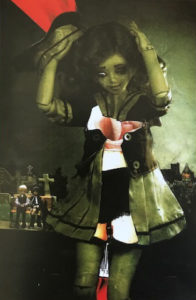
Patterns and parallels catch attention. When something repeats, be it sound or sight, there’s a resonance of some sort. There’s potential being built. We’re hardwired, I think, to be alerted when there’s a repeat. Curiosity gets engaged—something intentional seems to be happening. When a strange chirp repeats I know it’s more than random, so I go looking for it. When the 2nd plane hit the towers, there was universal recognition that we were no longer dealing with accident. I watched that 2nd plane hit, and was startled at how instantly that repeat was a game changer of terrifying consequence. Everyone who saw that knew instinctively.

I was in a workshop this past week with an artist who’s done a lot of reading about how our brains perceive and then recognize. He posited that we’re all visual learners; we all take in data and start making connections. But it’s in the investigating where real learning gets sealed in our memory. And that takes some time and consideration.

So back to Moses, why was he tasked to strike the first time but only speak the second? For me this parallel of two rock stories is really pregnant, there’s more here. Moses had learned about striking. And by the end of the long wilderness journey he was oh-so ready to strike again. Why twice this rock thing then at these completely different times/locations? There’s nothing particularly distinguishable about the rocks in either episode. What is God teaching here in the narrative? It’s not random. There’s much that is not explained in the text, but some particulars are very clear. Needed water came out of rock both times and the people were sated. God gave words, both times. But Moses failed miserably at the 2nd rock because he applied an old instruction to the parallel. At the repeat episode, he was only to speak to the rock. Most find this biblical episode harsh, as if we gift-receivers have any high ground for critiquing the gift-giver. But God poured out that gift of water—both times, in spite of Moses’ fail. I am wondering if the parallel isn’t more deeply meaningful than our memories can yet gather in.

Moses personally addresses God later as “The Rock!” and he does so with overflowing praise at God’s perfection in all His ways. Moses had learned these ways of God, even through severe disappointment. I am not a good listener, so this story stills me. I am an activist who gets angry easily, therefore my empathy for Moses is pretty deep. But deeper still is the provision from the water giver, unseen but present within each of these common rocks. The first time the rock was to be struck. The second time: only spoken to.


what mercy requires

A recent show opening this past week (well attended by students, artists and appreciators) was a kaleidoscope of ideas and emotion. The Fl3tch3r Exhibit’s aim is to further social and politically engaged art. The juror, Canadian Anita Kunz, is an internationally published illustrator who selected from over 350 entries coming in from around the world. Because of space restrictions, she eventually had to limit down to a 20% submission ratio. The show is strong. The ideas varied and electrically charged. And, I admit that with some tenderness, even as my own piece was among those passed over. Rejection stings. But good work, well curated, lifts even those who are observing from the reject pool.

Openings are not a good time to really let the whole sink in deeply, so I went back today to consider more. There were the usual political diatribes against prominent public personalities. There were powerful aesthetic statements against guns and drugs and racial violence. Some of that work was remarkably masterful. But then, I noticed a diminutive collage, chosen as a favorite by the museum staff, “Art to Stop Traffic: What Mercy Requires of Us”. The piece is only 5”x 3.5”. This submission is a poignant contrast, rendered from found images, paper, pen and pencil. The value and color contrast is immediately obvious, but peering closer one sees the uncomfortable juxtaposition of plastic expressions, skin color, garish lighting, things hidden and things exposed.

This very idea of things hidden and finally exposed is something I’ve been placing my heart on recently, and so I was gripped again.

Jesus is the one who called this out as a promise to His followers: “for there is nothing covered that will not be revealed”. Such a paradox this: that the ultimate mercy giver is also going to be the final adjudicator. The harshest words He had to say when walking our ground were to the religiously complacent (visualized in this collage). And the most lavish praise he gave was to a woman, not unlike the one pictured in this fragile piece, who wept at His feet. I am moved by this. And I am heartened that the museum staff would even notice a less prominent submission for this very grandest of ideas.

collage by Lucy Julia Hale, Cave Spring, GA


Hot. . .or cold

Maybe it’s my age. But maybe it’s the age we’re all in. For, I am sensing the rumblings of a cosmic shift. I’ll let the culture watchers detail it for you, but if your ear is to the ground, then you’ve already felt it. Here’s my summary: The real are getting real-er, and the fake are showing themselves. And here’s the best news: if you know the Creator, then you don’t need to fear (He said so). I feel like Caleb, who after 40 years of wandering finally was being allowed to see it. I listened to a young Swiss millennial at a gathering; rather than saying “amen!” shouted exuberantly “C’Mon!” Many were right there with him. This past summer in So.East Asia, we witnessed the next generation plan and lead the genesis of a movement that will influence nations. Here’s just a glimpse.

This past week, while the news was telling you of a truck bomb in Somalia and another Priest murdered in Egypt, I saw brothers arm in arm who are turning Africa inside out. You wont hear about this on the news. Politicians and religion-extremists cannot ignite something so holy, and they cannot stop it either. C’mon!

I was going to write about beauty this week, for it often captivates me, illustrating, hinting how more is coming. These bits are better. Eugene Peterson said it this way: “Wonder can’t be packaged, and it can’t be worked up. It requires some sense of being there and some sense of engagement.” You wont want to be sitting on the fence any longer. You’re either all in, or. . .

deception (Lord, I feel it)

It was time to paint the walls of my husband’s office. And knowing that the color I had hand-adjusted for our other rooms was a winner, and that we still had a good amount left in the 5 gal. container, we set out to use it. Whew, it did not work in there! He has one window in that small room, and the lighting is completely different. My wonderful color looked dark and morose in a different placement. So, back to Lowes we went. Color is a fickle thing. It is entirely dependent on context.

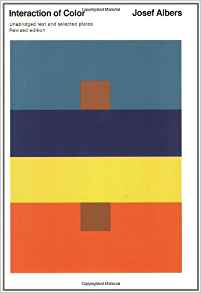
The mid 20th century Bauhaus instructor Joseph Albers was a master at helping his art students understand this. Using color chips and simple exercises, like “make five colors into six”, they learned the relativity of color. “In order to use color effectively, it is necessary to recognize that color deceives continually”, Albers said. Here is one exercise exampled. The brown squares are the same exact hue, but the reading of each is influenced by its surrounding colors. A dark context makes the center color lighter, a cool context makes the center color warmer and vice versa.
This relativity, this prone-ness to deception, is of interest in the time we’re in as a culture. Have you been in conversations with those who see things entirely differently than you do? It’s remarkable to me how a news story is interpreted so conversely by two folks with some of the same information. Context will determine whether the ‘facts’ being presented are orange or dark brown. I say, examine closely. Look at the context. Do some experimenting. Ask questions. You can stand and insist that orange is orange, but you could be easily wrong. Be sure about what is sure, and aware of what simply morphs. Be a humble sounding board, willing to test and to explore the assumptions being bantered and felt as ‘true’.

Deception is in the air. It’s good to do some work on this. Go back to the elementals. Albers’ students learned well because they were forced to wrestle with it. What is ‘color’ (changeable) and what is ‘fact’ (stable). What is surface charm and what is structure? What is emotion, and what is reliable here? What stands the tests of time, and what is a passing dew on the grass?


signs and blindness

Yesterday an artist friend and I viewed an exhibit at Penland having to do with human perception. The artist/printmaker’s aim was to “dislodge humankind’s assumption of its centrality.” Her work was inventive, but left me empty. For, if we artfully (and alertly) remove humankind from the throne of mastery, what is being offered as a guiding replacement? Is that not a concern? I see, and I sense the implications; and I need more.
Most artists would recoil at my desire for a follow up plan. They would say they want to ask the questions, not provide any next steps. I counter, such posing is soberly irresponsible in an era of increasing trauma. The signs are all around us with record breaking hurricanes, earthquakes, fires, famines, and mounting armies. Artists are pretty good at noting some signs of the times, but have a poor track record at managing the seismic shifts. We need more than what artists (or politicians, or academicians) are laying out. So much is dying.

Christian philosopher Norman Wirzba observes that in Modernity, we rendered ourselves the Masters. The resultant cultural mind-set assumes that whatever sense there is in the world needs to come from us, and us alone (for God was dethroned long ago). That explains the dogged insistence that ‘we can still figure this out’, that ‘we can fix it all’; even while post-moderns are at least admitting that we have lost control. Few are looking at much beyond the walls of their own perception.

Blindness has been a human problem since long before Modernity. And Jesus had much to say about it. He knew the people around him (with working eyes, ears and brains) had a perception problem. He loved them anyway. He artfully spoke and performed signs right in front of all in a way that revealed who was actually perceiving. In fact, He said that the signs given by Him then, and in the future that He predicted, would not be grasped by the willfully blind. And even better than a prophet with perfect accuracy, better than any artist with probing questions, Jesus offered the next steps for the only sure way through the chaos. He’s Creator after all; and chaos was, in the beginning, just a working canvas.

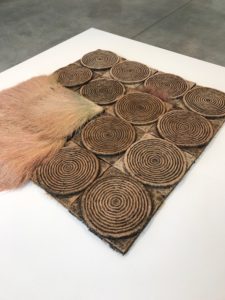
artwork: Susan Goethel Campbell, detail of Ground No.5, 2017, Inverted, dried earth, dead grass

Go Forth (again)

I was awakened one evening long ago. My young friend wanted to talk about Abraham, her Patriarch. I listened out of respect, surprised by her wonder, startled actually by her belief. This was a fairy tale to me. But she held onto it as if it were true. We took many simple steps that night, one foot in front of another, hiking around a lake, high in the Colorado mountains. I was quiet mostly while she spoke. But that night, something ignited in me because of the words she exclaimed about one man, long ago, who simply decided to trust what God had told him. “How could that be?!” I wondered.

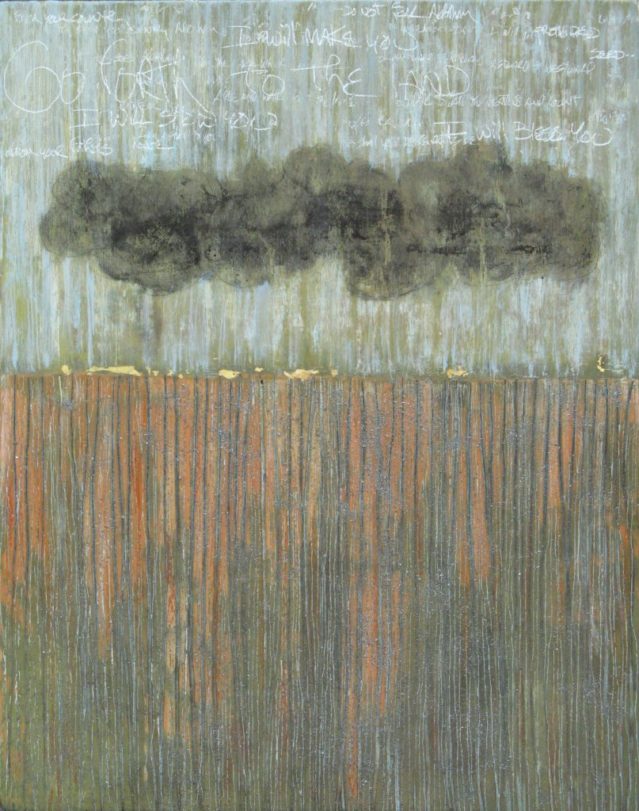
“Go forth, Abraham” is a piece I finished in 2012. It is an emotive response from 40 plus years of steps since that conversation, in which I have been reminded so very often of Abraham’s complex example.

I don’t think it is a very pretty piece, and therefore, to me, all the more true.
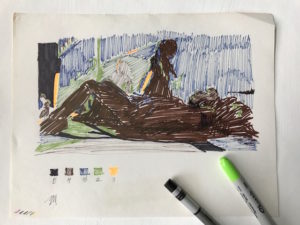
Abram, (renamed Abraham by God), was a real man, a very unique man. He listened. His radar was tuned for wherever there was God-frequency. And when he heard what God said, Abraham took it seriously and he stepped it out. If you read of his life in Genesis chapters 12-25 you can actually follow the learning curve of this man’s developing confidence in the God he was aiming to follow and learning to love. Though a Mesopotamian ancient, culturally distant from us, the human-ness of Abraham’s growing trust comes through. It was a real-time process that took decades. And God did real time revealings and interventions into Abraham’s process. The key throughout is this commendation in the narrative: “Abraham believed God, and it was reckoned to him therefore as righteousness.” Abraham himself was not righteous, as his history only displays. But God made a call, based on Abraham’s distinguishing characteristic: Abraham simply believed what God said. This is big. It was Abraham’s believing that accomplished an imputation of righteousness. This believing Him is a big deal with God; it can be defining for us.

Abraham lived according to the promises given him. These promises came in clear when they came, but they did not come often. And so there had to have been so many steps where Abraham was just putting one foot in front of the other, trusting, trying to remember what he had heard, relying on the character of the promise giver. That is what I was thinking about when I made this piece. This is a linear picture of all the heavy steps being made in desert sand, as Abraham moved out trusting. This piece looks at his whole journey. High in the stratosphere are markings: recordings of the words that rumble in his memory and bring light to his heavy soul. There are shining bits that come on the ground: the epiphanies he would tell us of if we could hear his whole story at the end. But a lot of the steps for Abraham as he lived them out, I expect felt dry and hard and shifting under his feet. Each step was consequential though. And there is this dark hovering cloud overhead. It is not one that brings rain, but one that brings only darkness and static. Discouragement is hovering not far away.

You will be hard pressed to find a better example of a mortal who risked it all to believe the One he heard speaking. It was not a pretty thing, but it was true. And it ended up being amazing.

I am highlighting this piece again for it was selected to be part of a traveling show called “Scribes of Hope II” which has made the rounds in the past several years. An artist whose work I have admired, Timothy Botts, was the juror for this collection, which can be viewed this Fall at Prince of Peace Lutheran in Portage, MI. My piece is cold wax with metal filings embedded, using also sumi ink and gold leaf; it is on a panel 19×15”

(update: January 2021. This piece is now hanging in an internationally juried show at the Manifest Gallery’s “5 Themes Project”, the “WHERE” exhibit. This honor was given to only a few select entries. I am thankful this piece is being seen further for its message is timely and timeless. This show can be seen on site and virtually through February 19th.)

Syrian Refugee

I plotted this sketch onto a full sheet of Arches oil paper, conscious that getting the value structure right was going to be pretty critical before color choices. Also, since my skills are not in the arena of literal portrayals, I needed a visual roadmap of sorts. I usually don’t do figures, but this one was persistent for attention.
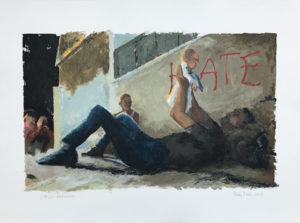
I found this idea watching a video made by a humanitarian organization I trust. The story line clipped past this dark scene for just a matter of seconds. I stopped the video and went back a number of times looking at the dramatic contrast of a baby being celebrated in a dark place, even lifted up unknowingly in front of the English word “hate” scrawled against the wall. There is much here that speaks, and much that remains achingly silent.

I live removed from scenes like this. I expect my readers and viewers do too. But the crisis of peoples moving, of governments gassing, of politicians vacillating or only capitalizing, of bombs dropping, of hands wringing, of minds numbing makes me near numb. But I can’t go numb, for these are desperate, present tense realities.

My hope is that in the venues where this might be seen that people may be moved to awaken, to care just a little, to not be able to forget.

It seems to me that this lifting of a child is an act of faith. The man, though low is stepping up. The bystander notices. The glaring artificial light is not what is illuminating the heart. The folks in the back mumble and miss it. There are questions that are unanswered here too. How will they be sheltered? Where is home? Where is the Mother? What makes someone bother to care in a place like this? The brokenness is not all there is here.The brokenness is not where the real story lies. And hate is not going to win.