Signs in daily life are indicators. I see a red stop sign; I stop within a few feet. Signs give warning as to what’s ahead, and signs give one time to think and still to choose which way to respond. There’s a little bit of time between seeing the sign and getting my foot soundly on the brake. I am glad for that. So are my riders.
Darkness is a sign; a shaded marker that is showing up everywhere now. Look around, listen, watch. I am just articulating what you already know (maybe don’t want to know, but sense just the same). Darkness is a departure from light. It surrounds, entraps and leaves one cold. You don’t want to be there. There is nothing calming in a place of unarticulated blackness.
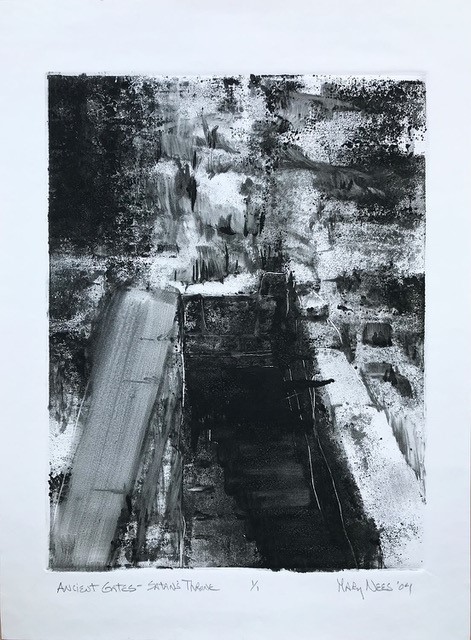 Artists work in the arena of making some kind of signs, knowingly or not, coherent or otherwise. All artists are doing representation of some sort, making indicators of something else. For example, even in the arranging of darks and lights, an artist seeks to use these elements toward highlighting some aim. We even talk about “value structure” though we might otherwise insist there is not such a thing as real value indicated at all by our arrangements. Still, handling lights and darks well are basic coins of the realm in visual work. All light in the composition and we are overwhelmed and cannot see. All darkness and there simply is nothing to see. This is basic, and objectively understood.
Handling light and darks well in life is another matter all together. I have worked with both. I am also a current events watcher, a Bible reader, and a concerned friend. I’m noting that dark signs are stacking up faster than I have ever seen in my 4 plus decades of following the words of the prophets. There is some heaviness in all this observing, there is also some significant hope. Think about this (recorded by the first prophet Moses): the Creator came first in the Genesis account. He was primal. He was deliberative. He spoke and then light came into a place that was full of darkness. That place is further described in Genesis, 1st chapter, verse 2, as being a deep and formless void. The light entering there was a jail break, a remake. The light came into the darkness and then started staging a re-creation. And that was just in the beginning.
But there’s a problem, revealed in the story of the rest of the book. There is an imitator of light who lies, and we are all vulnerable to him. He was named by Jesus as “the father of lies”, “the serpent of old”. He entrapped the whole human race early, not long after that re-make. He masquerades as light (or as any number of fascinating imitations). He can only imitate; he cannot Create but he is crafty. Even the most earnest seekers of good get sidetracked by his clever luring. He is luring you if you are unawares. His intentions are the opposite of the Creator’s; the imitator’s intentions are not good. Like the pilgrim in Bunyan’s tale, we are too easily blinded by this one who lies.
“This life’s dim windows of the soul
Distorts the heavens from pole to pole
And leads you to believe a lie
When you see with, not through, the eye.”
And here’s a watchword: it doesn’t have to end this way. Inserted here is a video that might help you see more of the grand story. If God is the originator of the story, then there is a story, and it has a valuable end. (If He is not, then ultimately there is no story.)
poem above by William Blake, 1757-1827
image “Ancient Gates/Satan’s Throne”, monotype by Mary Nees
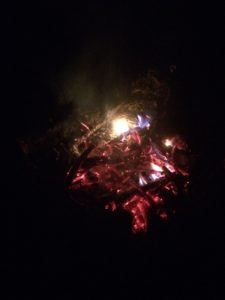 I found her sitting outside alone when I went back out to douse the campfire. Her heart language is Chinese, but here in my back yard she was using her phone to find words in English to capture what she was feeling. She showed me the little screen and a collection of words she thought perfect. Then we both were thrilled. She had just discovered one of my very favorite poems on her own. Here is Yeats’ “When You Are Old”
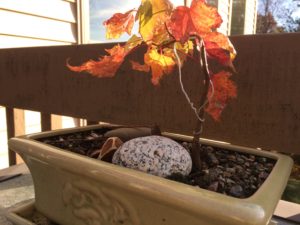 The little Maple volunteer, making it’s way toward light from underneath the canoe caught my attention this summer. It was rooted in a place that would not bode well for its survival. So I replanted it in good soil, placed it into a bright spot and it has been a happy little responder, even giving me another set of leaves. Right on schedule though, it changed with the cooler weather.
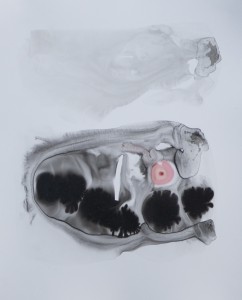 This image, which is the last in a 4 part series (still hanging at the Reece Museum on ETSU’s campus) is a visual glimpse. There are two parts to it’s form: a wispy cloud-like from in the upper horizon, and a more grounded darker mass. Both these forms show movement in one direction, and they are moving together that way. The bottom form is enclosed, and seems to be a holding place that is dynamic and not completely shut. This is a picture of fearful grace. Fear must come first for grace to even be a topic of concern. Both these ideas are glimpsed here. I could say more. I would be interested in how this image affects viewers who may well see more, or who may see what I did not intend as this gets viewed and judged and passed over as part of the public record. For me, as I made this, and as I still muse on what dried in front of me with the inks settling: this is a glimpse of hope that still hangs in time.