I was awakened one evening long ago. My young friend wanted to talk about Abraham, her Patriarch. I listened out of respect, surprised by her wonder, startled actually by her belief. This was a fairy tale to me. But she held onto it as if it were true. We took many simple steps that night, one foot in front of another, hiking around a lake, high in the Colorado mountains. I was quiet mostly while she spoke. But that night, something ignited in me because of the words she exclaimed about one man, long ago, who simply decided to trust what God had told him. “How could that be?!” I wondered.
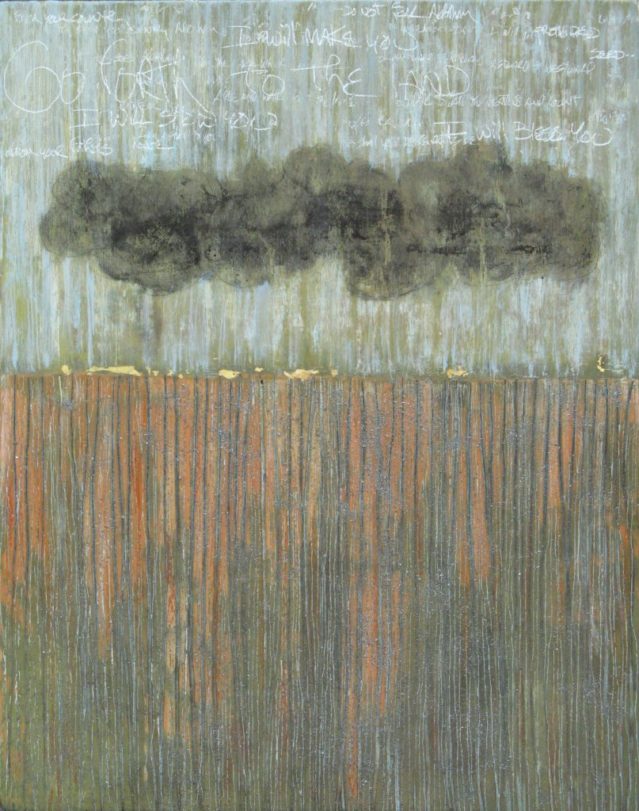
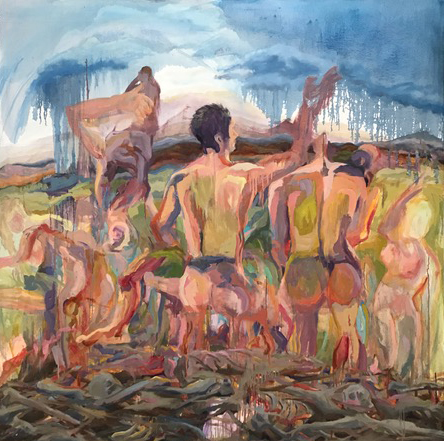
“Go forth, Abraham” is a piece I finished in 2012. It is an emotive response from 40 plus years of steps since that conversation, in which I have been reminded so very often of Abraham’s complex example.
 I don’t think it is a very pretty piece, and therefore, to me, all the more true.
Abram, (renamed Abraham by God), was a real man, a very unique man. He listened. His radar was tuned for wherever there was God-frequency. And when he heard what God said, Abraham took it seriously and he stepped it out. If you read of his life in Genesis chapters 12-25 you can actually follow the learning curve of this man’s developing confidence in the God he was aiming to follow and learning to love. Though a Mesopotamian ancient, culturally distant from us, the human-ness of Abraham’s growing trust comes through. It was a real-time process that took decades. And God did real time revealings and interventions into Abraham’s process. The key throughout is this commendation in the narrative: “Abraham believed God, and it was reckoned to him therefore as righteousness.” Abraham himself was not righteous, as his history only displays. But God made a call, based on Abraham’s distinguishing characteristic: Abraham simply believed what God said. This is big. It was Abraham’s believing that accomplished an imputation of righteousness. This believing Him is a big deal with God; it can be defining for us.
Abraham lived according to the promises given him. These promises came in clear when they came, but they did not come often. And so there had to have been so many steps where Abraham was just putting one foot in front of the other, trusting, trying to remember what he had heard, relying on the character of the promise giver. That is what I was thinking about when I made this piece. This is a linear picture of all the heavy steps being made in desert sand, as Abraham moved out trusting. This piece looks at his whole journey. High in the stratosphere are markings: recordings of the words that rumble in his memory and bring light to his heavy soul. There are shining bits that come on the ground: the epiphanies he would tell us of if we could hear his whole story at the end. But a lot of the steps for Abraham as he lived them out, I expect felt dry and hard and shifting under his feet. Each step was consequential though. And there is this dark hovering cloud overhead. It is not one that brings rain, but one that brings only darkness and static. Discouragement is hovering not far away.
You will be hard pressed to find a better example of a mortal who risked it all to believe the One he heard speaking. It was not a pretty thing, but it was true. And it ended up being amazing.
I am highlighting this piece again for it was selected to be part of a traveling show called “Scribes of Hope II” which has made the rounds in the past several years. An artist whose work I have admired, Timothy Botts, was the juror for this collection, which can be viewed this Fall at Prince of Peace Lutheran in Portage, MI. My piece is cold wax with metal filings embedded, using also sumi ink and gold leaf; it is on a panel 19×15”
(update: January 2021. This piece is now hanging in an internationally juried show at the Manifest Gallery’s “5 Themes Project”, the “WHERE” exhibit. This honor was given to only a few select entries. I am thankful this piece is being seen further for its message is timely and timeless. This show can be seen on site and virtually through February 19th.)
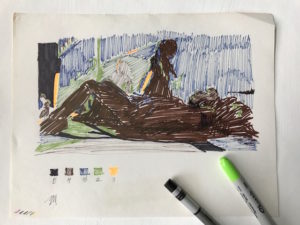 I plotted this sketch onto a full sheet of Arches oil paper, conscious that getting the value structure right was going to be pretty critical before color choices. Also, since my skills are not in the arena of literal portrayals, I needed a visual roadmap of sorts. I usually don’t do figures, but this one was persistent for attention.
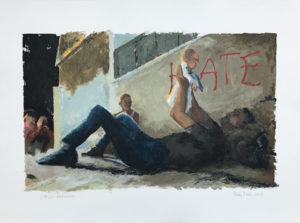 My hope is that in the venues where this might be seen that people may be moved to awaken, to care just a little, to not be able to forget.
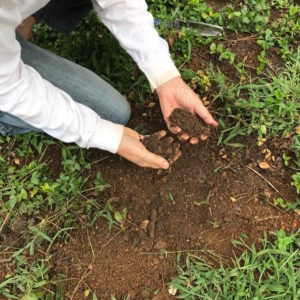 All this and more fascinates me for the Creation account in Genesis 2 has God Himself getting his hands into the dirt, in time, on the ground to make things. Then we are tasked, after His exampling, to make things. It’s in the making that seeing is enhanced. It’s in the time taken and slowed down where relationships are better understood. It’s work, but strangely hope-filled.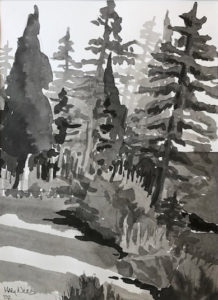
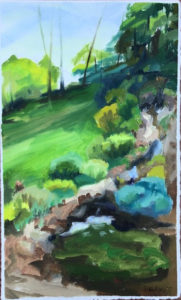 So I did a little exercise to test my “strike” resolve (see last post on the burger billboard). Abstractions made concrete, thoughts made real. The green has been shouting at me for attention, so I dug in to bring it home.
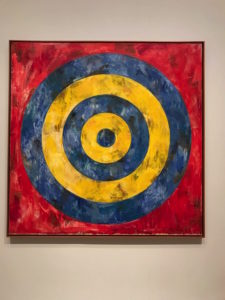 Jasper Johns’ 66 inch square piece is showcased at the Art Institute of Chicago and it jogged some thought. Johns’ intention when he made this and several other target images in the 60’s, was that viewers would see something familiar, “something the mind already knows” as a bridge or a catalyst toward further meaning. He was using the known to pry loose more that is not yet grasped.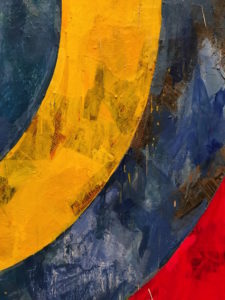
 .
.
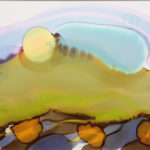 I will end the year with a simple post and a simple piece. After the workshop I taught, putting materials away, I decided to play on my own just a bit more. This one is a success and I matted it with an Emily Dickinson poem I have loved: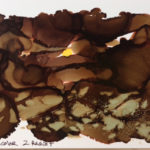
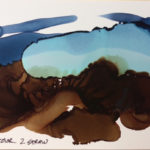 I am inserting here two little experiments with some inks for a workshop I’ll be conducting next week. Beginners will be introduced to some of the rationale behind abstraction’s promise. If some good work shows up from some of these craftsmen, I’ll be sure to post.
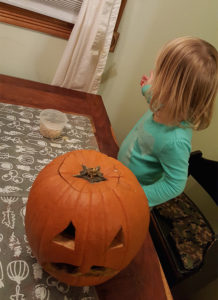 My granddaughter asked “what’s that?” as I was wiping up pumpkin mess. I looked up and saw her pointing to the wall and the round gray mimic cast by our big orange beauty. “That’s a shadow! Do you see how it moves as I slide this over? And if I turn the light off. . . it goes away! Isn’t that amazing? The light is what causes that shadow and the pumpkin is just blocking light on the wall. See, you can do the same thing with your hand: move your fingers and see how you can block the shine and change the shadow’s shape.” So, she got totally engaged with that exercise, and kept twinkling her fingers while I twinkled with thoughts.