Author Archives: marynees

A Vehement East Wind

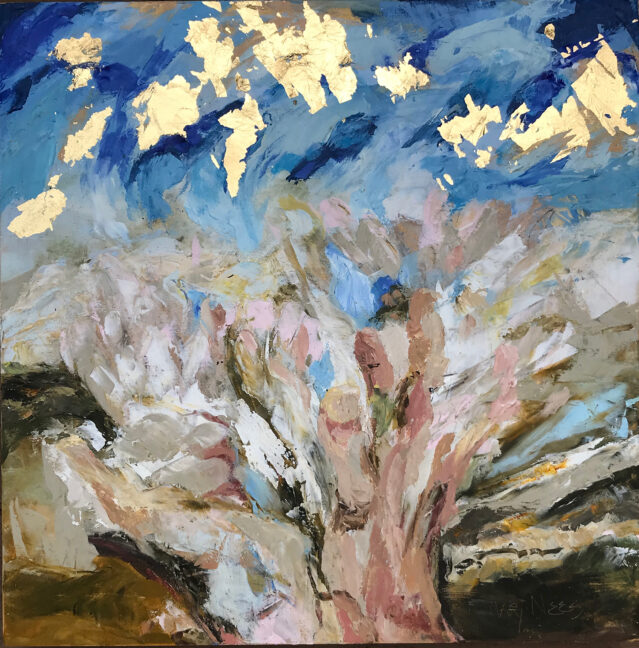
In my Images on this website, the category “Icons” pulls up a collection of meditative symbols that have moved my expression, and to me they still speak. Employing various media from collographs to monotype, from drawings to collage, are suggestions of themes which are universal as well as biblical. Each of these works, as a stand-alone visual, is an offering toward the pondering of ultimate things that matter. If the images intrigue, titles may suggest further. And in future posts I may elaborate on a couple more of these with some detail.

So this month, I want to highlight the predicament of one troubled sage. It’s a true story of how unbelievers were moved to trust the true God in contrast to the dismal character of His prophet.

Jonah’s story is found in the Hebrew Tanakh, in the last portion labeled “The Writings”. In the Christian grouping of the same writings. Jonah is called one of the “minor prophets”. He lived and labored in the 8th c. BCE . Anyone can learn much through his struggle. Even the Quran takes lesson from the tale of this Hebrew. His is a short 4-chapter drama, worth your read.

The single image I drew from Jonah is the tension left unresolved at the end of his story. Jonah himself is long gone from earth, and what he did in response to God’s words and God’s obvious compassion is unknown to us. Yet his quandary  — which mirrors so much of real life  — can be a rich mine for so much more. Jonah leaves us as he broods, sitting under the meagre shade from a wilting gourd vine, having to decide what he’s going to do with what God has said to him. Herein lies the crux of the whole matter inside his own sulking heart.

Jonah’s problem is as current as today’s news. In fact, I read this week in The Times of Israel, writer David Horowitz’ description of their current situation: “I get the sense of time stopping, of a fateful moment — a balance that can swing either way, in the Old City and beyond”.

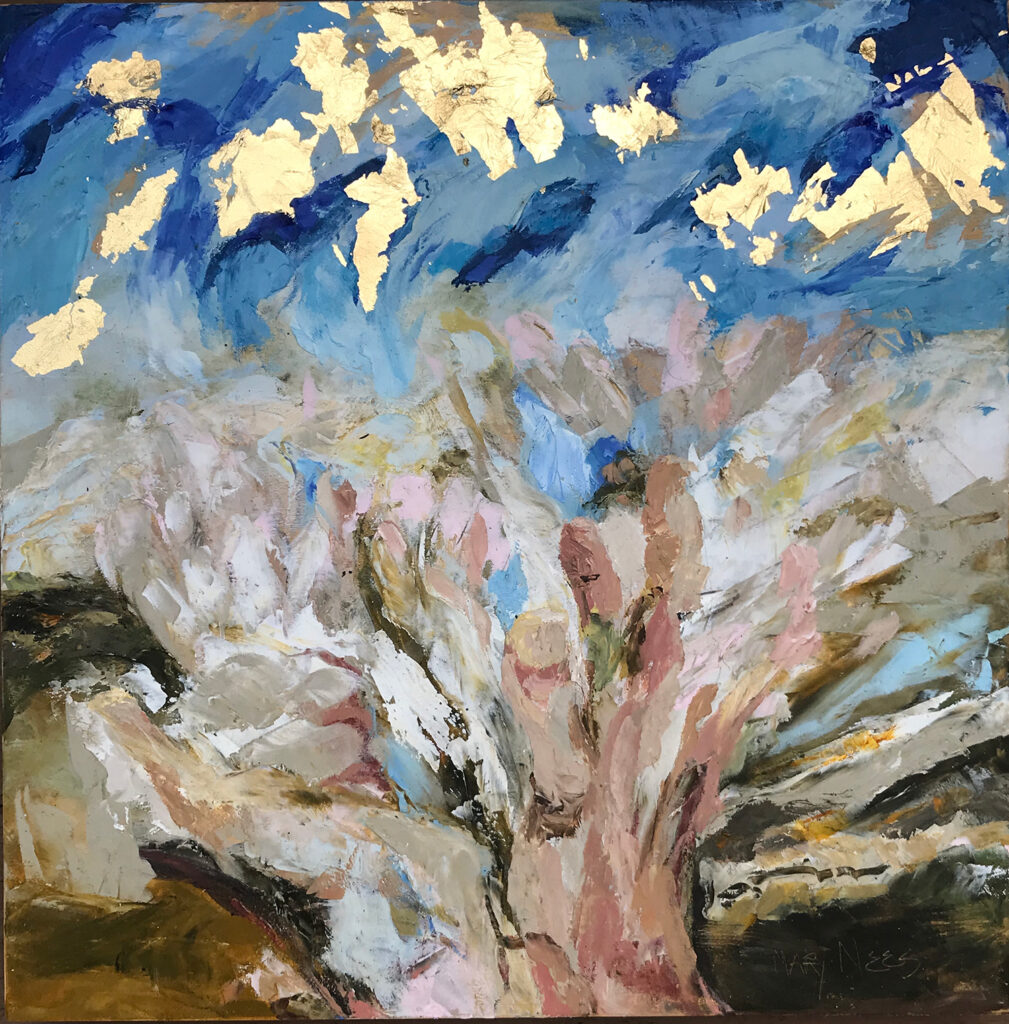
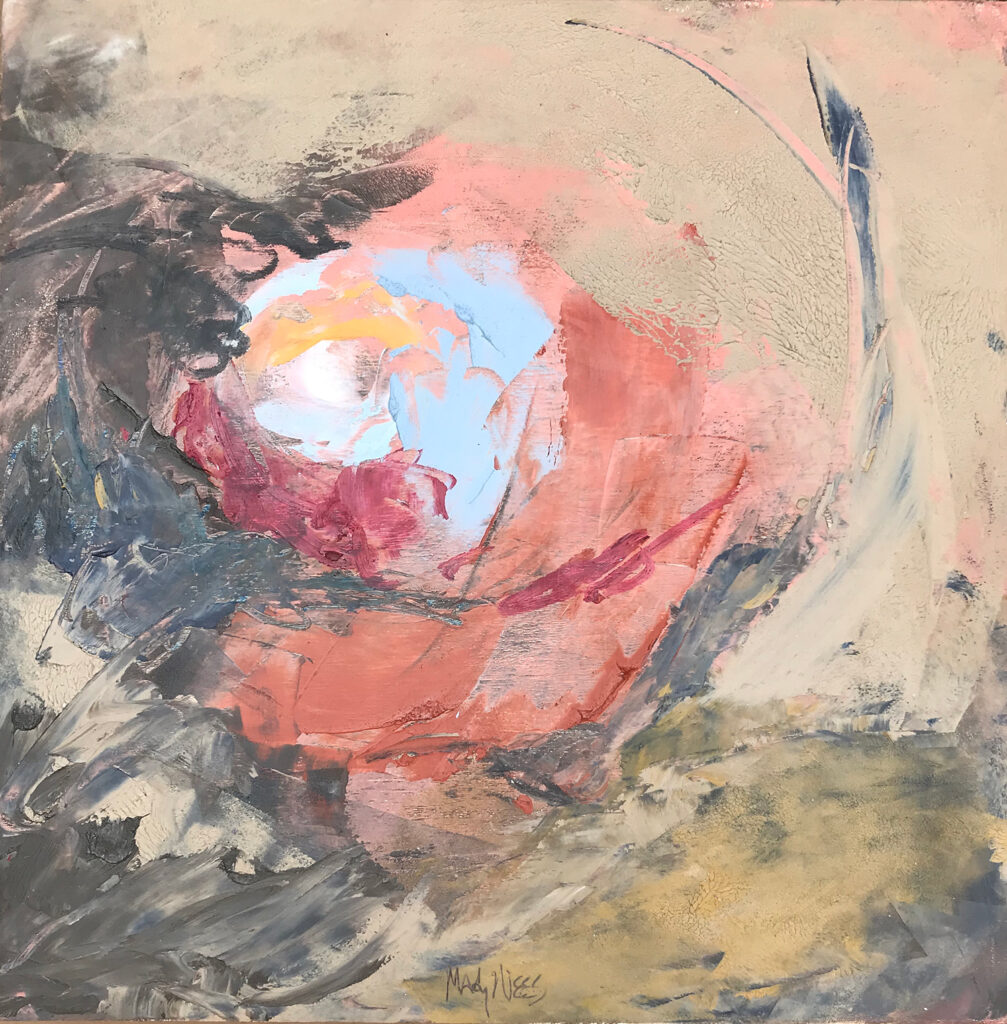
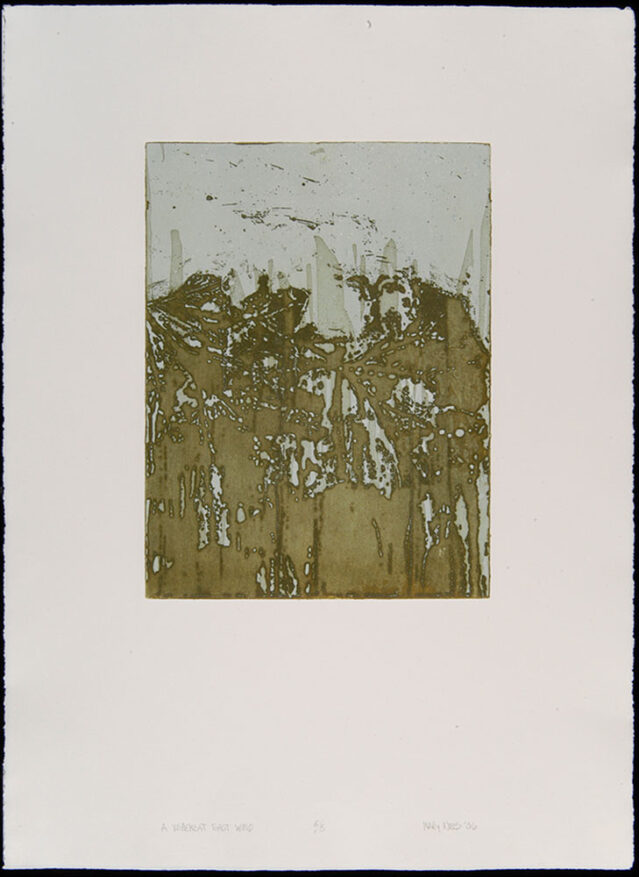
My work here, aims at that same pregnant tension. I titled it “A Vehement East Wind” taken from words in the 8th verse of Jonah’s 4th chapter.

An east wind is an unusual shift in the natural order. Normally winds and weather approach us from our West. The reason for this is that the earth we stand on has an axis, rotating rapidly from what we call east into west from any point on the globe. Like the trails that slide over the hood of a moving car, the atmosphere meets and moves contra the direction we’re traveling. But east winds are a strange and often violent reversal, almost like an ambush coming from behind. And biblically, east winds portend danger. Isaiah said “Thou dost contend with them…with His fierce wind He has expelled on the day of the east wind.” Job agrees “The east wind carries him away…for it whirls him away from his place.” Drought is indicated by Hosea’s east wind (13:15), and Ezekiel’s as well (17:10).

So when Jonah, late in the day of his return to God’s business, finds himself insulted by an east wind, we know this is not a gentle eastern breeze but rather a sign of significant trouble.

You might empathize with the man. He tried to ignore God but that proved mercifully impossible.

In all this, I was moved to tears, and moved again even as I re-read Jonah’s account today. For God cares more for pagans than we do; and He knows how to get their attention. And in the harder end, He speaks into our angry hearts, quietly awaiting our own response! There is beauty in the wilting gourd, if only Jonah could see it. The poet John Moriarty says of his own coming to clarity that it was like being “shattered into seeing”.

In my image, it’s like a still shot in this moving drama. What am I going to do with God’s words and with His heart?

This piece was selected and now hangs in my United States’ Congresswoman’s office.
in entropy

en·tro·py   (ĕn-trə-pē) n.

1. Symbol For a closed thermodynamic system, a quantitative measure of the amount of thermal energy not available to do work.

2. A measure of the disorder or randomness in a closed system.

3. A measure of the loss of information in a transmitted message.

4. The tendency for all matter and energy in the universe to evolve toward a state of inert uniformity.

5. The deterioration of a system or society, especially when it seems inevitable: city activists who fought entropy by organizing neighborhood groups.


[German Entropie : Greek en-, in;  + Greek tropē, transformation; see trep- in the Appendix of Indo-European roots.]

(cited from the American Heritage Dictionary: https://www.ahdictionary.com/word/search.html?q=entropy&submit.x=48&submit.y=13)

Entropy is an important concept to understand for it describes the very time in which we’re living. I offer not only basic definition here but also some explanation through my own work, for I think it informs our moment.

I learned the meaning of “entropy” in a physics class; it marked me immediately as a truth. Not “my truth” (oh, please don’t bore us!) but universally recognized reality.

Entropy is a thermodynamic law, the Second Law, in fact. This means it is intrinsically true for all and has been observably tested through time. You can’t get away from it anywhere on earth. Entropically all material things degenerate. Bouncing balls left alone return to lower and lower heights, metal corrodes, soil depletes, smiles fade. As a high-schooler I had seen enough to know that things weren’t right, that breakdown and disappointment of outcomes was plaguing each and every one. I am not a philosopher, but as a chronic melancholic, learning there was a stated “law“ for this was actually a huge relief! Someone had identified and spoken the Truth out loud. Admitting this, it seemed to me then, at least maybe we could get somewhere meaningfully even in the midst of such harsh goings on.

That recognition was before I even cared about spiritual things, but I do think it was an important beginning point. One has to admit the universally bad news before any transcendent good news is even relevant!

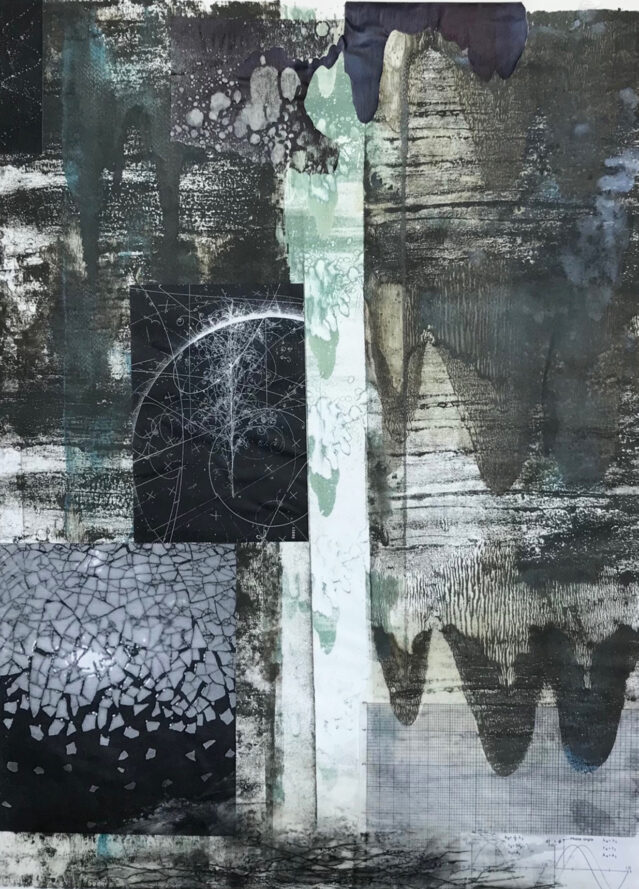
Just recently I was pulling older work out of my flat files and re-discovered this large mixed media piece: “In Entropy”. I have entered it into my Icons gallery here, for its timeless significance. I accomplished this in 2006, and it was included in my MFA (graduate work final) show. This is a large collage pasted together from science text snippets, a photograph I took in Asia, and some hand-inked brayings onto good printmaking paper. I then layered in encaustic wax overlays.

What moved me here, and still moves me, is that in the midst of all the deconstruction going on all around, there are sure hints of pattern observable in forms and waves, in repeats and cycles. Pattern reveals a plan and a planner for those who are hungry to look into the back story. Scratchy lines (seen in so much contemporary work) are a symbol, as are sine charts which suggests process in time. We are all heading somewhere even in the dim.

I made this visual as a statement: that ultimate plan is bigger than breakdown, that hope has reason outside our narrow system, that beauty is a sign even in the dissipation, and that the Maker, the ultimate Planner is not at all perturbed. The prophets all spoke of when and how He will intervene in the mounting chaos. The time is His. Listen to Habakkuk quoting God’s words in his second report (2:3) “For the vision is yet for the appointed time; it hastens toward the goal, and it will not fail. Though it tarries, wait for it; For it will certainly come, it will not delay.” Jeremiah a couple decades later describes his own crushing trauma in Lamentations, but then he also grapples with the only One who could intervene into his particular pit “and therefore I have hope

Slice through or tear apart what is and what will be any way you wish. But if you dare to care, you may notice hints of promise shining through the fragments of ruin, for what Creator started, He will certainly also bring to resolution.

And though I am weighted (each day now) by the gravity pulling us all, my hands and my heart exult (every day) in the One who is truly coming as He promised. What He made He cares about, He sees how things are being handled. He will set right what concerns Him. Wait for it.

“Sitting with Pretty”, or seeking the WHY before the HOW

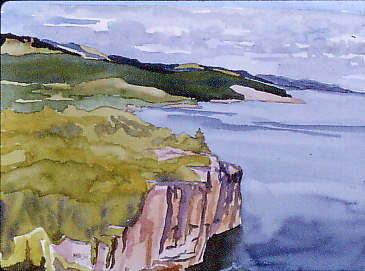
I remember the day I painted this, sitting on a high rock perch with my oldest daughter. She (always pretty) owns this painting now, and every time I visit her home, I am reminded of those quiet moments in that magic place with her. The natural pink palisade wall below us overlooks the great midwestern American lake we love. That day and some way over on the edge of the cliff, my son and husband were fixing rope to rappel this wall. Preferring not to watch that episode, I chose this view, and got transported instead into the beauty of the long and the far of it all. As C.S. Lewis puts it, we went “higher up and further in.”

This is an early work, one of a few I show on my reorganized image page. It’s important not only sentimentally, but also aesthetically because of the pull landscape has long held for me. Before I knew how to work painting tools, and even as I was fumbling around through the years with them, it was always the big views into far away vistas which moved me into any effort to capture something onto a 2D surface. The result has never been enough but rather a reminder of the “something more” out there that gets me pursuing. I can feel that inner draw even as I type these words.

There are poignant moments when one senses that kind of pull, even without knowing its source. It’s a faint whisper that there is something really important, really heavy, really good “out there for the asking”. How do we even know these things? I do wonder with a kind of humble awe. I somehow grasped a bit of this early on and wanted to understand more long before I became interested in biblical specifics. The WHY draws one first, it seems to me at least, before the HOW has any pertinence. What about for you?

Emily Dickinson, a recluse and a poetic mystic often would use dashes — as if extending thoughts into the air — as part of her vocabulary. I suspect this is so because words themselves (like painting tools) could hardly frame what she was after in any attempt to communicate for others what she could sense in her spirt. Here are just two samples:

In many and reportless places

We feel a Joy –-

Reportless also, but sincere as Nature

Or Deity –-

It comes without a consternation –-

Dissolves — the same –-

But leaves a sumptuous Destitution –-

Without a Name –-

Profane it by a search –- we cannot

It has no home –-

Nor we who having once inhaled it –-

Thereafter roam. 

(c. 1876, #1382 in T. Johnson’s Chronology)

____________

I groped for him before I knew

With solemn nameless need

All other bounty sudden chaff

For this foreshadowed Food

Which others taste and spurn and sneer –-

Though I within suppose

That consecrated it could be

The only Food that grows.

(c.1882, #1555)

Jesus called this food “rivers of living water” and invited the hungry and thirsty to dine with Him. I’ve become convinced that every longing that we experience here, is only a merciful foretaste of the truly more that is available to any, and that, as He said — just for the asking.

finish in Zion

finishing the ascent

Since July of this CoVid year, I have been posting a reflection on each of the 15 psalms in a sub-collection out of the ancient Psalm book called the “Psalms of Ascent”. These Psalms: 120-134, have fascinated me for a long time as a pattern for spiritual progress. Like Jacob’s ladder, these ascend meaningfully. Like the Hebrew walk up to Jerusalem these get more complex in time and in history referencing that land. And like King Hezekiah’s answered prayer these are an emblem of 15 movements on steps arranged by the only One who controls time and who responds so mysteriously through our requests to Him.

We live in linear time. We start somewhere, we end somewhere; but time moves for us in only one direction. We also live under the limitations of life in all its complexities. Gravity, hardened ground, hardened hearts, decay, illnesses of many kinds, warring nations, suspicions and patterns of mistrust put us all on watch. It does not matter on which continent you live, what language you speak, or what century your life has passaged through, this has been true for you: life is hard, and time only goes forward. None of us can move back in time to our earlier days, we can only step some way ahead into days we’re not sure of. My best advice? Don’t go it alone. Go with the One who is over time and nations, and who has echoed through His whole book about a plan and a purpose for those who are hungry to know.

Abraham was shown the stars, given words about offspring (he didn’t have) a settled land (he couldn’t see) and a blessing beyond his ability to measure. Abraham simply believed the intervening voice of a God he was choosing to follow. What is evidenced in this last Psalm in the Ascent collection is a prophetic view of that coming blessing. It’s a short burst of praise; and like the last two responses in this final triplet it’s a corporate response. Many now are believing, beholding, praising and responding. But we ain’t seen nothin’ yet.

I started this series after a lot of study, then some sketching of the patterns I thought I could see. I’ve mentioned often in earlier posts about the triplet pattern evident: every three Psalms in this set of 15 shows a rhythm that gets repeated through the whole. But there is also a pattern of fives that reflect the 3 promises earlier given to Abraham about the land he was walking toward, the seed which would come from him and the blessing God was not only promising but would guarantee (Gen.12, ratified in ch.15).

The Psalm writers were all descendants of Abraham. The prophets were also; and what they saw ahead was mysteriously sure and echoed often in both their own times but also pointing toward a final fuller FINISH. We’re almost there. I can hear the cheering in the stadium. I have motivation and great confidence, like Abraham did, because of the One who spoke these promises. I can trust (not what I see now but rather) these words because God not only spoke His promises again and again, but He also guaranteed that He would get it done some day in fullest human history.

finish in Zion

A song of ascents.

134 Attention! Praise the Lord,
all you servants of the Lord,
who serve in the Lord’s temple during the night.
Lift your hands toward the sanctuary
and praise the Lord.
May the Lord, the Creator of heaven and earth,
bless you from Zion.

a Vision and a Prophecy of UNITY

A song of ascents; by David.

133 Look! How good and how pleasant it is
when brothers truly live in unity.
It is like fine oil poured on the head,
which flows down the beard—
Aaron’s beard,
and then flows down his garments.
It is like the dew of Hermon,
which flows down upon the hills of Zion.
Indeed, that is where the Lord has decreed
a blessing will be available—eternal life. (NET version)

We’re in the home stretch now with this short burst of a psalm. Like when a marathon runner makes his last turn and can see the stadium up ahead, there’s a final push to make it in. There’s expectation here, but also a necessary reach.

In every triplet of this series of 15 ascent Psalms. we’ve seen specific need expressed in the middle psalm of its set of 3. The theme of each triplet ascends this way in the whole series. From ENTRY to TESTING to FRUIT to PERSECUTION and finally now to the dream of FINISH; the anticipation is heightened. But this last effort is the hardest. And all the more so because this is not a solitary song. It is not a singular race. This whole last triplet is a corporate expression now. Here it is a group, a family, a nation that needs to make it in together.

The Bible is honest about human effort, and especially the track record of brothers getting along well — not a pleasant picture! From the first set of brothers (murder), to Jacob’s sons (treachery), from David’s brothers and his sons to Jesus’ own brothers before His resurrection, we have conflict repeated. Unity is not a facile thing; it cannot be superficially pronounced especially for those who have to “dwell together”. Jews say about themselves “two Jews, three opinions”. How then does any group, hammering out differences, come to any place of real unity?

Unity is not one group silenced or cancelled so the other can claim peace. Coerced unity is the enemy’s game. True unity is hard and courageous work. It is the last battle, and was most on Jesus’ mind for his followers — and what He asked of His Father before He was arrested. Jesus’ torch, and His prophecies have been passed to us — wether we also get arrested or not.

Dr. Martin Luther King said it this way: “We must learn to live together as brothers or perish together as fools”

Unity means not to live in one’s own monologue but rather a teachable dialogue. And according to Rev. King, it takes the oppressed to have to bring the issue up. The ones comfortably in power won’t care to know otherwise. When a news anchor (former political strategist) says there aren’t two sides to the story, he is advocating for his monologue and has lost his way as an open minded “journalist”. Unity happens when two sides do the hard work of listening, of trying to respect, and coming to some kind of reasonable understanding.

Come let us reason together” says the Lord. Think of that! Why would God even care to listen to our argument, our problem! And this is the key: no unity is possible without God’s help.

This core truth is evidenced in Psalm 133. The solution to our problem of unity only comes through Him, and when it does it is a true wonder. That’s why the Psalm begins with an exclamation of astonishment and humility. The resolution toward unity has to come from a source higher than any human’s meagre position.

Just as life is sustained by the material sustenance of water from on high, so also unity is sourced from above: a spiritual anointing from God. Both the material and the spiritual are illustrated in parallel here. Then Aaron is referenced: he was the first priest to the Hebrew nation. The human priest was simply not effectual until he was anointed by God with oil, and then symbolically that sustenance flowed from him to the group.

Simply and urgently put: human unity does not happen apart from God’s entrance into the situation, and our recognition of need so that He does, invited.

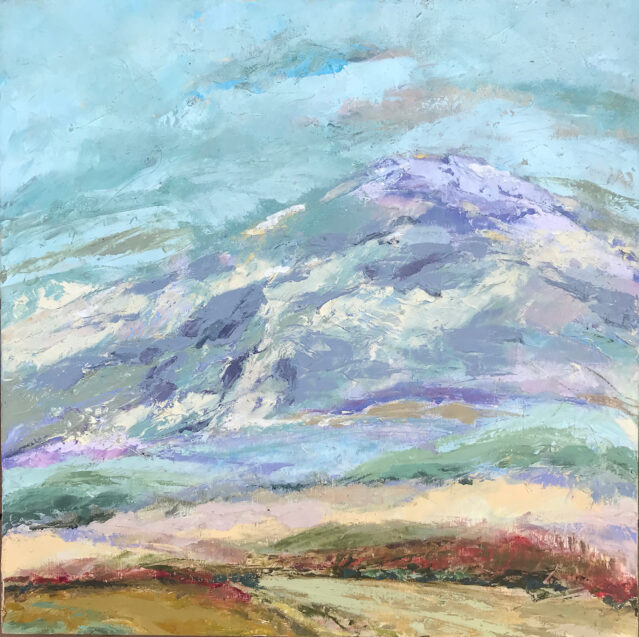
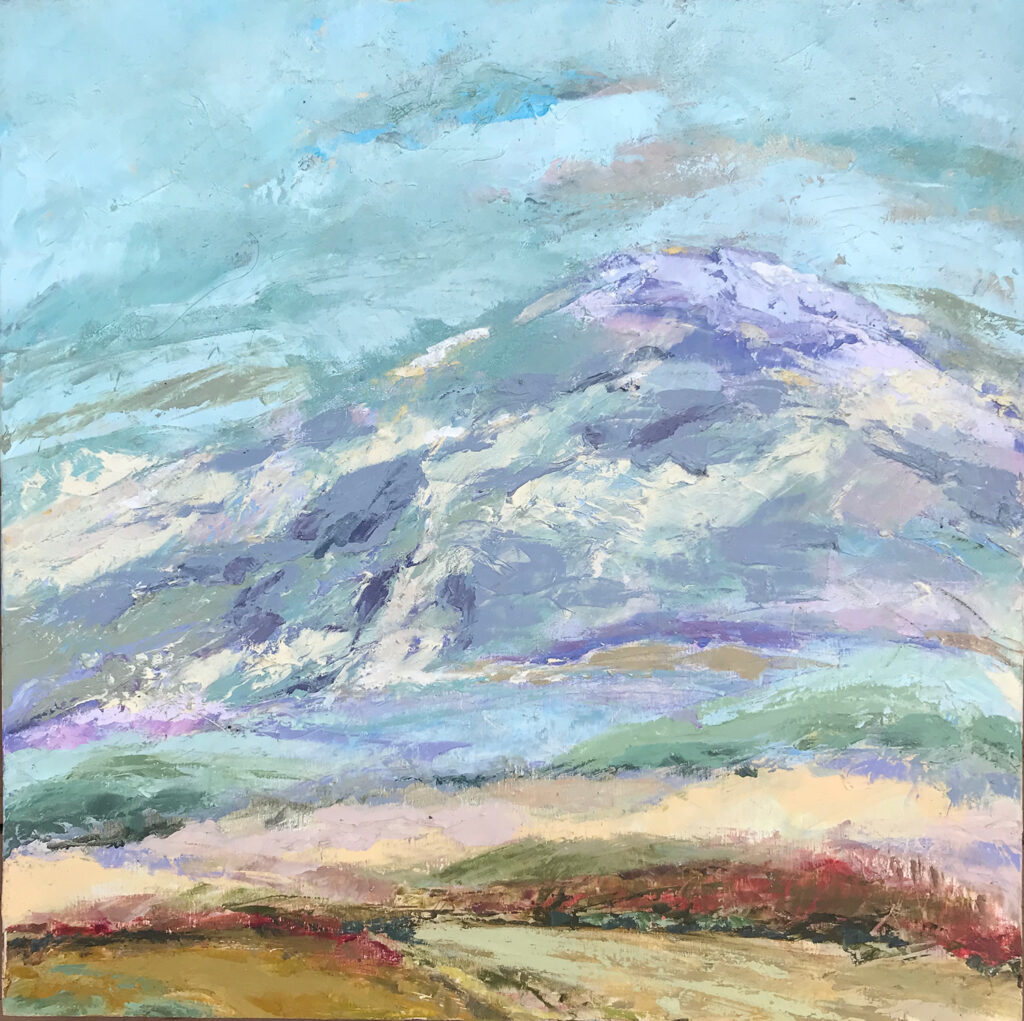
Mount Herman, Israel. A symbol of Unity

In my rendition of this Psalm, I tried to suggest Mt. Hermon, the highest height in Israel. Jews and pagans would look to the heights for answers (cf. Psalm 121). But if their expectation was only in the natural realm there would be no real help coming. In this Psalm however there is a picture of lasting spiritual blessing with God. For only with God is true unity possible.

remember

As we enter the very last triplet in this series called The Psalms of Ascent, we are hearing more than a brief plea, but rather now a treatise of important national memory. We’re moving from the personal to the corporate. In Psalm 132, we are in the longest Psalm in the collection of these Hebrew traveling songs. King David’s written and very personal prayers we’ve recently encountered. 132 is an older Psalm from the same era; but it broadens to a corporate call forward. Psalm 132 looks back, but also importantly ahead to a very sure God-promised and covenanted future, and specific promise made to David. We are peering currently here into the world-wide importance of Israel’s story, which is highlighted in so much of the Bible’s macro-story. Inform yourself, especially in our own times at hand, as to what is yet coming for all earth dwellers. What has gone before is pattern for what is yet to play out. To know this is to know the way forward.

Why would an American gentile, born midway in the 20th century have any interest in these words? If it weren’t for a Jewish friend who spoke of Abraham to me personally 52 years ago, I would have remained oblivious and blinded to most important things. Have you not yourself seen enough evidence in current events to hunger also for someone to speak to you about what is real, true and lasting?! Eugene Peterson wrote poignantly in 1980 “A Christian who has David in his bones, Jeremiah in his bloodstream, Paul in his fingertips and Christ in his heart will know how much and how little value to put on his own momentary feelings and the experience of the past week.” (!)

These are traveling songs: as has been outlined in my previous 12 postings. These entire 15 psalms concern the journey of celebratory return. They are arranged and patterned out for the sons of Israel, on their way up to Zion. The language is clear about this throughout. Those of us who are not of the Hebrew tribes can take instruction from these at least as symbolic parallels, as watchwords; but the words themselves were written by and for Hebrews, especially in this very last triplet before us now. I may not live through the fulfillment of what these Psalms point to, but it is possible you will, my friend.

As already detailed, every triplet in this series followed a certain cadence (1. distress, 2. reliance, 3. resolution). Here in this last triplet we see the very same. Psalm 132 is the distress of longing, memory and urgent appeal. The last two psalms yet coming will quickly and very concisely move like staccato beats to the corporate national finale. Like in a fireworks show, you will know it when you see it! The full throated unified reliance and then joyous resolution is yet coming, but not before some detailed distress. This has been long promised in all of the Book.

Mature direction pays attention to history; any wise counselor, gentile or Hebrew knows this. The best questions I ever heard were given by the angel of the Lord to a distraught woman in Genesis 16: “Where have you come from? And where are you going?” Without a clear-eyed sense of what went before and what is yet coming, we are at the mercy of whims and lies. You have enough evidence of that kind of stupidity all around you. Don’t stay there paralyzed in media fog, speculation, political manipulation, empty promise and bias. You are being lied to and your gut already knows it.

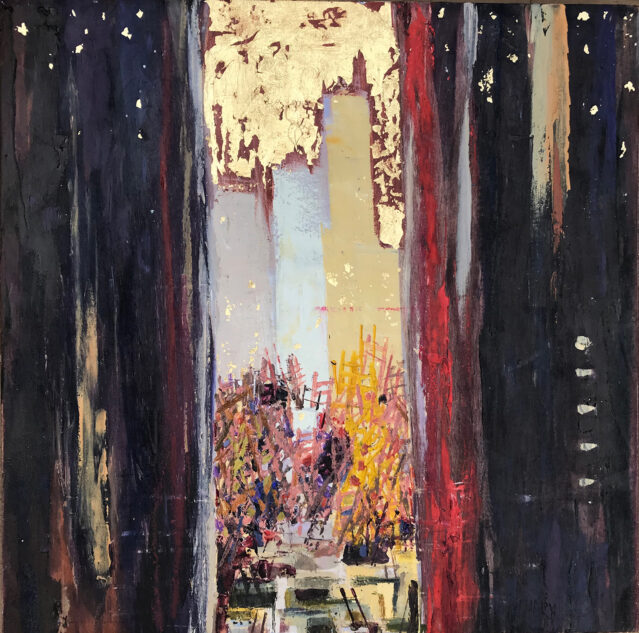
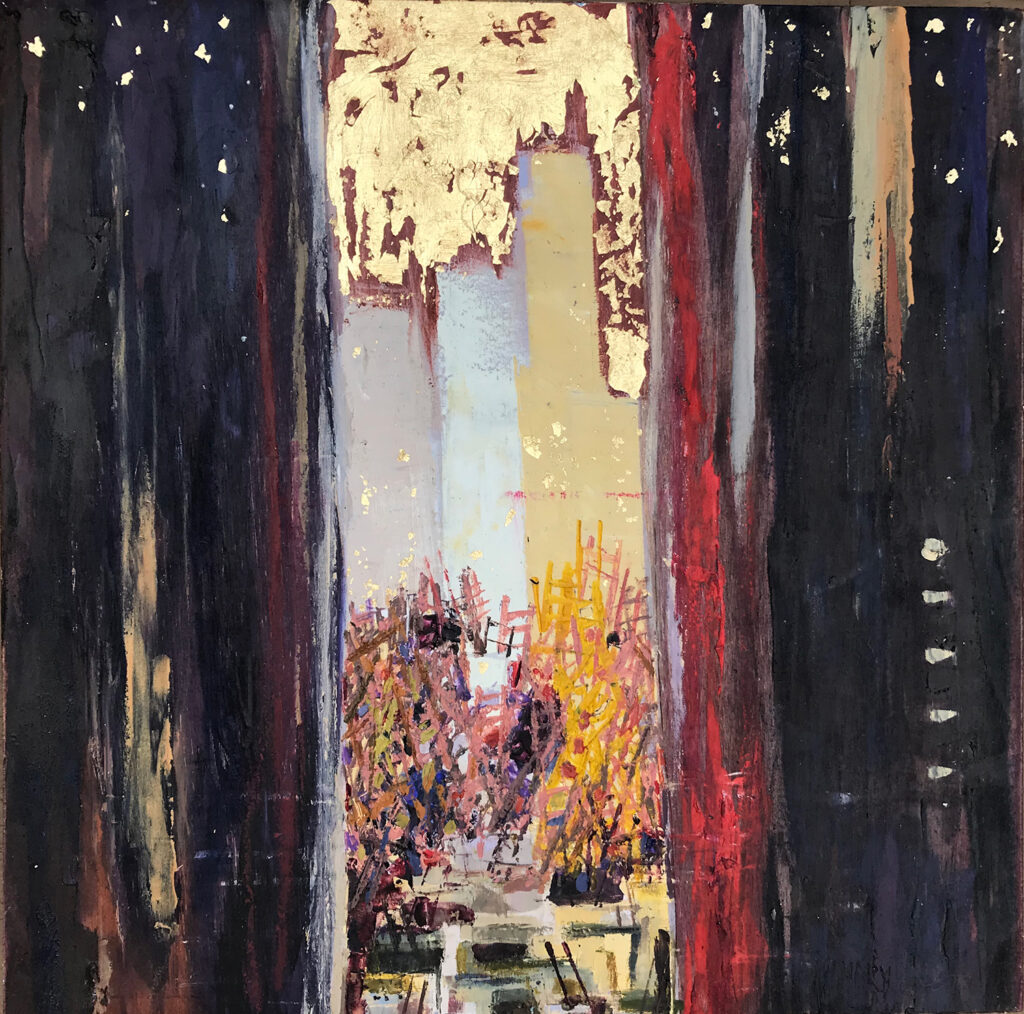
In my illustration of this important historical Psalm, I aimed to give a sort of timeline sense of the historical darkness which existed before Israel ever came into the land of promise, and the darkness and destruction which came upon them later from both the Babylonians and then later the Romans. The ladders in the middle reference Jacob’s dream repeated in the human aspirations of every other wrangler who aimed for what he was after without relying on God’s good direction. But there is a way given, “even for Jacob” .

Remember the God who still promises. He is the bigger point in all these Psalms. In the end, He alone is the golden sustainer.

The singers of these songs were not the first to seek after God’s sure presence in a walking trek, nor would they be the last who will seek Him with songs of remembrance. Why don’t you consider joining them?

the repose

How fitting, though unplanned by me, that the last entry I post in this tumultuous year 2020 is Psalm 131! This psalm and this particular painting is my practiced place of determined rest. I set this Psalm to music in my 40’s so I could memorize it and live it better. These words have served me, checked me so importantly and practically! Soak in them for just a moment of your own:

A Song of Ascents, of David (NAS version)

131 O Lord, my heart is not proud, nor my eyes haughty;
Nor do I involve myself in great matters,
Or in things too difficult for me.

For Surely, I have composed and quieted my soul;
Like a weaned child rests against his mother,
My soul is like a weaned child within me.

O Israel, hope in the Lord
From this time forth

and forever.

We’ve been tracking on this blog my ambition in the present year to finish a long-imagined dream rendering the 15 Psalms of Ascent onto 14×14” cradled panels. There are 3 more yet to show you, but those I’ll talk about next year. For now, it is enough to just stay in this important place for a little while.

King David of Israel spoke these words, likely put it to melody, and also had to learn it the hard way. In other words, this place of repose did not come naturally to him either. His life was complex, but this psalm is not!

This entire collection of 15 Psalms were arranged into the book after Israel’s exile for travel home. Four of these songs were selected from Israel’s archive, from their ancient King. Here are David’s contribution to the whole: 122 (the 1st triplet’s rest Psalm), 124 (the 2nd triplet’s determination to trust), 131, here the result of the 4th triplet’s trial, and then 133 (the last triplet’s middle declaration).

David surely practiced what he talks about here. The imagery of a haughty look is something easy to imagine in any gifted personality exalted to a high place. We have current examples from our own time. But David, from a young age had also a heart after God. Note that God has a true hatred for arrogance. And God won out.

David’s imagery continues with this idea of a weaned child resting against his mother. As one who fed babies, this is poignant to me. If the baby stays close even when the feeding part is over, there is a wonder of rest for both the child and for his mother, skin to skin. It is a matter of just quiet enjoyment, of built relationship. This is priceless. And for many who use God just for what they imagine he can do for them before they quickly run off, this is a hard thing to learn. It takes time and a decision to stay.

The 17th century Catholic mystic Madame Guyon wrote in her autobiography about this very thing. Like David, she’d had to determine where she would reside for “the better part” beyond physical nourishment. David said “I have composed and quieted my soul like a weaned child…” So even past child feeding, there is this place of sumptuous rest. Guyon describes it this way:

“It is not a repose in peace tasted, in the sweetness and mildness of a perceived presence of God; but it is a repose in God himself which participates of his immensity, so much has it of vastness, simplicity and purity.”

In my version here, the key of the painting is much lighter and brighter than the Psalm painting which preceded this (which in fact led to this). No longer is the voice here self-focused but rather enmeshed. The pilgrim here has moved more deeply into God’s side, and more simply into the place of His given repose. For David, for Guyon, even for me and any number of others who know this sweetest place it is a very personal thing.

This is not a corporate psalm; it is in no way a group experience. The last triplet to come in the collection we’ll see is entirely a corporate experience. But this personal expression necessarily comes first, this is a singular place learned and enjoyed. Yet as the last verse here hints, from this place one longs for others to know it also. That’s why all three of us: David in Hebrew, Guyon in French and me in English have labored to put this beauty to words.

As a further treat to end the year, I offer a link, introduced in English spoken in contemporary French and referencing the Hebrew which grounds the hope given therein.

the crucible

In the previous Psalm of this series the writer has been hit broadside. You can hear it as he flails around in focus between the pain, his long history with this pain, the ones causing the pain, his recollection of the Lord’s justice and his imagination at what observers might say…

Psalm 130 follows and this is where the writer gets way more effectively focused. It is fitting that such singularity would happen here, for remember the triplet rhythm we’ve already seen 3x in this whole collection of 15, even as we sit now in the middle of its 4th triplet. Every time this rhythm was walked through (1. Distress, 2. Reliance, 3. Resolve) the middle Psalm of each triplet was the pivotal expression, or the necessary bridge between the problem and the resolution.

We don’t know how much time has passed between the writer’s experience of the pain of Ps.129; but by the time in his own life that he voices 130, the pain is excruciatingly worse. It is internal now, personal; it is between him and his God now, and some things have had to get clear to him in focus. Observe how he does that, how he pivots, and how he makes a direct appeal:

A song of ascents.

130 From the deep water I cry out to you, O Lord.
O Lord, listen to me.
Pay attention to my plea for mercy.
If you, O Lord, were to keep track of sins, O Lord, who could stand before you?
But you are willing to forgive, so that you might be honored.
I rely on the Lord.
I rely on him with my whole being; I wait for his assuring word.
I yearn for the Lord, more than watchmen do for the morning,
yes, more than watchmen do for the morning.
O Israel, hope in the Lord, for the Lord exhibits loyal love,
and is more than willing to deliver.
He will deliver Israel from all their sins.

It’s commonly easy to bail on God at any broadside hit. I love how the scriptures, in many places, are downright transparent about this. We flounder, we fret, we complain bitterly, then we look for a fix. Too often that fix is our own quick pain-relieving strategy: “out of my way, let ME handle this” (read Jacob, read Peter…). But to stay with God, to trust His character through our own tears, to wait on His solution is by far the better (even if immediately more painful) choice. Can you hear the excruciation going on here? “deep water” “pay attention”! “who can stand” “rely on Him with my whole being” “wait” “yearn” “He will”…

A crucible is defined by one dictionary as “a situation of severe trial, or in which different elements interact, leading to the creation of something new”. I find that fascinating, for there is mention even by definition of an elemental interaction before we can get to the something new. And consider this: apparently the latin root, crux, references back to the cross. In the medieval period, a “crucible” was a night lamp which illuminated that cross as the main point in the darkness.

Now, I wasn’t thinking of the cross when I painted this piece (though that reality certainly is prefigured in this Psalm 130: “willing to forgive” “loyal love” “sins” “deliver”. I was thinking of my own Psalm 129 type pain, which is spoken also in Psalm 42 “Why are you in despair, my soul? And why are you restless within me? Wait for God, for I will again praise Him For the help of His presence, my God.”

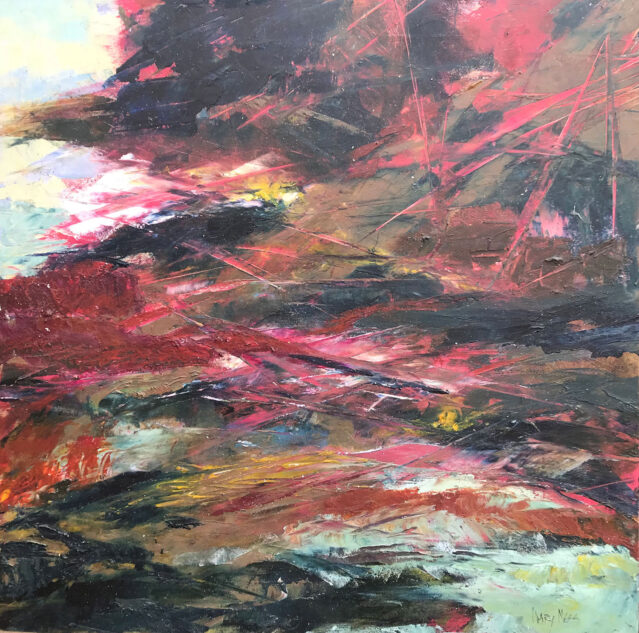
Both these cries were voiced and recorded by a God follower hundreds of years before the cross. Both of them were experienced on the cross. And both of them have been my experience. But like the focus forged inside the Psalmist’s heart, I have had to learn to look to the only fix that is solid and worth waiting for. Look at the mud color in my rendition of this hard place. The black and red intrusions show the pressure, and the paint application is fluid. There’s a linear mark indicating the cry upward, and in the distance, something comes clearer to focus on. That something is detailed by the Psalmist’s words about the abiding character of His God.

This to me, is the most important pivot in the entire collection of 15 Ascent Psalms. A lot of journey has been covered already. But there is nothing “automatic” about making it to the end intact with a heart that has stayed hot toward God. The choice of Psalm 130 is where that aim gets exampled.

ambush

Where the reward took time and trust, we are suddenly thrust now into a reversal of fortune. The movement from Psalm 128 to 129 is the most drastic change in all the flow of this progression. Psalm 128 was enjoyment around a table of blessing. Psalm 129 is a cry of pain, and the scariest reality encountered in this entire 15 Psalm series of Ascent.

The fact that this can happen, and so suddenly begs some closer examination. What is the real nature of good things we enjoy? Good is typically something ‘organic’, that is, it grows with cultivation and care. Evil is like a car crash; you didn’t see it coming until it hit you.

Good is a crafted re-making. It’s participatory also: some one is involved with some stuff, and this emerges with grace (see the entire triplet just before 129 crashes into the story). Evil is autocratic, at its entry you had no say. This contrast was very evident in the beginning (read the 1st 3 chapters of Genesis). And both these realities, good and evil, have shown themselves as exhibits A-Z throughout all of human history. This is so anyone with eyes to see and a hungry, struggling heart can make up their own mind from their own experiences with good and with its opposite about which place they want to call home.

I’m calling it out: this obvious contrast between good and evil, and I am doing so because I don’t like to see what happens to people stuck in Psalm 129. I’ve hated, just viscerally hated being there myself. And I am bearing a deep sadness for a couple people I know who are there right now.

In this series of 15, we have now plunged into the 4th triplet. I’ve named it TRIAL. It begins hard and it becomes harder until some release at the end of this triplet. It is the most difficult to experience and the harshest visually. In my rendition you can see this with color, line and cords of pain. But paradoxically, this triplet (Ps.129-131) includes my very favorite and most practiced prayer. We’ll get there soon; but for now, don’t deflect the excruciating reality of this harsh place, it must be walked through before more can be realized.

Jesus carefully warned his intimates, in the last week of his life here about harsh times coming, saying that for many their “love will grow cold.” And hundreds of years earlier the prophet Habakkuk saw the same on the horizon “and I fear”.

It is an act of faith for God-followers to voice, out loud and to Him, when things get really tough, being honest with the One we say we trust. If He is real, then an expectation of justice is reasonable. If He is not real, then any words, and any expectations are entirely meaningless.

In the Jewish Talmud, Ben Bag-Bag said: “Turn it over, and [again] turn it over, for all is therein. And look into it; And become gray and old therein; And do not move away from it, for you have no better portion than it.”

I will just add (and it’s on good authority that I can) to Ben Bag-Bag’s wisdom, that the better portion is yet coming. Jesus and Habakkuk spoke of that also. This place of despair is not the end; it is only the voicing in the distress. We’re not finished yet. Even in Psalm 129 this expectation is hinted at, even as it trails off in sadness.

Psalm 129, a song of ascents

“Since my youth they have often attacked me,” let Israel say.
“Since my youth they have often attacked me, but they have not defeated me.
The plowers plowed my back; they made their furrows long.
The Lord is just;
he cut the ropes of the wicked.”
May all who hate Zion be humiliated and turned back.
May they be like the grass on the rooftops, which withers before one can even pull it up, which cannot fill the reaper’s hand, or the lap of the one who gathers the grain.
Those who pass by will not say,
“May you experience the Lord’s blessing!
We pronounce a blessing on you in the name of the Lord.”

(NET version)

reward realized

Patterns that come to our awareness reveal that something’s up. For example, leaves which have fallen to the ground are not surprising — there’s a randomness in the pile which I can easily ignore. But if on my sidewalk one Fall day, 15 colorful leaves are lined up pointing in the same direction, and every set of three repeats the same color progression: let’s say first a bright red; after that a solid yellow; thirdly a brilliantly splashed leaf of oranges over green (and then that pattern repeats 5x) probably anyone would puzzle instinctively that somebody set this up! We’d expect that there was some kind of intention, maybe lifting our eyes to look around for the instigator. Order is no accident; in fact, this is one of the foundational laws of thermodynamics: order is an intervention from typical randomness. And any pattern shows some causation which is bigger than the elements involved. Even newborns perk up at patterns with focused attention.

So it is with this collection of Psalms called “the Ascents” (120-134). There are five sets of triplets in this whole of 15 songs, all gathered to catch your interest. The entire collection is pointing the alert reader somewhere. These were often sung on an ascending journey. We’ve already mentioned in earlier posts the 1.2.3. cadence in this arrangement. The first Psalm in each triplet presented a problem, the second stated an act of reliance, and the third reported the resolution.

With Psalm 128 we’ve completed the third repeat of this triplet pattern. And I find it interesting (and compatible with life) that the problems of each subsequent triplet have magnified to more complex issues. The first set: 120-122 was about ENTRY, the second set: 123-125 about TEST, and the third we’re finishing now is about the reward in time of enjoying the FRUIT:

A song of ascents.

128 How blessed is every one of the Lord’s loyal followers,
each one who keeps his commands.
You will eat what you worked so hard to grow.
You will be blessed and secure.
Your wife will be like a fruitful vine
in the inner rooms of your house;
your children will be like olive branches,
as they sit all around your table.
Yes indeed, the man who fears the Lord
will be blessed in this way.
May the Lord bless you from Zion,
that you might see Jerusalem prosper
all the days of your life,
and that you might see your grandchildren.
May Israel experience peace.

(New English Trans.)

If you’ve been tracking these songs, you already read the longing for such fruit in Ps.126, then the implicit promise of it in Ps.127 to any who trusted in his Originator, now we have real experience of result.

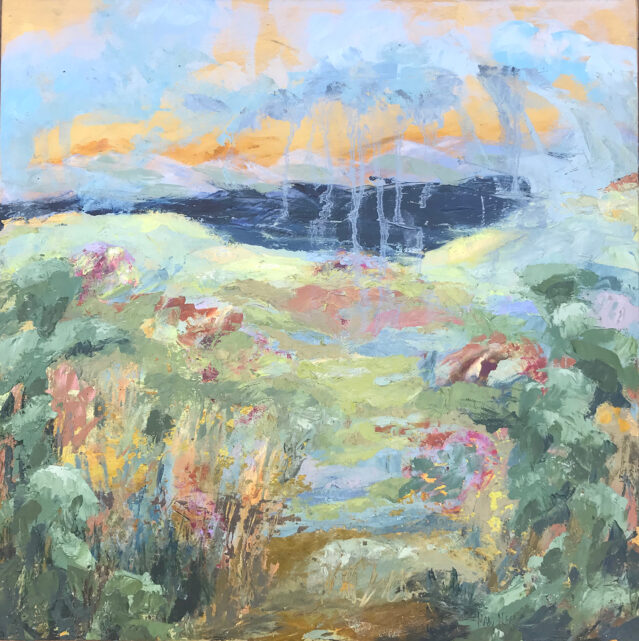
I selected bright field colors for this one, in fact this is one of the brightest of the whole series as I have rendered them. We’re catching a thanksgiving moment here with lots of anticipation of good things. The paint is laid down thickly. It took time to see this emerge for me in a way that was satisfying. But if the viewer or singer enters into this, we’re still also in a real moment, one we can sense right now. A light bright rain is falling, the ground is wet, and the fruit is ready to be enjoyed.

then ‘give it a REST’

In the middle of this triplet, Psalms 126-128, in fact right in the exact center of the entire set of 15 Ascent Psalms we’ve been tracking through, is a very surprising removal of sorts. God prompts the Psalmist on this journey to ‘give it a rest’ !

A song of ascents; by Solomon.

127 If the Lord does not build a house,
then those who build it work in vain.
If the Lord does not guard a city,
then the watchman stands guard in vain.
It is vain for you to rise early, come home late,
and work so hard for your food.
Yes, he provides for those whom he loves even when they sleep.
Yes, sons are a gift from the Lord;
the fruit of the womb is a reward.
Sons born during one’s youth
are like arrows in a warrior’s hand.
How blessed is the man who fills his quiver with them.
They will not be put to shame when they confront enemies at the city gate.

Psalm 127 is the only contribution Solomon makes to this complied set of 15 Psalms. Why his voice inserted singularly here, why these particular words, and why now?

The collections placed into this entire last set of Psalms were added into the Psalter some 500 years after Solomon’s time. A Psalm from Solomon’s voice is particularly interesting here, for God had long before said to Solomon’s father “a son shall be born to you, who shall be a man of rest…his name shall be Solomon, and I will give peace and quiet to Israel in his days.”(1 Chronicles 22:9) So, before this Psalm recorder was born, and long after he had written these words, he was known as a man of rest. His name means the very same.

Add to this, that in the broader picture of this set of 15 Psalms we’ve already seen a pattern in each triplet, a meter of sorts 1. Distress, 2. Reliance and 3. Resolve. The distress we saw in the previous Psalm: “the dream” for a restoration from captivity. Solomon’s words are selected here for the reliance statement.

So then, how is his voice or his reliance accomplishing anything having to do with the problem or the dreams just spoken in Ps.126?

The young King Solomon, in Israel’s earlier history had been tasked with an immense project to lead the grand construction for what would be called Solomon’s Temple in Jerusalem. The history of his reign shows he was a very active leader. And so all the more poignant it is that this unique King, appointed to build, is the one who tells us that his work would be completely vain (a word he uses a lot in Ecclesiastes) apart from God being the builder, the watchman and the legacy giver. How does rest having anything to do with being a necessary builder?

And here is a broader highlight to his key idea that “He gives to His beloved even in his sleep” (vs.2b NASV). God does His very best work when we who’ve been diligently active are put to rest. And there’s a pattern here, for consider that when Eve was constructed, Adam was first put to sleep. Or when the grandest covenant was made with Abraham, that Abraham was put to sleep so that God alone would make and thereby fully guarantee the finish of everything He was promising there.

And so, when you put your head on your pillow, rest in real expectancy, for God gets His best work done when we are willing to give our dreams a trusting rest.

We’re on a journey in these 15 Psalms of Ascent, we’ve even seen a rest stop already. But here in the middle of the entire collection is a call, from the grandest builder to place our full reliance in the only One who builds the greatest things, even the children he gives to young parents. They will become rewards yet to see. And in the resolution of our grandest dreams, we will realize long beyond this trek is over, that He meant what he said “I will give you rest.” For active people on an active journey now, honoring His ability in our days is an act of faith.

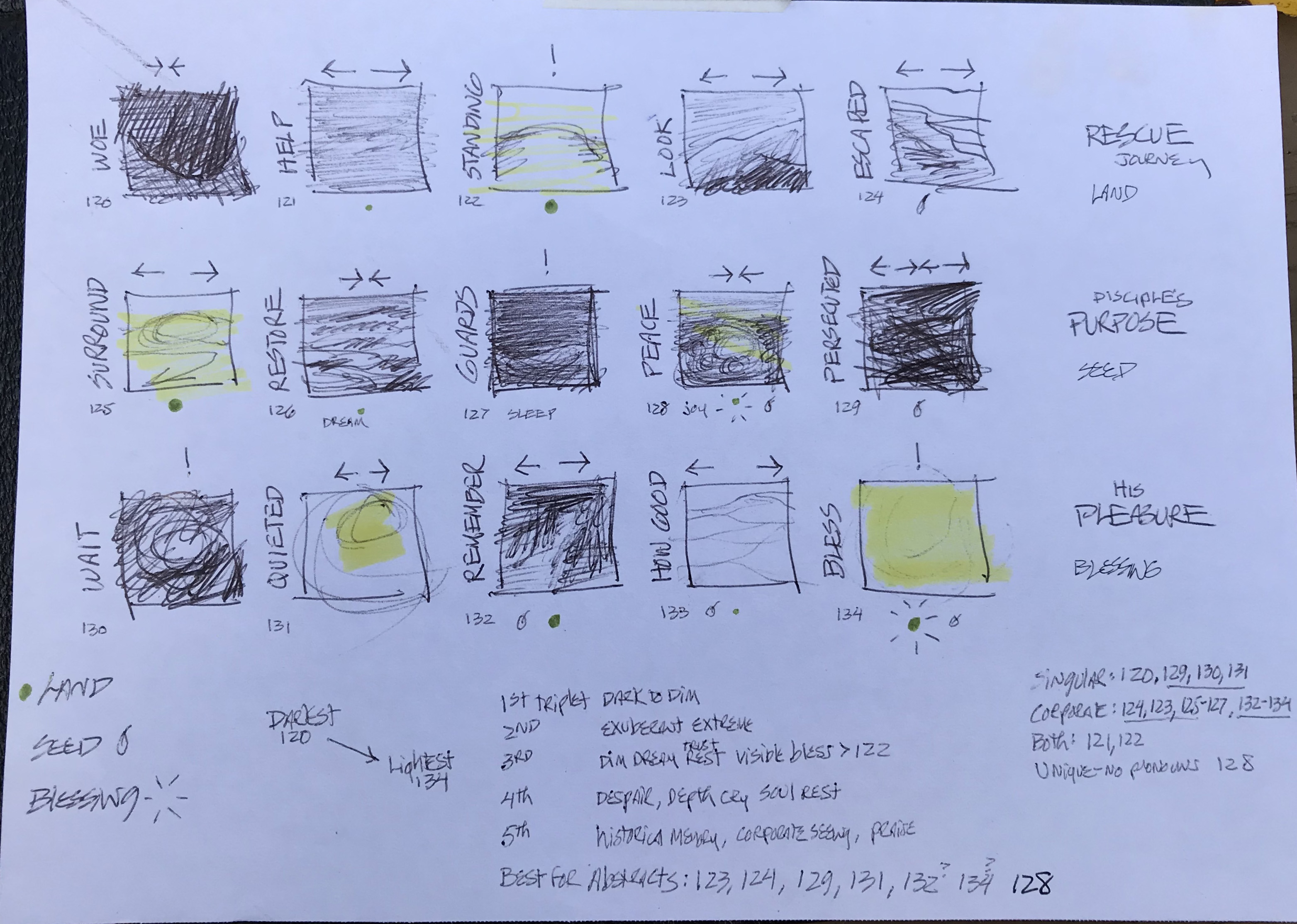
Ascents sketch

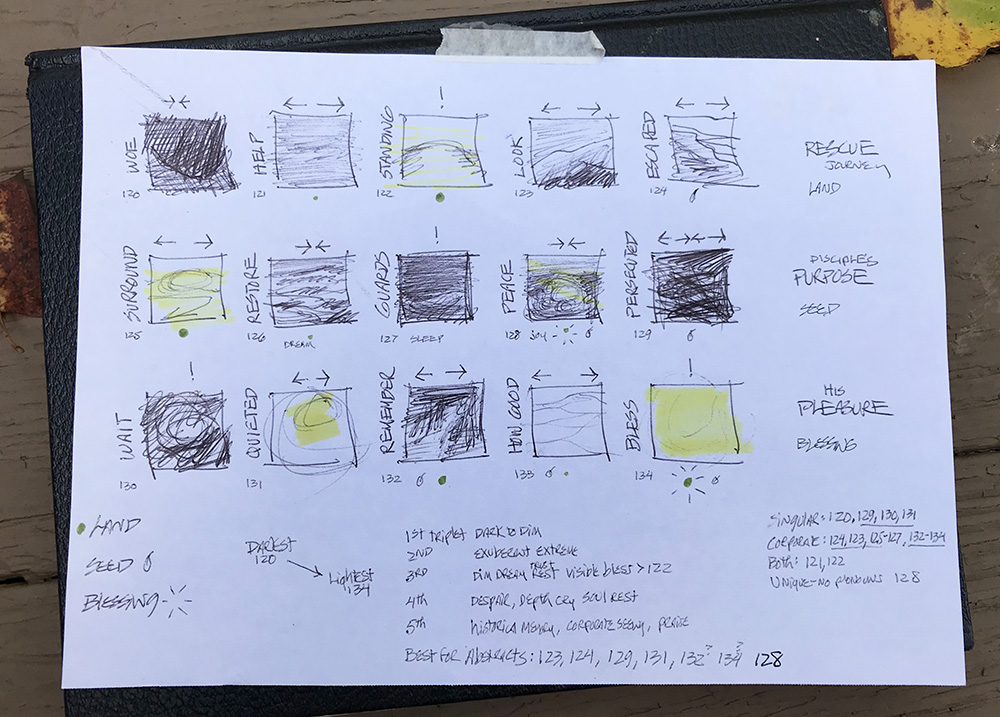
When I display this collection of 15, they will be hung together like a table with each of three rows holding 5 Psalms. Here is a sketch of my plan and note that this Psalm 127 is exactly in the middle.